
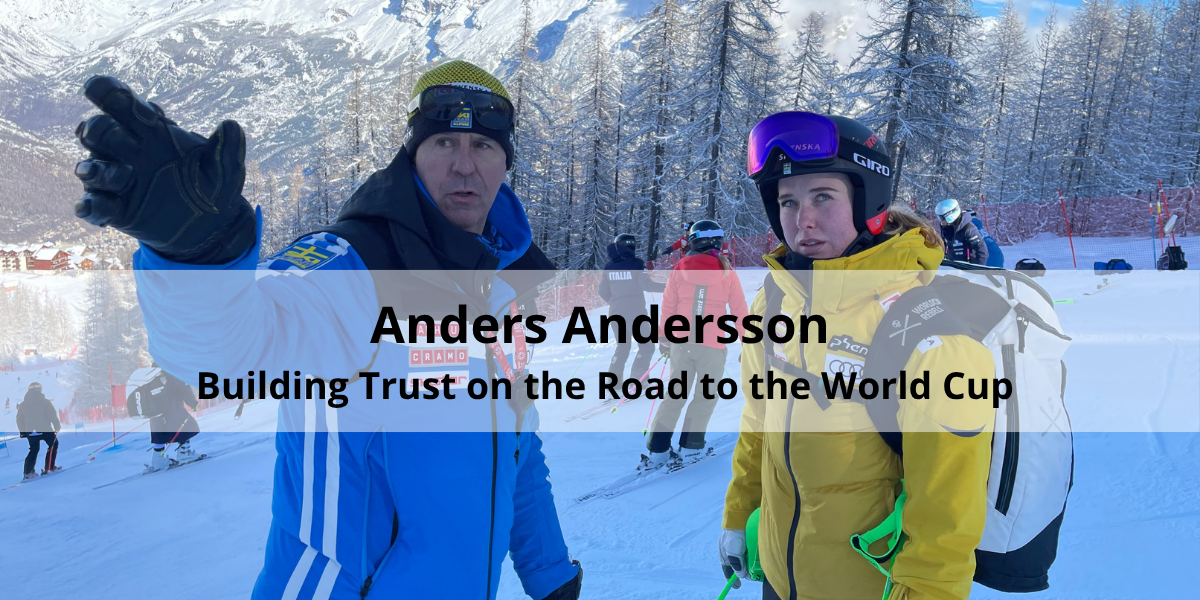
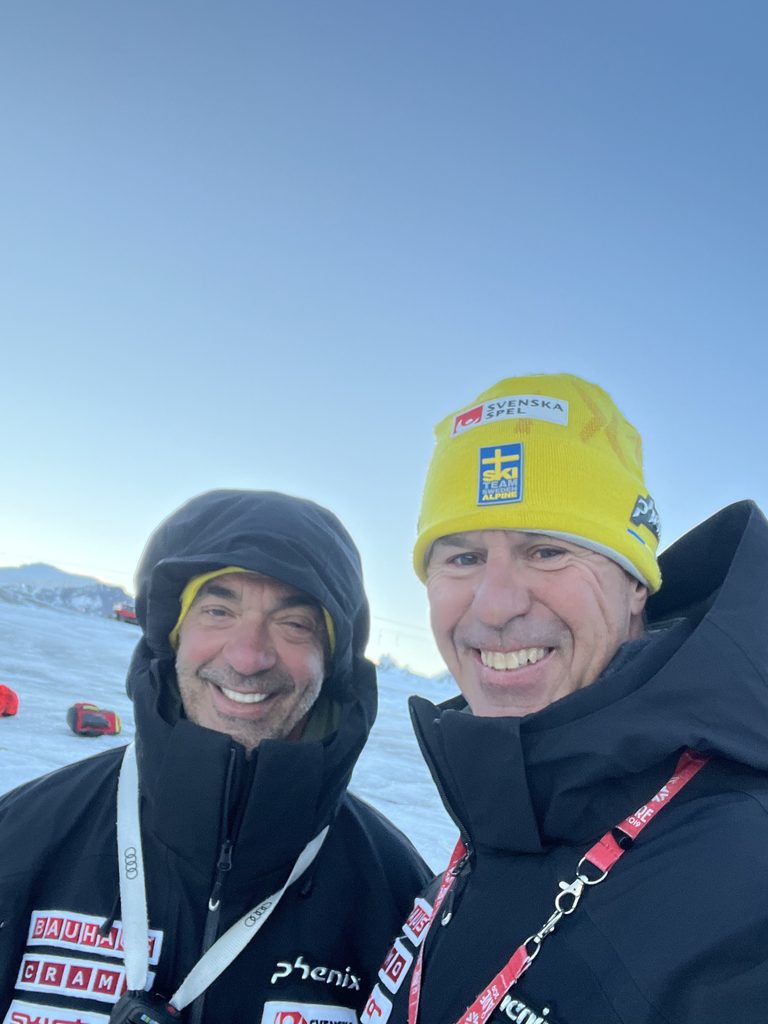
Featured image: Anders Andersson inspecting the course with one of his athletes. Photo courtesy of Anders Andersson.
The Swedish Europa Cup coach shares why relationships, team culture and consistency matter in helping athletes take the next step.
When I was coaching with the U.S. women’s team, Anders Andersson was someone I always appreciated seeing on the hill. He had a calm presence, and you could see the respect other coaches had for him across nations. In an environment where plans change constantly and everyone is trying to find an advantage, he was someone who seemed comfortable getting on with the work.
When we caught up recently, I asked whether that calmness had always been part of who he was or whether years on the road had taught him to approach coaching that way. He credited a combination of his personality and the coaches who had influenced him, including mentors who paid attention to the person behind the performance.
“I try to stay calm on the surface,” he said.
That distinction made me laugh because any coach who has spent enough time on tour understands it. Staying calm does not mean there is nothing to manage. For Andersson, it means giving athletes someone they can trust while they work through the demands of becoming better racers.
Now entering his ninth season in his current stretch with Sweden’s women’s Europa Cup program, Andersson remains drawn to the part of the pathway where progress can take many forms. A first point, a breakthrough result or an athlete finding the confidence to move forward all give him a reason to keep doing the job.
Why the Europa Cup Still Matters
Andersson’s experience reaches well beyond the Europa Cup. He began working with Sweden’s women’s Europa Cup team in 2003, spending two years there before moving into six years with the women’s World Cup program. He then spent two years working with the men’s World Cup giant slalom program, followed by five years with the men’s Europa Cup team before returning to the women.
His first years on tour involved sending faxes to enter races, long before a phone could handle much of the work coaches now manage from the hill. The logistics have changed, but his interest in developing athletes has remained.
Having worked at both levels, he understands the appeal of the World Cup. He also knows where he feels most useful.
“I don’t like to be in the front,” Andersson said. “And I like the impact, like you said, to help each other.”
That was something we connected over during our conversation. People often assume coaching at the World Cup must be the best part of a coaching career. I enjoyed that experience, but I also loved the Europa Cup and NorAm level, where you could see athletes making meaningful steps and help them build toward something they had not yet achieved.
Andersson values that same work. He also appreciates the cooperation between coaches and nations on the Europa Cup circuit, where helping one another is part of making the tour function.
Success there depends on where an athlete is in their development. Someone scoring a first Europa Cup point may be just as excited as the athlete who wins the race. For a coach, understanding what that result represents is part of understanding the athlete.
“You get closer to the athletes,” he said.
Being There After a Difficult Race
When I asked Andersson about putting ego aside within a coaching staff, his answer came back to trust, enjoyment and the strength of the group. Looking back across the Swedish teams he has worked with, he sees a connection between sustained success and athletes who work well together.
“I always try to say you win together, you lose together,” he said. “We are going to stand there together and help each other.”
That approach becomes especially important when a race has gone badly. At the finish, Andersson tries to find the athlete who went out or struggled before turning his attention to the athlete celebrating a good result.
“The one who actually won the race, they can be by themselves for another 20 minutes,” he said.
It is a practical example of what he means by taking care of a team. The athlete who has performed well knows something worked that day. The athlete who is disappointed may need help understanding what happened, settling down or finding a way to approach the next race.
Those interactions also give meaning to the trust coaches ask athletes to place in them. Being available after a difficult performance shows an athlete that the relationship holds up when the result is missing.
For Andersson, that work sits alongside everything a coach does on snow. Technical knowledge matters, but so does knowing who needs your time and how to help them receive the information you are giving.
Developing What an Athlete Does Well
Andersson describes coaching as a constant process of adapting. Conditions change, athletes respond differently and a plan that looked right before training may need to change once the session begins.
He also questions how much coaches sometimes focus on technical details without giving enough attention to the decisions an athlete makes on course. Different racers can find speed in different ways, and understanding those differences is part of helping them improve.
“You cannot put them just in a box,” he said.
His approach is to identify what an athlete already does well and build from there. He is careful about making changes that could take away the qualities that make a racer effective.
“You need to find them where they are and try to develop the good part they have,” Andersson said.
That requires knowing the individual. Across his experience coaching men and women, he has learned that the same feedback can land very differently from one athlete to another. Some respond well to direct instruction; others need more context before they can use it productively.
The responsibility for the coach is to understand that response while still being honest about performance. Andersson wants athletes to feel comfortable and safe working with him, with enough trust in the relationship to address what needs to improve.
Taking Your Own Skiing to the World Cup
One of the challenges Andersson understands personally is moving from Europa Cup success into World Cup racing. As an athlete, he experienced the temptation to do more when he reached the higher level, even when the skiing that earned him the opportunity was already working.
It is something he now tries to help his athletes recognize before they make the same mistake.
A racer can arrive on the World Cup believing the new level requires a different version of their skiing. The field, surroundings and expectations can make it difficult to trust the approach that brought them there. Andersson wants athletes to keep developing without losing that foundation.
“Stick on your path because you know it was working,” he said.
That message also applies when younger athletes train with an established World Cup group. They can learn a great deal from the experience, but they do not need to take on every concern or frustration around them. Their job is to stay focused on their own work.
Andersson pointed to the young American women he watched last season as a group whose approach stood out. He liked their willingness to attack and keep committing, even when a run did not work out. It was an attitude he wanted his own athletes to see.
“They go full gas,” he said.
For a development coach, there is a balance between helping athletes prepare for the next level and allowing them to bring their own confidence into it. Andersson’s observations were a reminder that coaches also need to recognize what is already working well enough to protect it.
Speed You Can Repeat
Our conversation eventually turned to golf, a sport Andersson has played since he was 17 and regularly uses to explain ideas to his athletes. He sees similarities in the decisions, patience and consistency required in both sports.
A golfer can hit the ball a long way and still struggle to put together a round. A ski racer can show exceptional speed and struggle to reach the finish. In both cases, the ability is there, but turning it into a performance requires more than producing a few impressive moments.
“If you made a mistake, you cannot try to recover in the next two strokes or turns,” Andersson said. “You need to keep on working, try to be consistent.”
He wants athletes to understand the level they can reproduce. Two strong results can improve a points profile, but they do not necessarily describe how someone is skiing throughout a season. Being able to deliver that performance repeatedly gives a coach and athlete something more reliable to build on.
That thinking also helps explain his preference for coaching giant slalom. Although he was a slalom racer, he enjoys the timing and balance of GS, where trying harder does not automatically produce more speed.
“Golf is like GS,” he said. “If you’re trying too hard, you don’t get anything out.”
Helping Athletes Move On
This season brings practical challenges for Andersson’s program. He said financial constraints have left him as the sole coach, with three racers attending camps. Integrating with the World Cup team through the fall has provided support, while he explores ways to manage the racing season through relationships with other teams and potentially bringing Swedish ski school coaches onto the circuit for shorter periods.
He sees value in that opportunity for the coaches as well. A week on tour can give someone working at home a chance to reconnect with the international racing environment without committing to an entire season away from family.
Even while working through those logistics, Andersson’s interest remains in bringing athletes into the environment, giving them opportunities to test themselves and helping them return better prepared. He knows they will not all become world champions. What he wants to see is the commitment to find out how far they can go.
“To see the fire in their eyes,” he said, “and if you see the fire in the eyes, I’m willing to help them as much as possible to be there.”
Eventually, the goal is for those athletes to leave his group because they are ready for the World Cup. Andersson described that as the best reason to stop seeing an athlete every day. It means they have taken the next step, and he can begin working with someone new.
Listening to him, I recognized the approach I had appreciated when we were coaching on the same hills. He enjoys getting to know athletes, helping them through the difficult days and seeing their work turn into progress. After years across different teams and levels, that is still the part of coaching that keeps him coming back.