
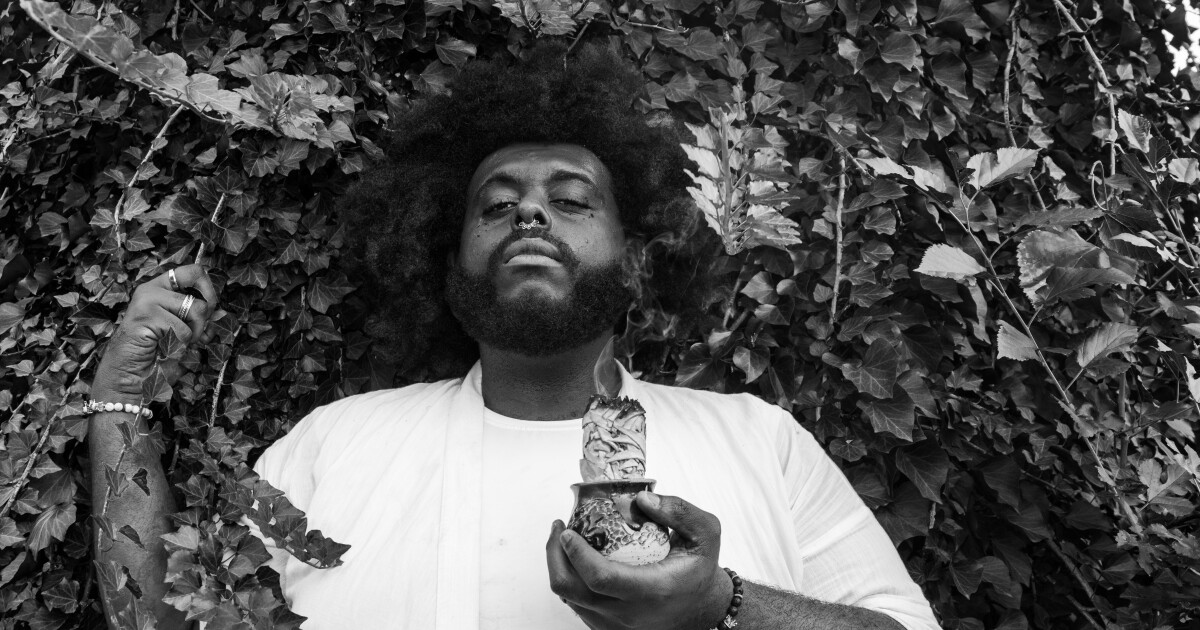
To Robin “Hyperius” Blake, jazz and hip-hop aren’t separate traditions. Neither are soul, funk, blues or house music. They’re all connected by the same cultural thread.
This belief inspired him to found Black Voltron, a Cleveland collective weaving together genres, identities and communities that don’t often share the same stage.
Asked what Black Voltron sounds like, Blake doesn’t list influences or genres.
“It sounds like Blackness. It sounds like queer joy. It sounds like beauty,” he said.
That philosophy comes to life on “Motion,” the collective’s new live EP, arriving Aug. 1.
Finding a place to belong
Blake’s journey began in Euclid, where theater, choir, creative writing and music helped him find new meaning.
Encouraged by a high school band director, he enrolled at Cleveland State University as a saxophone performance major.
“My assistant band director told me something that I’ll never forget,” Blake said. “‘The world is so much bigger than what you’ve experienced, and music can show you the world.’ That was all the convincing I needed.”
Without formal lessons or a background in music theory, Blake spent his early years catching up.
He went on to create an independent degree focused on Black American music.
His senior thesis explored hip-hop as a continuation of jazz, tracing the roots of American popular music back to Black musical traditions.
That research culminated in an ambitious recital-lecture, “A Sound Experiment,” blending live performance with musical analysis.
The project changed the course of his career.
“It made me look around at the music scene and realize that there was a lot missing,” Blake said. “As a person who lives on the margins, I didn’t find a lot of things around that were speaking to me. If no one else was going to do it, I guess I had to.”
Blake identifies as a queer, neurodivergent Black Indigenous artist and said he often felt caught between communities: too Black in some spaces, too queer in others.
Rather than waiting for the right artistic community to exist, he decided to build one himself.

A new beginning
Following his recital, Blake invited the musicians who had performed alongside him to continue the project, forming an ensemble called Hyperius Blake & the Sound Experiment.
The name “Hyperius” – also a video game character – became his artistic alter ego, a higher self he could step into on stage.
“I feel like ‘Hyperius’ is the part that I’m able to give to the world, and then Robin is for me,” Blake said. “My real truth will always be for me, and that’s what gives me the strength to be vulnerable through ‘Hyperius.’”
Black Voltron began to take shape during one of the most difficult periods of Blake’s life.
In 2023, after years balancing music with a career in tech, he said he suffered a stress-induced stroke.
He left his job, entered intensive therapy and began reassessing the way he measured his own worth.
Looking back, he said he spent years measuring his worth by what he could produce instead of who he was.
“Black Voltron was born kind of out of a survival instinct,” Blake said. “I realized I need to do what I want to do, not what I think other people want to hear.”
That perspective also shaped the collective’s music.
“I’m saying it from the experience, just be bold. Not just musicians, everybody. Be bold. Take big risks. Risk your heart. It’s the only way.”
Robin “Hyperius” Blake
Rather than focusing on polished studio recordings, Blake prefers releasing live performances that capture the spontaneity and chemistry of the ensemble.
“Black Voltron is a live experience,” he said.
The new name came during a conversation with a friend, who described the group as “an amalgamation of Black music,” something akin to the cartoon robot Voltron, assembled from many distinct parts.
Blake immediately knew he’d found it.
“Not only is it an amalgamation of Black styles of music, but it’s an amalgamation of people and experiences and backgrounds that we bring together.”
Curating an experience that inspires
Black Voltron functions as a collective rather than a traditional band.
The core lineup of Randall Hoyle, Crystal Burks, Tyler Jasterbowski, Elijah Khalil, Neo Kiio, Vandarrel Woods and Bobby Belairs is joined by a rotating network of collaborators from across Northeast Ohio’s music community.
Their backgrounds span jazz ensembles, church choirs, wedding bands, classical performance and more, mirroring the collective’s expansive musical vision.
The sound blends jazz, blues, hip-hop, neo-soul, funk, disco, house music and Afro-Latin influences as expressions of the same throughline rooted in Black musical traditions.
“It sounds like Blackness. It sounds like queer joy. It sounds like beauty.”
Robin “Hyperius” Blake
Blake considers himself a “disruptor.”
“I can go in spaces and carry myself well and professionally and defy people’s expectations,” he said, adding that “y’all ain’t never seen nothing like this and you might not ever see anything like this again.”
Blake hopes listeners walk away with something deeper than an appreciation for musical craftsmanship.
His spoken-word piece, “Impression,” which includes the line “I am a human being, not a human doing,” grew directly out of therapy and his realization that personal worth isn’t tied to productivity.
He said the goal of Black Voltron is to create space for vulnerability, curiosity and healing.
The message appears to be resonating.
Since forming, Black Voltron has earned a Cleveland Arts Prize Verge Fellowship, won Best Hip-Hop Group at the Cleveland Music Awards and performed throughout the region at venues including the Rock & Roll Hall of Fame, the Bop Stop, Brite Winter and Larchmere PorchFest.
As Black Voltron prepares to release their upcoming EP, Blake said he hopes audiences hear more than a collection of songs but also connection.
“I’m going to keep putting in that work and keep being in the community and keep creating value with my art,” he said. “I’m saying it from the experience, just be bold. Not just musicians, everybody. Be bold. Take big risks. Risk your heart. It’s the only way.”