

Rochester Couple Recreates 1920s Film in Their Basement, Honoring Leica’s Centennial
(Rochester, NY) – In a remarkable feat of historical recreation, a husband and wife team in Rochester, New York, are crafting a black-and-white film meticulously designed to emulate the photographic experience of the 1920s, coinciding with the 100th anniversary of the iconic Leica 35mm camera. Mark Osterman, a former process historian at the George Eastman Museum, and his wife, France Scully Osterman, have transformed their basement into a miniature film factory, producing a unique vintage film from scratch.
The couple’s endeavor began when Osterman acquired a 1928 Leica I camera and realized the significance of the centennial celebration. Driven by a desire to authentically experience photography as it was a century ago, they embarked on a project to create a film mirroring the fine-grained, low-ISO films used during that era.
(Image: Contact sheet positive image of Mo-1925 film shot by Mark Osterman. Courtesy Scully & Osterman)
Their basement workshop houses a remarkable collection of vintage film-making equipment, including a rare film coating machine originally from Polaroid’s research lab and a Bell and Howell perforating machine, generously donated by the Rochester Institute of Technology (RIT). This specialized equipment allows them to coat acetate film with their custom-made emulsion, resulting in a truly one-of-a-kind vintage black-and-white film.
“I bought a 1928 Leica I camera early in 2025,” Osterman explained to Kosmo Foto. “Only then did I realize that the Leica camera was actually introduced 100 years earlier and that Leica was celebrating the centennial.”
The process is intricate, involving a base recipe called MO-1880 (ISO 1-2), followed by a heat and sulphur sensitization to create MO-1925, a film with an ISO of 8-12 – the standard for early Leica cameras.
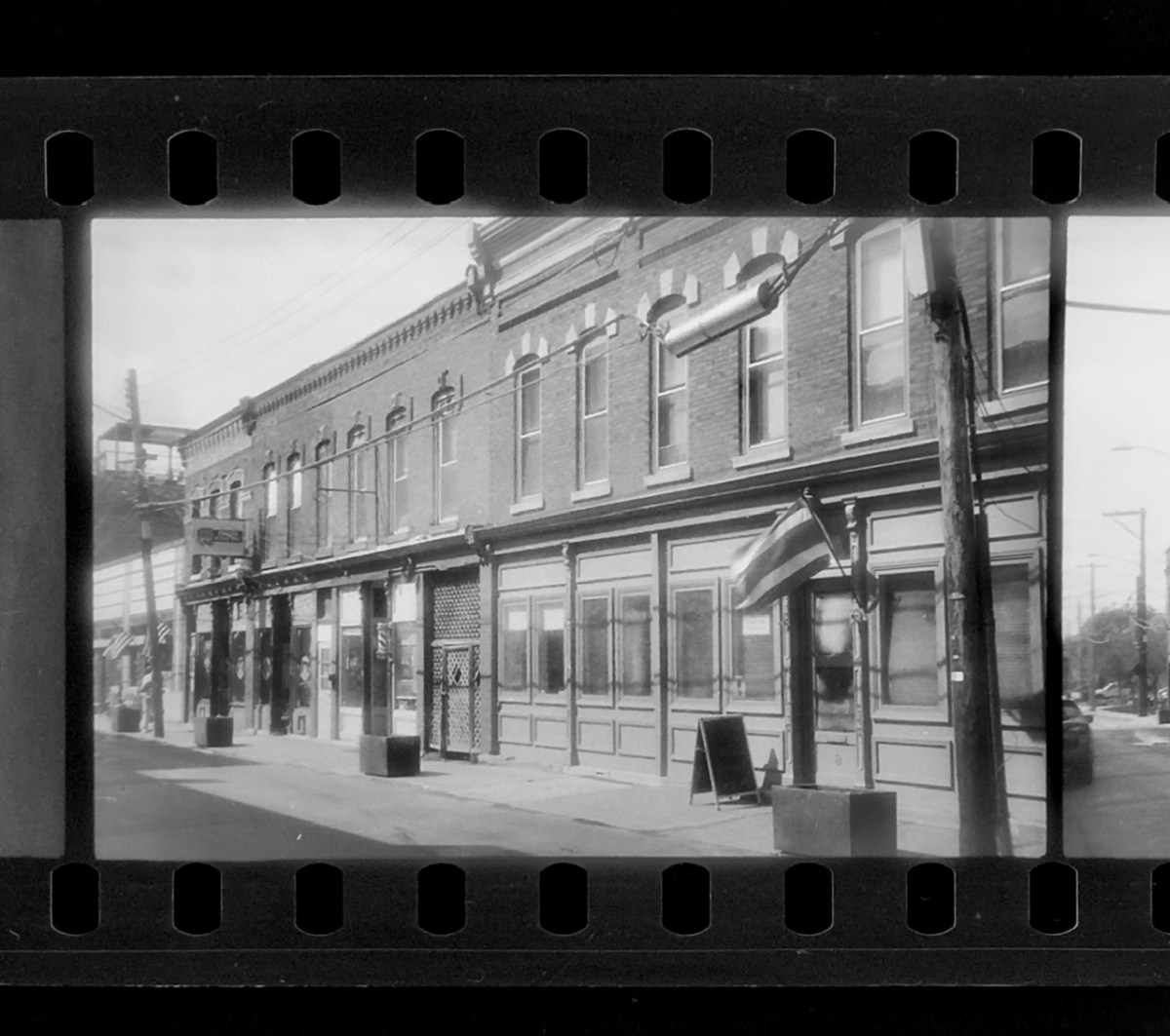
(Image: Negative of Rochester street on MO-1925 film. Courtesy Scully & Osterman)
(Image: Negative of parade taken in 1925 by Henri Dumur. Courtesy Scully & Osterman)
The Ostermans’ dedication extends to meticulous comparison with historical film. They possess a rare roll of film shot and developed by Oscar Barnack, the inventor of the Leica, allowing them to refine their process and ensure accuracy. This precious roll will be presented to the Leica company in June.
While the MO-1925 film won’t be available for commercial sale, the couple is documenting their journey in a short film, produced in collaboration with cinematographer Gerardo Puglia. A GoFundMe campaign has been launched to support the film’s completion, offering a glimpse into their unique operation. The documentary will showcase the 1928 Leica I camera and other vintage equipment, including a glass drum visual developing apparatus from 1925 and an early Leitz Leica enlarger.
Osterman anticipates the documentary will be screened at international film festivals in the coming year, offering a fascinating look into the revival of a bygone photographic era.
About the Author:
Stephen Dowling is the founder and editor of Kosmo Foto. A New Zealander based in London, he’s been a dedicated film photographer since 2000. Kosmo Foto has evolved into a film brand, releasing films like Kosmo Foto Mono 35mm and Kosmo Foto Mono 120. Dowling is committed to promoting and preserving film photography for future generations.