

Kenya is accelerating plans to fully integrate its HIV response into a unified national health system after a donor funding shock exposed deep vulnerabilities in service delivery and long-standing dependence on external financing.
Speaking at the 2026 Joint Annual Programme Review (JAPR) in Nairobi, health leaders said the disruption marked a turning point in Kenya’s HIV response, forcing a shift from vertical, donor-dependent programs to an integrated model under Universal Health Coverage reforms.
Acting Chief Executive Officer, National Syndemic Diseases Control Council (NSDCC), Dr. Douglas Bosire, framed the moment as both a stress test and a strategic inflection point.
“It was the test. What it revealed is what Kenya chooses to build next,” Dr. Bosire said. “We are not proposing integration. We are implementing it.”
He said that the reforms are rooted in the aftermath of a 2025 U.S. stop-work order that disrupted PEPFAR and USAID-supported programs, affecting 40.6percent of health facilities nationwide.
According to NSDCC data presented at the JAPR forum, rural facilities were disproportionately affected, experiencing disruption rates more than three times higher than urban areas.
“About 2,127 facilities reported service interruptions, while staffing withdrawals were recorded in nearly 40percent of affected sites. The nurse-to-patient ratio deteriorated to approximately 1:120 during the disruption period.”
Dr. Bosire said the system held, but not without exposing structural weaknesses. “Kenya did not collapse,” he said. “But the vulnerabilities were exposed.”
He added that emergency measures helped sustain continuity of treatment, but it underscored the risks of overdependence on external financing.
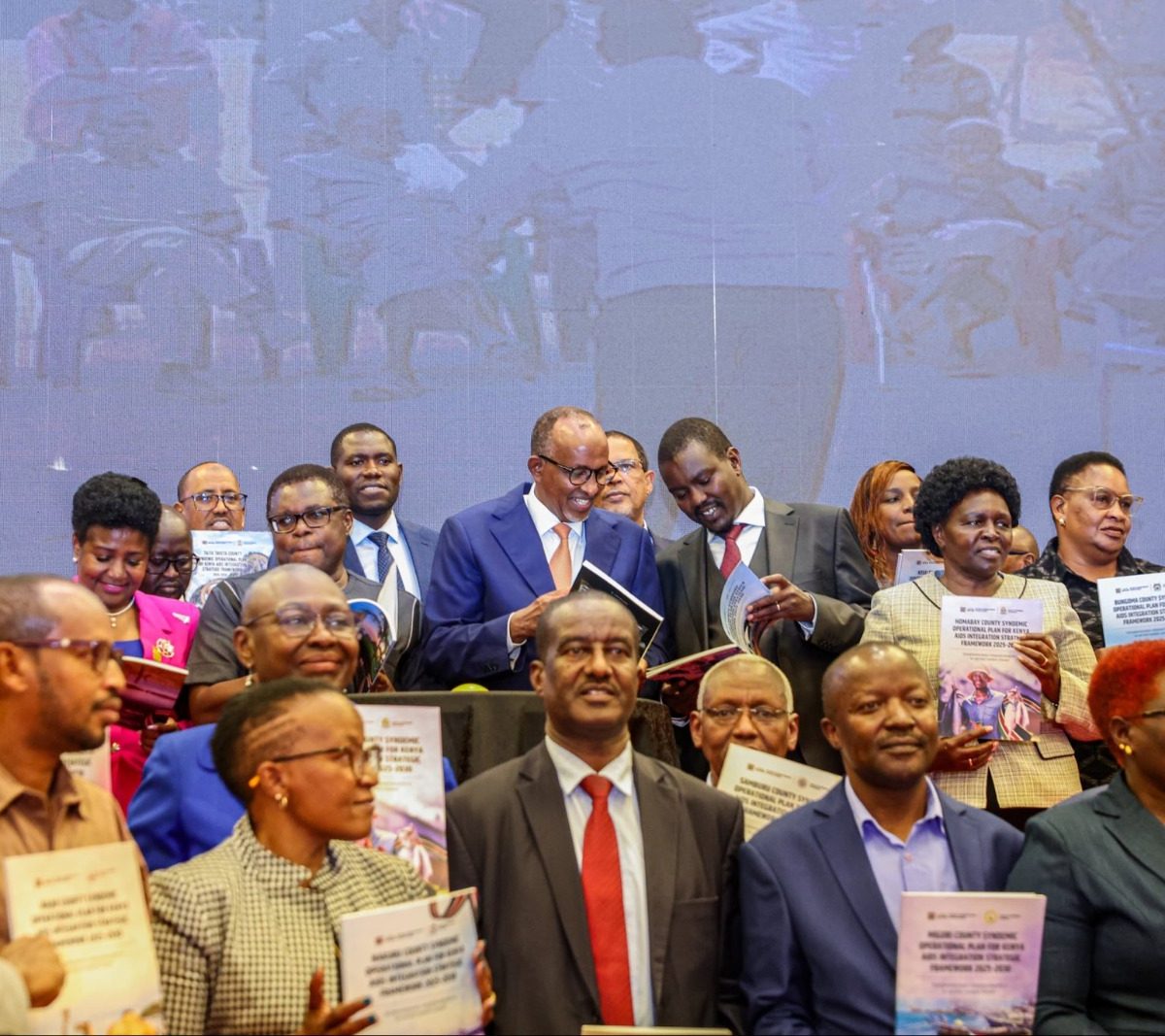
At the 2026 Joint Annual Programme Review (JAPR) in Nairobi, Kenya AIDS Integration Strategic Framework (KAISF) 2025–2030 was unveiled. KAISF seeks to dismantle parallel disease programs and embed HIV services within a broader, people-centered health system.
The KAISF framework integrates HIV, tuberculosis, malaria, sexually transmitted infections, hepatitis, and non-communicable diseases into a single coordinated platform supported by shared supply chains, unified data systems, and cross-trained health workers.
Dr. Bosire said the goal is not to downgrade HIV, but to reposition it within a stronger system. “This is not a shift away from HIV,” he said. “It is an evolution of the response.”
Health Cabinet Secretary, Aden Duale, echoed the position, saying integration is essential to sustainability.
“Integration should not be viewed as a shift away from HIV,” Duale said. “It represents an evolution of the response and an opportunity to strengthen broader health systems.”
According to the 2026 Kenya AIDS Progress Report by the National Syndemic Diseases Control Council (NSDCC), Kenya continues to carry a substantial HIV burden, with an estimated 1.48 million people living with HIV in 2025.
National prevalence stands at 3.22percent, with higher rates among women (4.3percent) than men (2.1percent).
New infections have declined by about 56percent since 2020, falling to 13,936 annually, while AIDS-related deaths stood at 19,434 in 2025.
However, Dr. Bosire warned that progress masks persistent structural gaps.
Children account for 24percent of new infections, while mother-to-child transmission remains above global targets at 8.04percent.
Men continue to present late with advanced disease, and adolescents and young women remain disproportionately affected.
“These are not marginal gaps,” he said. “They are system failures we must fix within a unified response.”
A major pillar of the reforms is devolved implementation through all 47 counties, each of which has developed a County Syndemic Operational Plan.
The plans require counties to integrate HIV services into general outpatient care, consolidate supply chains, eliminate parallel reporting systems, and expand community health services.
Dr. Bosire emphasized that counties are not implementing agents of national government but constitutional actors in their own right.
“County governments govern health. National government enables,” he said.
The officials acknowledged that more than 80percent of HIV and TB programming is currently externally funded, but said the long-term objective is full domestic financing by 2030.
Dr. Bosire said Kenya can no longer defer the transition. “We cannot wait indefinitely for external financing,” he said. “Sovereignty requires ownership.”
The strategy includes expansion of the Social Health Insurance Fund (SHIF), domestic resource mobilization, health bonds, and earmarked taxes.
The reforms are framed as a structural redesign of Kenya’s health system rather than incremental adjustment.
Under KAISF, patients will receive multiple services in a single visit HIV testing, TB screening, maternal care, and chronic disease management supported by unified digital records and a national patient identifier system.
Health workers will be trained across multiple conditions, replacing disease-specific silos with integrated clinical competencies.
Dr. Bosire said Kenya’s HIV infrastructure should be seen not as a liability, but as a national asset.
“Kenya’s HIV infrastructure is not a liability,” he said. “It is a national asset. The question is whether we repurpose it or allow it to fragment.”
The reform agenda sets ambitious 2030 targets, including fewer than 1,000 new adult HIV infections annually 50percent reduction in AIDS-related deaths and full integration of HIV services into the national health system.
However, projections shared at the forum warn that without integration, fragmentation could result in tens of thousands of avoidable infections by 2030.
A three-phase roadmap stabilization, consolidation, and transformation will guide implementation through the decade.
Dr. Bosire, the transition represents a historic reset in Kenya’s public health architecture. “The era of parallel programs is ending,” he said. “What begins now is a single, integrated, and sovereign health system.”
If successful, the reforms could position Kenya as one of the first countries in the region to fully integrate its HIV response into Universal Health Coverage marking the end of donor-driven vertical programming and the beginning of a unified health era.