

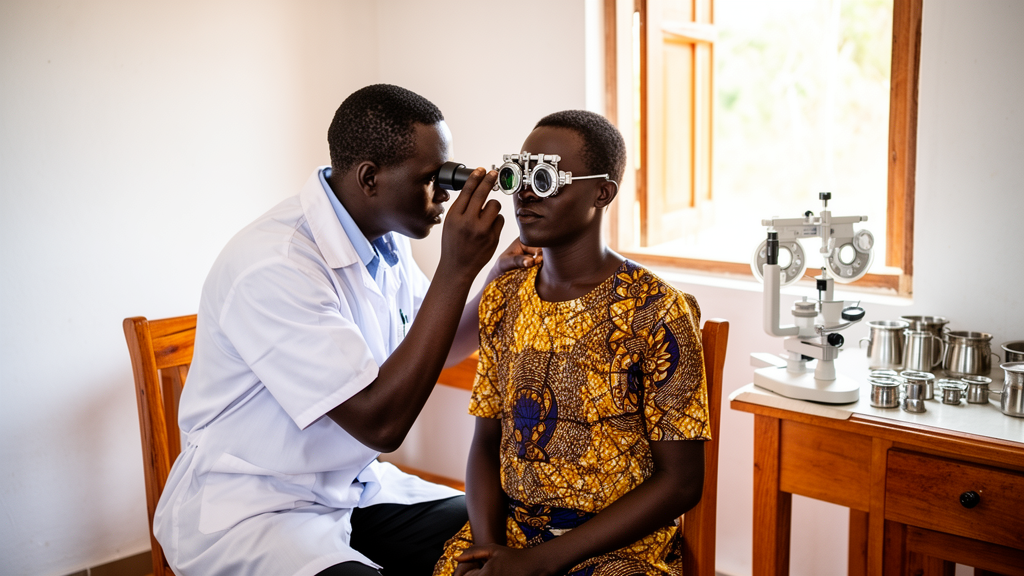
A large community-based cross-sectional study conducted in Nakuru County, Kenya, has identified uncorrected refractive error as a primary driver of avoidable visual impairment among local residents. The research, published in BMC Ophthalmology, analyzed data from over 5,000 participants to estimate the prevalence of presenting and residual visual impairment.
The study was designed to address limited data on presenting and residual visual impairment after refractive correction in sub-Saharan Africa. Researchers utilized data from three annual community-based eye screening programs conducted between 2023 and 2025. These programs involved standardized clinical eye examinations for a total of 5,096 participants, with a mean age of 38.9 years and 69.2% of the sample being female. The cross-sectional design allowed for the assessment of age, sex, and temporal trends in refractive error and presbyopia within the specific geographic context of Nakuru County.
Participants underwent standardized assessments of monocular and binocular distance and near visual acuity, along with anterior and posterior segment examinations. Objective and subjective refraction was performed without cycloplegia, but only for participants whose unaided distance visual acuity was worse than 6/9 in the better-seeing eye. This subgroup comprised 2,306 individuals.
The results revealed that presenting distance visual impairment affected 21.7% of all participants, with the majority experiencing mild to moderate impairment. Blindness was observed in 1.0% of the total sample. Following refractive correction, the prevalence of visual impairment decreased significantly to 9.4%, while the rate of blindness changed minimally to 0.9%. This reduction demonstrates that a large portion of the measured visual impairment was avoidable through the provision of corrective lenses, underscoring the potential impact of refractive services on community eye health.
Refractive error was identified in 1,345 participants, representing 58.3% of the 2,306 individuals who underwent refraction and 26.4% of all 5,096 participants screened. Myopia was the most common type of refractive error, affecting 30.6% of the right eyes and 30.1% of the left eyes among those refracted. When viewed against the total screened population, myopia prevalence was 13.8% for the right eye and 13.6% for the left eye. These figures provide a detailed breakdown of the specific optical conditions contributing to the overall burden of visual impairment in the study area.
Age emerged as the strongest predictor of visual impairment in the multivariable logistic regression analysis. Children and youth had significantly lower odds of visual impairment compared to older adults, with adjusted odds ratios of 0.3 and 0.4, respectively. Improvement in visual impairment following optical correction was observed across all age groups, although the magnitude of improvement was less pronounced among older adults.
Temporal trends in presenting visual impairment were evaluated across the three years of data collection. The prevalence increased from 22.4% in 2023, involving 2,016 participants, to a peak of 24.8% in 2024, involving 1,346 participants. Subsequently, the rate declined to 18.5% in 2025, with 1,734 participants screened.
The study employed convenience sampling to recruit participants, which is a limitation that may affect the generalizability of the findings to the broader population of Nakuru County or other regions in Kenya. The refractive assessment was limited to those with unaided visual acuity worse than 6/9, meaning those with milder impairments or normal vision were not subjected to the same level of detailed optical analysis. Additionally, the cross-sectional nature of the study prevents the establishment of causal relationships between refractive error and visual impairment over time, although the strong association is evident in the data.
The conclusions of the study highlight that visual impairment affected approximately one in five participants, with a substantial proportion attributable to refractive error. The data supports the potential contribution of refractive correction to reducing visual impairment among individuals accessing community eye-care services.
Subject of Research: Prevalence and impact of uncorrected refractive error on visual impairment in Nakuru County, Kenya
Article Title: Avoidable visual impairment due to uncorrected refractive error in Nakuru county, Kenya: evidence from a large community-based cross-sectional study of over 5,000 participants
Article References: Wakesa, A., Kwarteng, M. A., Ragot, A., Nangena, S., Ovenseri-Ogbomo, G., Agho, K. E., Ogbuehi, K. C., Mashige, K. P., Rasengane, T., Naidoo, K. S., Ekpenyong, B. N., Ndep, A., & Osuagwu, U. L. (2026). Avoidable visual impairment due to uncorrected refractive error in Nakuru county, Kenya: evidence from a large community-based cross-sectional study of over 5,000 participants. BMC Ophthalmology. https://doi.org/10.1186/s12886-026-05479-0
Image Credits: AI Generated
DOI: 10.1186/s12886-026-05479-0
Keywords: visual impairment, refractive error, Kenya, community health, ophthalmology, myopia, presbyopia, cross-sectional study, eye care, public health, Avoidable, visual