
Kenya’s government is tying its push to manufacture more medicines, vaccines and medical technologies locally to a broader overhaul of health financing, arguing that reducing the country’s heavy dependence on imports is essential if its healthcare reforms are to succeed.
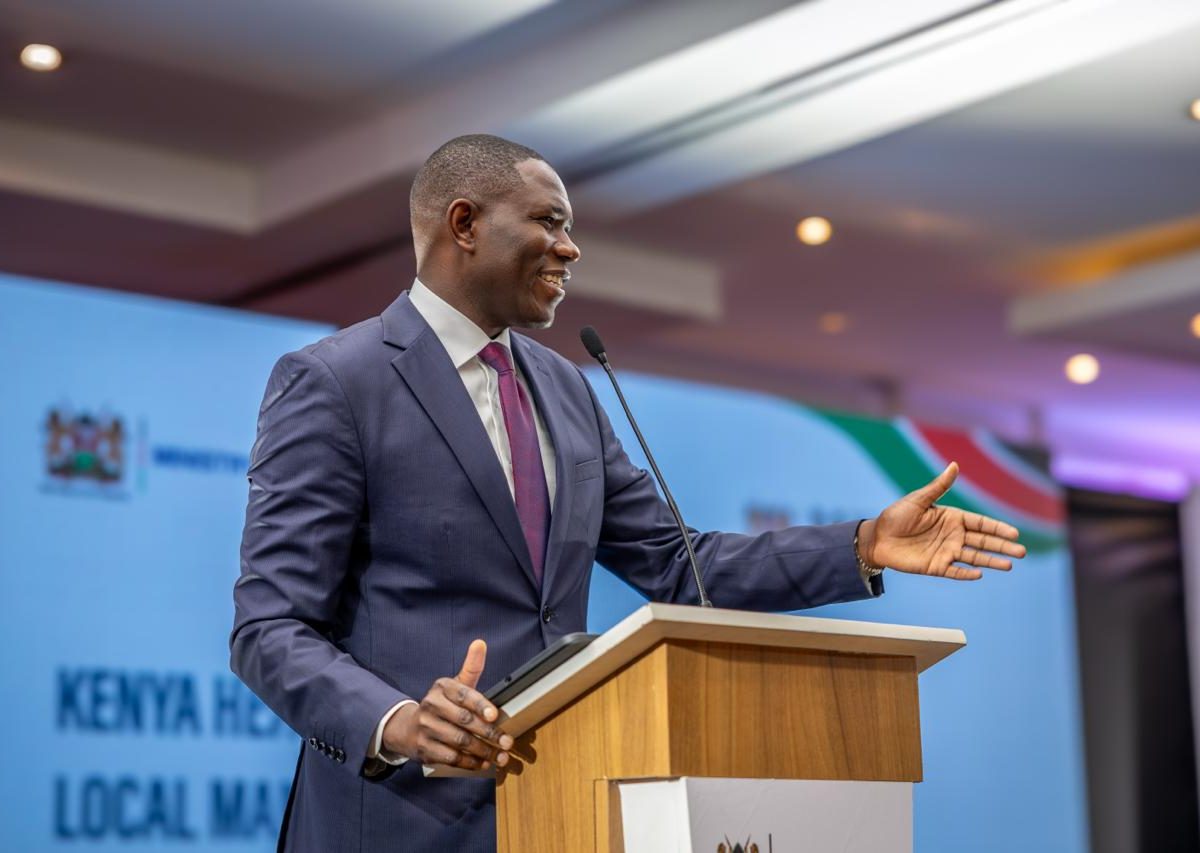
Speaking Tuesday at the launch of the Kenya Health Products and Technologies Local Manufacturing Strategy 2026–2030, Principal Secretary for Medical Services Dr. Ouma Oluga said local production must be treated not as a stand-alone industrial policy but as part of the architecture of Taifa Care, the government’s flagship health reform program.
The strategy comes as Kenya seeks to cut the cost of care, improve access to medicines and reduce exposure to global supply disruptions after years in which the country has imported about 70percent of the health products and technologies it uses, including nearly all vaccines.
“This strategy sits right inside Taifa Care,” Oluga said. “You cannot finance a healthcare system that you cannot supply. And you cannot digitize a supply chain that has nothing flowing in it.”
Oluga described local manufacturing as the “fourth arm” of Kenya’s health reforms, alongside health financing, primary healthcare and digital transformation, saying the long-term viability of those reforms will depend on whether the country can reliably produce and procure the medicines and technologies its health system needs.
Kenya’s domestic market for health products and technologies is valued at about $1.2 billion, he said, with more than $760 million leaving the country each year in the form of imports. Health products account for a large share of healthcare costs, he added, making them a critical target for reform as the government tries to make treatment more affordable under the Social Health Authority.
At the primary healthcare level, medicines and other health products account for about 40percent of total care costs, Oluga said. If diagnostics are included, that rises to 57percent. At tertiary hospitals, medicines alone account for roughly 20percentof the cost of care, even before doctor fees, imaging, utilities and hospital overhead are added.
“The reason why we want to manufacture here, the reason why we want to give manufacturers incentives, the reason why we have wiped out taxes, the reason why we are giving you an energy pipeline, is not so that you can make profit or so that you can be proud that Kenya is manufacturing,” he said. “It’s so that every single Kenyan can have access to a quality product at a cost that the country can sustain.”
Oluga’s remarks offered one of the clearest explanations yet of how the government sees local manufacturing fitting into President William Ruto’s wider health agenda.
He said that members of the public have repeatedly argued that Taifa Care will fail if patients are insured on paper but cannot access affordable medicines in practice.
He pointed to cancer treatment as one example of the pressure imported medicines place on the health system, saying some drugs are so expensive that a patient can exhaust their health coverage after only a few doses.
Lowering those prices, he said, is one of the main reasons the government wants to support local manufacturing and negotiate more aggressively with global suppliers.
Oluga cited the example of Roche, saying the government had already worked with the company to reduce the price of Herceptin from 120,000 Kenyan shillings to 38,000 shillings, which he said showed the potential for pricing interventions to lower the cost of care.
But the principal secretary also acknowledged that Kenya’s manufacturing ambitions have been held back for years by structural barriers, particularly the high cost of financing and the difficulty local firms’ face in raising long-term capital.
Manufacturing plants, he said, cannot be built “on hope.” Unlike traders who import finished goods and repay bank loans quickly, pharmaceutical manufacturers face long investment cycles and need patient financing. Banks, he said, are often reluctant to lend because specialized factories are harder to value and resell if a borrower defaults.
To address that, Oluga said the government is working with the National Treasury and the Kenya Industrial Development Corporation to establish a dedicated health manufacturing credit guarantee facility to help de-risk long-term lending for pharmaceutical, vaccine, diagnostic and medical-device production.
He said the government is also pursuing concessional and blended finance from development lenders, including the African Development Bank , the International Finance Corporation and Afreximbank, to make capital cheaper and extend repayment timelines for investors.
A second challenge, Oluga said, is the gap between scientific research and industrial production. Kenya has universities, research institutes and scientists producing academic work in medicine, pharmacology and biomedical science, but too little of that research translates into products that can be manufactured at scale.
He said the government wants to create a more direct pipeline from university laboratories and research institutions into local production, so that discoveries move beyond academic publication into pre-clinical development, formulation and manufacturing.
“There is no value in having 50, 200 publications, calling ourselves professors, when there is not a single innovation in the drugs that we have produced,” Oluga said.
He pointed to institutions such as the Kenya Medical Research Institute (KEMRI), the Kenya Institute for Primate Research, the University of Nairobi and the Kenya AIDS Vaccine Initiative as potential anchors of a stronger research-to-product system. The government is also considering an institute for bioprocessing to help bridge the gap between research and manufacturing, he said.
That issue has become more pressing as Kenya seeks to expand vaccine production through Kenya BioVax, the state-backed manufacturer that has been positioned as central to the country’s future vaccine ambitions. Oluga said technology transfer and imported active pharmaceutical ingredients remain major cost drivers, limiting the extent to which local assembly can actually reduce prices unless Kenya develops more of its own underlying science and production capability.
The third obstacle, he said, is a fragmented market.
Kenya’s 47 county governments, national agencies, faith-based health providers and private distributors all buy medicines and health products through separate channels, leaving manufacturers to navigate multiple buyers, inconsistent demand and intense price competition.
Oluga said that model would not support the kind of long-term investment needed to build sustainable factories. Instead, he called for demand to be aggregated through multi-year volume commitments and advance purchase agreements that would give manufacturers visibility over future orders.
“We cannot build factories on competition, not at the national level,” he said. “If we are to build factories that are sustainable, we have to work together.”
He said the government wants to use digital track-and-trace systems and health financing reforms to support more coordinated procurement, while also exploring advance market commitments that could give manufacturers a guaranteed three- to seven-year planning horizon.
Oluga also tied the strategy to Kenya’s continental ambitions. The African Union has set a goal of manufacturing 60percent of Africa’s health commodities locally by 2040, and Ruto has been named the AU champion for local manufacturing.
Kenya, Oluga said, must show it can move beyond speeches and policy papers to deliver factories, jobs and cheaper medicines.
“We will be judged by the factories people see us build,” he said. “We’ll be judged by the jobs that we have created. We’ll be judged by the medicines that we have produced, how much quality they are, and whether they reduced the cost of our healthcare.”
For Kenya, that may be the hardest part of the agenda. The country has spent years discussing pharmaceutical self-reliance, but officials now say the pressure of rising health costs, fragile supply chains and universal coverage promises has left little room for delay.
Oluga urged manufacturers, researchers, financiers and government agencies to treat the strategy as a shared project rather than another policy declaration.
“Please help me not to be part of stories,” he said. “If we want to do it, let’s do it and let’s commit to do it.”