
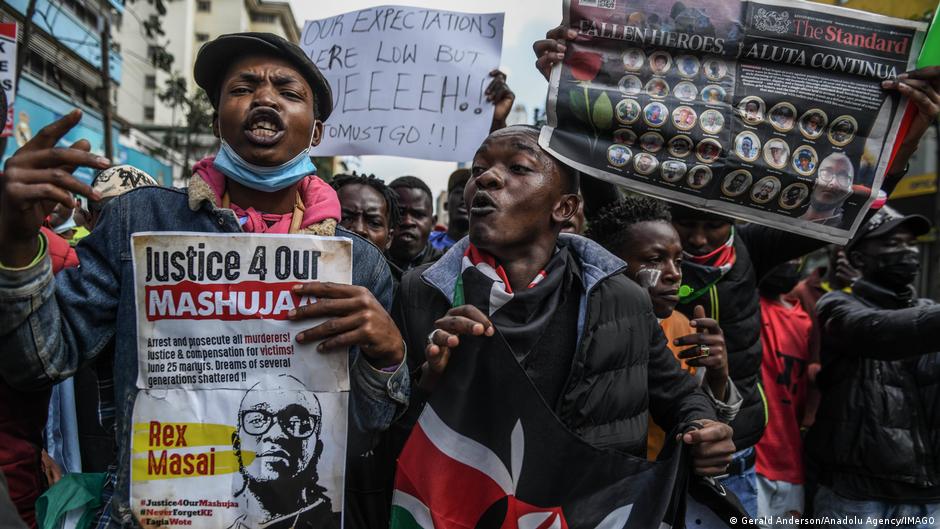
Kenya’s anti-riot police were out in full force in the capital, Nairobi, on Thursday, two years after Gen Z protesters breached the grounds of Kenya’s parliament during demonstrations against the Finance Bill 2024.
For many young Kenyans, June 25 is no longer just a protest date; it has become a symbol of resistance against police brutality, economic hardship and what activists see as a growing gap between leaders and citizens. Many young Kenyans say little has fundamentally changed. Youth unemployment, rising cost of living and concerns over governance continue to resonate across the same generation that first mobilized online and poured into the streets.
“June 25th is a reminder of what this regime is all about,” Faith Njeri, a university student in Nairobi, told DW. “It is a reminder of when you guys lost legitimacy to the people of Kenya… because of just simply saying no to the Finance Bill.”
Others emphasized the importance of commemoration.”Thursday is our greatest day that is about to happen,” said youth activist Brian Otieno. “Celebrate the life of the comrades who died… We are coming with flowers. So your government should prepare to give us security.”
Digital activism continues to play a crucial role in the Gen Z-led protests. “Kenyans we have decided we are all changing our profile pictures to Rex and the other heroes we lost… Everyone we’ve lost to police brutality,” said Mercy Wanjiru. “You cannot kill us and lead us.”
For some, remembrance is also about restoring names that risk being forgotten. “We are in that dark month… Rex Masai, Denzel Omondi, Eric Shieni, David Chege, Erickson Mutisya… and the many who disappeared,” businessman Kevin Mwangi, told DW. At least 60 deaths were recorded during the protests, according to the government-mandated Kenya National Commission on Human Rights (KNCHR). Rex Masai, a 29-year-old activist was the first fatality of the June 2024 anti-Finance Bill protests.
Beyond personalities and political affiliations
Unlike earlier protest waves in Kenya, which often revolved around political parties or established civil society actors, the anti-Finance Bill demonstrations were markedly decentralized. Organizing largely unfolded online, through social media platforms and loosely connected local networks.
Beatrice Waithera, national leader of the Red Vest Movement, told DW this approach was partly a response to increasing scrutiny of public gatherings. “We had to mobilize ourselves discreetly in ways that [President William] Ruto had to come into one of the spaces on X, formerly Twitter, to try and speak to us,” Waithera said.
Digital spaces became coordination hubs, linking young people across the entire country. The protests drew students, young professionals, gig workers, and first-time demonstrators—forming one of the most spontaneous youth mobilizations in Kenya’s recent history.
“That’s where the first faction of the Gen Z and youth movement started,” she said.
Questions about the movement’s leadership persist, with some political figures attempting to link the protests to opposition actors or well-known activists. But participants often reject those narratives. “What happened in 2024, what happened in 2025, was larger than life, was larger than Boniface Mwangi, was larger than me,” Waithera said.
While acknowledging that veteran activists laid the groundwork for civic engagement, she stressed that the protests quickly outgrew any single individual. “We were brave enough to occupy parliament and we did it without Boniface Mwangi being present,” she said.
The absence of centralized leadership became a defining feature—and, for many, a strategic advantage. Without a single figurehead, the movement proved harder to co-opt or suppress, even as authorities sought to rein it in.
Activists agree that June 2024 altered how young Kenyans relate to authority. Even as arrests, intimidation, and alleged abductions were reported, participation did not collapse. “The fear is gone,” Waithera said, acknowledging that the risks forced constant adaptation. “So the fear is gone. But we’ve had to go back and reinvent ways.” Today, the movement operates both online and offline, mobilizing quickly on issues beyond taxation, including governance, police accountability, and economic reforms.
Justice still unresolved
As the youth-led movement remembers June 25, demands for accountability remain unresolved. Human rights groups and families of victims have repeatedly called for investigations into alleged excessive force during the protests. “The courts are apathetic to our issues,” Waithera said. “The judiciary is captured, the executive is captured, and the National Police Service is captured.”
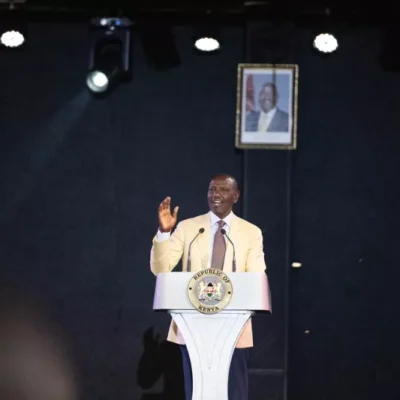
President Ruto recently pledged to compensate families of those killed during the protests but stopped short of an apology. For families, compensation alone offers little solace. “There is no greater compensation. There is no amount of money that will ever pay for the lives we lost.”
Waithera points to relatives still pursuing justice through the courts. “I see Mama Rex going to the courts all the time,” she said. She argues that Kenya needs a broader reckoning — a national conversation akin to post-conflict healing. “What happens is for a national conversation to begin, for a nation to heal after war… And at the same time, why has he [Ruto] not issued a national apology?”
The movement’s future remains uncertain. But there’s no denying that its energy has reshaped how many young Kenyans engage with politics, shifting from passive observation to active participation. “We are suffering,” Waithera said.
Frustration, she suggests, is likely to find expression beyond the streets. “But how angry are we? We are angry and we are going to the ballot with it,” she added, alluding to Kenya’s 2027 general election.
“What happened in 2024, what happened in 2025, was larger than life,” Waithera said. For many, the protests are no longer just history; they are unfinished business.
Edited by: Chrispin Mwakideu