
This is part of Opinionpalooza, Slate’s coverage of the major decisions from the Supreme Court. Keep up with all of our Supreme Court coverage and analysis by signing up for weekly email roundups. The best way to support our work—and unlock exclusive legal analysis—is by joining Slate Plus. (If you are already a member, consider a donation or merch!)
So far this year, 15 people have been executed in the United States. More than half of them were Black men; nearly all of them were put to death in Florida, Oklahoma, or Texas. Last year, the number of executions was 47, the largest number in 16 years. Fifteen of them were people of color: 14 Black people and one Hispanic person.
Fifty years after the Supreme Court reinstated the death penalty as constitutionally permissible after a brief ban, these figures are a reminder that executions still play a role in American life. If the Trump administration gets its way, they will play an even bigger role. Capital punishment may be “alive” in the United States, but it is not well.
The death penalty system is rife with miscarriages of justice, racial discrimination, execution failures, and arbitrariness from beginning to end. None of this is news, but on the 50th anniversary of the death penalty’s reinstatement in the United States, it is worth reflecting on why those problems persist.
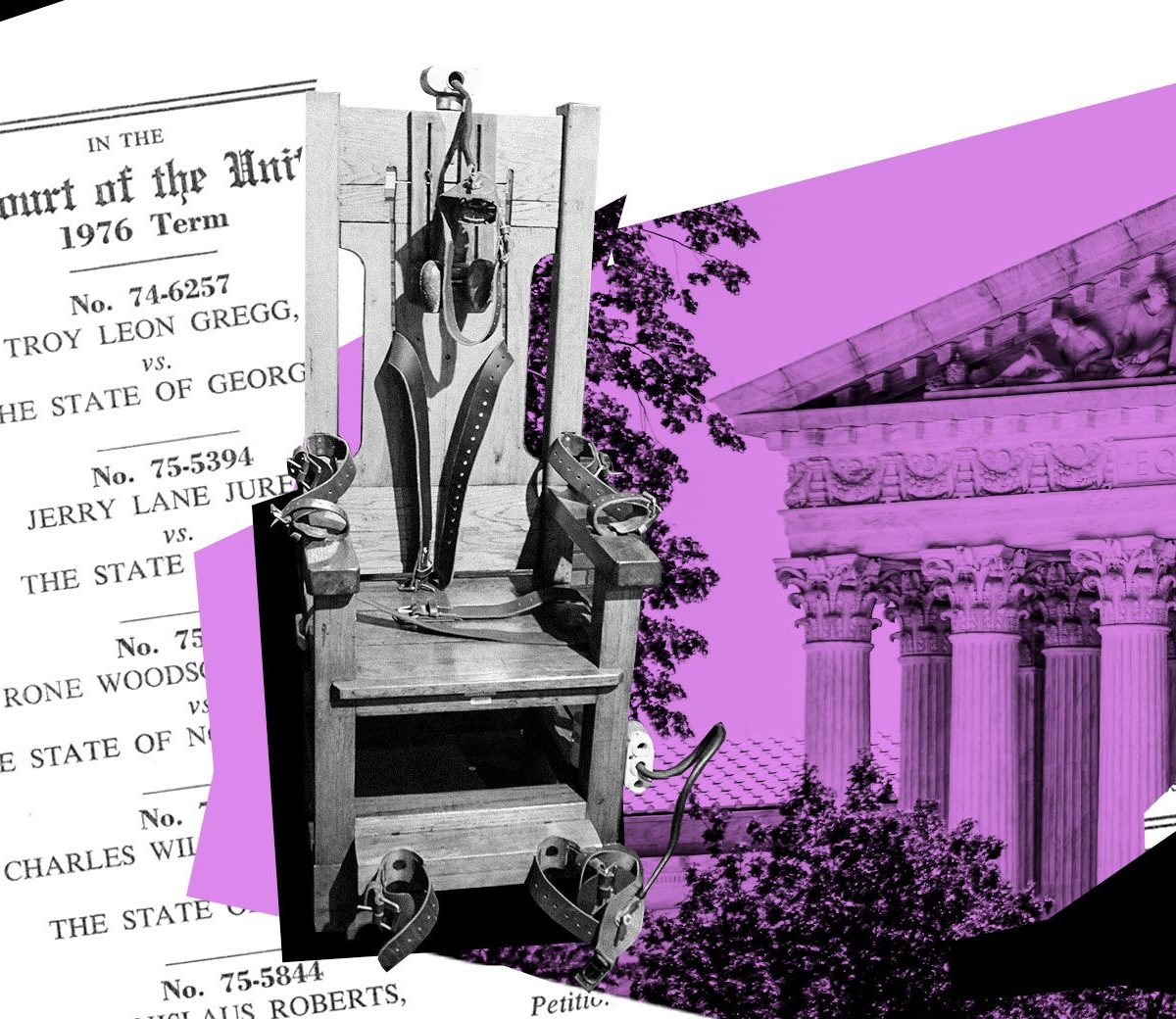
The death penalty returned after a brief period of suspension when the United States Supreme Court handed down its decision in Gregg v. Georgia on July 2, 1976. Gregg said that death sentences and executions could resume because the court was satisfied that the penalty could be administered in a way that guaranteed that capital defendants would be treated fairly and equally.
The court’s decision in Gregg was an exercise in smoke and mirrors and wishful thinking. Fifty years of constitutional fiction is enough. It is time to face the fact that Gregg failed to put the death penalty on a sound footing and that nothing can improve on Gregg’s frailties.
Four years before Gregg, the Supreme Court had brought the death penalty to a halt in Furman v. Georgia. It found that statutes which left it to “the [complete] discretion of the judge or of the jury” whether or not to sentence someone to death were not sufficient to guarantee against arbitrary or discriminatory results.
Borrowing language from an earlier case, Justice William Douglas argued that giving “untrammeled discretion” to the judge or jury to make sentencing decisions in capital cases was “offensive to … the Constitution.” Such “discretionary statutes are unconstitutional,” he added, “in their operation.”
“They are pregnant with discrimination,” Douglas added, “and discrimination is an ingredient not compatible with the idea of equal protection of the laws that is implicit in the ban on ‘cruel and unusual’ punishments.”
The mere risk of discrimination was intolerable to the Furman court.
But instead of ending capital punishment in the United States, the Furman decision set off a scramble in which states reenacted their death penalty laws in the hope of curing the problem Justice Douglas identified. As professor Evan Mandery observes, “Between the Furman decision and 1976, 35 states passed new death penalty statutes.”
“Seven,” he says, “made the death penalty mandatory for murder. Others, including Georgia, instead attempted to make the process less ‘arbitrary’ by requiring capital jurors to find ‘aggravating’ factors, by separating capital trials into the guilt/innocence and sentencing phases we see today and by guaranteeing appellate review of all death sentences.”
Georgia identified the conditions under which someone who committed a capital crime would be “death-eligible.” It specified 10 aggravating factors, the presence of which would allow a jury to return a death sentence in the belief that such “guided discretion” would pass constitutional muster.
And it did.
Mandery suggests that the “political and legal momentum against Furman” weighed on the Supreme Court justices when they heard Gregg v. Georgia. That led them to “reject the mandatory statutes, which they regarded as barbaric, but uphold the guided discretion approach.”
Writing for the majority in Gregg, Justice Potter Stewart said that “Furman mandates that, where discretion is afforded a sentencing body on a matter so grave as the determination of whether a human life should be taken or spared, that discretion must be suitably directed and limited so as to minimize the risk of wholly arbitrary and capricious action.”
Discretion that is “suitably directed and limited” would “ensure … the sentencing authority is apprised of the information relevant to the imposition of sentence and provided with standards to guide its use of that information.”
“Guided” discretion sounds good. But, as the Gregg court recognized, that guidance could only take a jury so far. Once it was found that a capital crime fell within the aggravating factors specified in the statute, the offender could be given a death sentence.
Whether they would receive such a sentence was again left to the jury, to be exercised in a wholly discretionary manner. In Stewart’s view, what a jury was not to be trusted to do without the guidance given in the Georgia statute, they could now be entrusted to do.
Do you believe in magic? Apparently, Stewart and the six other justices who joined the majority did.
But even he recognized that his formula could only “minimize (not eliminate) the risk of wholly arbitrary and capricious action.” Nonetheless, the deed was done, and the death penalty was reborn.
Gregg, Mandery writes, “created the bedrock principles of modern death penalty jurisprudence: that a non-arbitrary death penalty satisfies the Constitution and that the requirement of non-arbitrariness could be satisfied by Georgia’s approach.” But since Gregg was handed down, we have learned that arbitrary and capricious action has remained characteristic of America’s death penalty system.
Studies have shown that even after Gregg, the race of the victim plays a powerful role in determining who gets a death sentence. Someone who murders a white victim is much more likely to receive such a sentence than someone who murders a person of color, regardless of the defendant’s race.
We know that geography also matters. Defendants who commit a capital crime in one county may stand very different chances of getting a death sentence than someone who did the same thing in another county in the same state.
And we know that death sentences are often reversed on appeal because of problems in the trials of someone accused of a capital crime.
Looking back at the legacy of Gregg 10 years ago, Mandery concluded that “excessive racism, a failure to identify the ‘worst of the worst’ among murderers, the death penalty’s sporadic use, or simple geographical randomness” remain persistent problems in the death penalty system.
Ten years later, nothing has changed.
We continue to send people to their death under “the ‘guided discretion’ statutes endorsed in Gregg.” Mandery is right to conclude that such statutes “haven’t remotely fulfilled their promise.”
We should think of that as this year’s execution total grows. Surely, now 50 years after Gregg, it is time to stop, as Justice Harry Blackmun once famously said, tinkering with the machinery of death.