
Less than a year to the 2027 Africa Cup of Nations (Afcon) finals to be co-hosted by Kenya, Uganda and Tanzania, CAF inspectors will next month visit the three East African countries to assess their preparations towards hosting Africa’s premier national team football tournament.
Today, it is exactly 326 days until the tournament starts across the three East African countries. On July 19, it was exactly one year to go until kick-off. The 36th edition of the continental showpiece, featuring 24 nations including the three co-hosts, will be held from June 19 to July 17, 2027.
Africa’s football governing body CAF has set a strict deadline of January 2027 for all the match venues and training grounds across the three countries to be fully operational. Following its February 2026 inspection, which revealed that none of the proposed venues in all the countries met the required standards to host the tournament, CAF outlined key targets that must be achieved ahead of next month’s inspection.
They touched on venues, governance, cross-border movement, operations and finance. Yesterday, a spot check by Nation Sport at the venues earmarked for the tournament showed that Kenya was behind schedule in meeting most of the infrastructure targets. However, Local Organising Committee (LOC) chairman Nicholas Musonye insisted that the country will meet the deadlines.
“We are very much on course. By the time CAF (inspectors) come here next month, we will be in a very good position to explain ourselves,” Musonye said.

A view of a section inside the under construction Talanta Sports City Stadium in Nairobi on May 15, 2026.
Photo credit: Chris Omollo | Nation Media Group
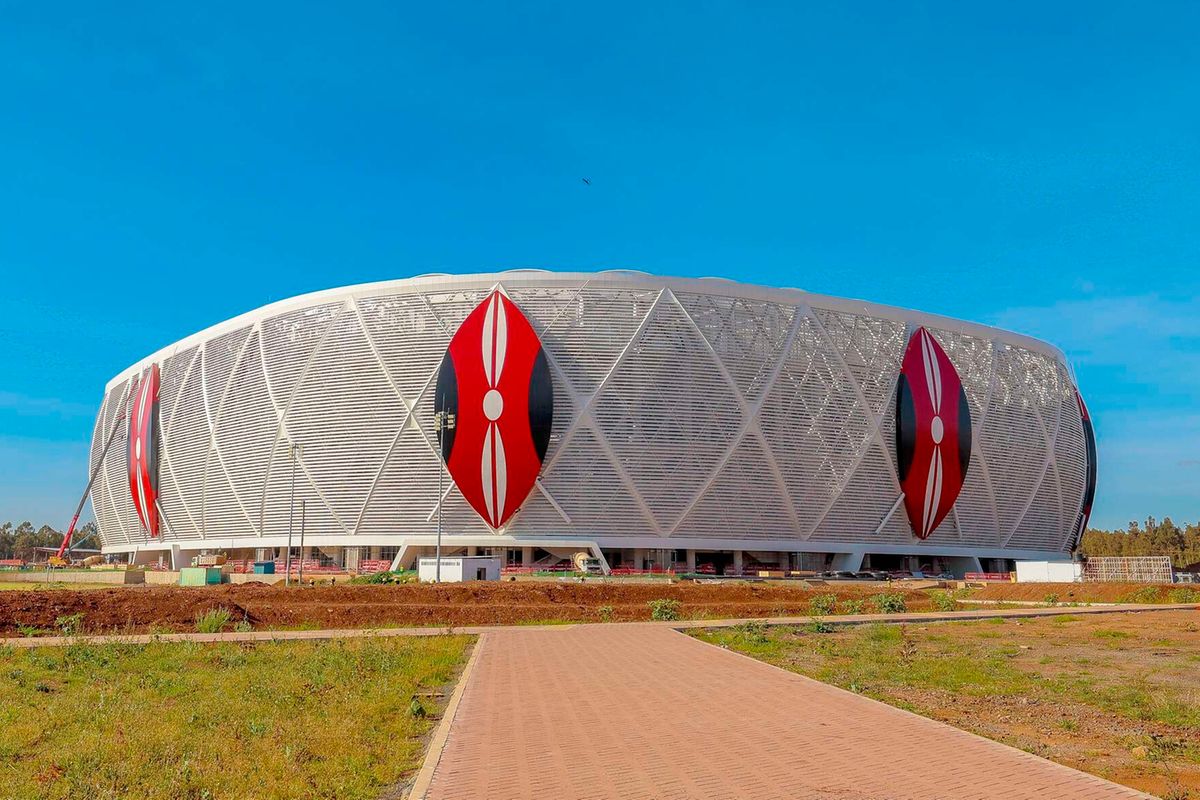
The 48,000-seater Moi International Sports Centre (MISC) Kasarani and the 60,000-seater Talanta Sports City are the tournament’s match venues in Kenya. The training grounds are Ulinzi Sports Complex, Nyayo National Stadium, Police Sacco Stadium, MISC Kasarani Annex “A” and “B”, Kenya Academy of Sports “A” and “B”, Kenya Utalii Sports Ground and Talanta Sports City Annex 1, 2 and 3 and Kirigiti Stadium in Kiambu. CAF’s report on the preparedness by the co-hosts following its February 2025 inspection stated that a minimum 80 per cent physical completion must be achieved by the time that the August inspection takes place.

The Talanta Stadium in Nairobi that is under construction in this picture taken on February 8, 2026.
Photo credit: Billy Ogada | Nation Media Group
While the construction of Talanta Sports City crossed the 90 per cent mark in May 2026, the renovation of MISC Kasarani to international standards is behind schedule. Replacement of the playing surface is among the upgrades, which are currently underway. Although Musonye admitted that the progress of renovation work at MISC Kasarani is a concern, he exuded confidence that they will have made great strides by the time CAF inspectors arrive in the country.
“My worry as I talk to you now is Kasarani. By the end of this week, a lot of things will have been done there to ensure that by the time CAF inspectors come, they will be satisfied that we are honouring their requirements,” said the veteran football administrator.
Regarding CAF’s requirement for the construction of 61 sky boxes at MISC Kasarani, Musonye said his team had informed CAF that they will maintain 14 sky boxes present at the venue, since adding others would be costly and could interfere with the structural integrity of the stadium.
Apart from sky boxes, CAF’s other key requirements for Afcon venues are: installation of a modern natural grass pitch with a proper drainage system, automatic irrigation, lighting of between 2,500 and 3,000lux, presidential area with a seating and private lounge, VVIP and VIP areas each with a seating and private lounge for at least 250 and 500 persons respectively.

An aerial view of Nyayo National Stadium.
Photo credit: File | Nation
The others are four dressing rooms for the players of equal size, two referee dressing rooms, including facilities suitable for female referees, press conference room with 100 to 200 seats, media center with a minimum capacity of 100 seats, media tribune with at least 300 seats, including 10 commentator positions accommodating three seats each, 120 desk positions for written press, 130 free seating positions for media, and 20 observers seats.
Out of the 12 training grounds that Kenya has earmarked for the tournament, only three grounds at Talanta Sports City are currently being developed.
On June 22, Sports Cabinet Secretary Slim Mvurya handed over the three training grounds to the Ministry of Defence for refurbishment to international standards.
Stating that the renovation of the training grounds requires minimal work, Musonye said that renovation work at Kasarani Annex 1 and 2 would start later this week, since pending issues concerning the contract had been addressed.
“The contractor met with the relevant authorities last week to harmonise payments and other details so I know by the end of this week, a lot of things will also happen on the training grounds,” Musonye said.
He gave an assurance that renovation of the other training venues will be completed in good time. CAF’s requirements for training grounds include: venues must be secured and protected from public view, they should be of the same surface type and dimensions as the competition pitches, and have a minimum lighting of 500 lux. They must have a dedicated team drop-off parking area, two dressing rooms with 25 lockers each, and team benches and shelters. They must also provide separate access for media and include training equipment and sports equipment.
On the governance milestones to be achieved by the time the August inspection happens, CAF stated that the LOC across the three countries must be fully operational. Regarding the cross-border movement, a working group must have been formally established by August. Additionally, a practical roadmap on cross-border movement approved by the governed must be in place and the drafting of the legal framework initiated.
On operations, the framework for transport, team services, and security must be confirmed, procurement for suppliers must be underway, and a credible and documented delivery model must be in place.
On finance, government funding commitments must be confirmed in writing, the expenditure schedule agreed on and signed, and the baseline submitted to CAF.
Musonye revealed that when the LOC met President William Ruto on July 9, 2026, the matter of free entry visa for fans and other stakeholders during the tournament was approved. He said Tanzania had done the same and they are only waiting for a confirmation by Uganda before sending a communique to CAF.
“We were invited by the Head of State, and the issue of free entry visa for Kenya was approved. Tanzania has also been approved. We are only waiting for communication from Uganda so that we issue a joint communique to CAF that cross-border movement and free entry visa for all people in our region is guaranteed,” said Musonye.
On security, he said they have constituted a strong 25-man security committee and submitted the details to CAF. The team has stakeholders from the security sector.
“We have not left any security sector out. The safety of our visitors during the tournament is very crucial,” he said, adding that the Ministry of Sports is in charge of suppliers and procurement. On financial commitment, Musonye said the government had paid Caf Sh3.9 billion hosting rights fee. He remained confident that the LOC would secure the budget to run its operations.
In May, Sports Principal Secretary Elijah Mwangi said the LOC was grappling with a funding gap of Sh5.7 billion. Mwangi told the National Assembly’s Committee on Sports and Culture that the LOC’s budget had been revised to Sh7.2 billion from an initial Sh3.5 billion. However, it had only been allocated Sh1.5 billion in the 2026/27 Budget Estimates.
Follow our WhatsApp channel for breaking news updates and more stories like this.