

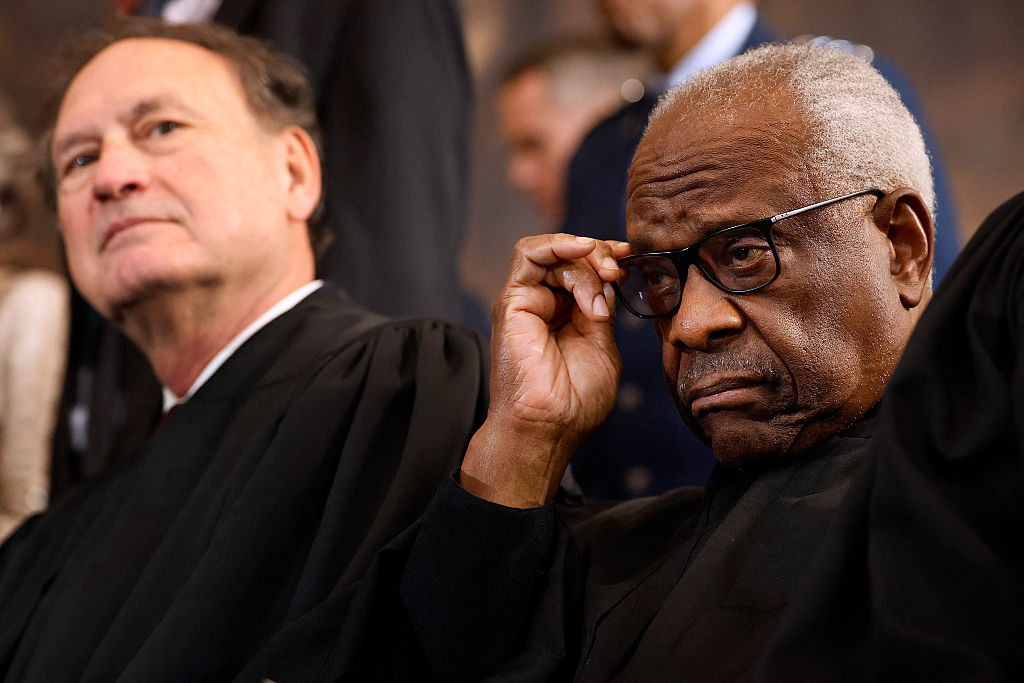
If Justices Clarence Thomas or Samuel Alito retire after the midterms, Senate Republicans could move to confirm their replacements before a new Congress takes office in January, potentially reshaping the Court for decades.
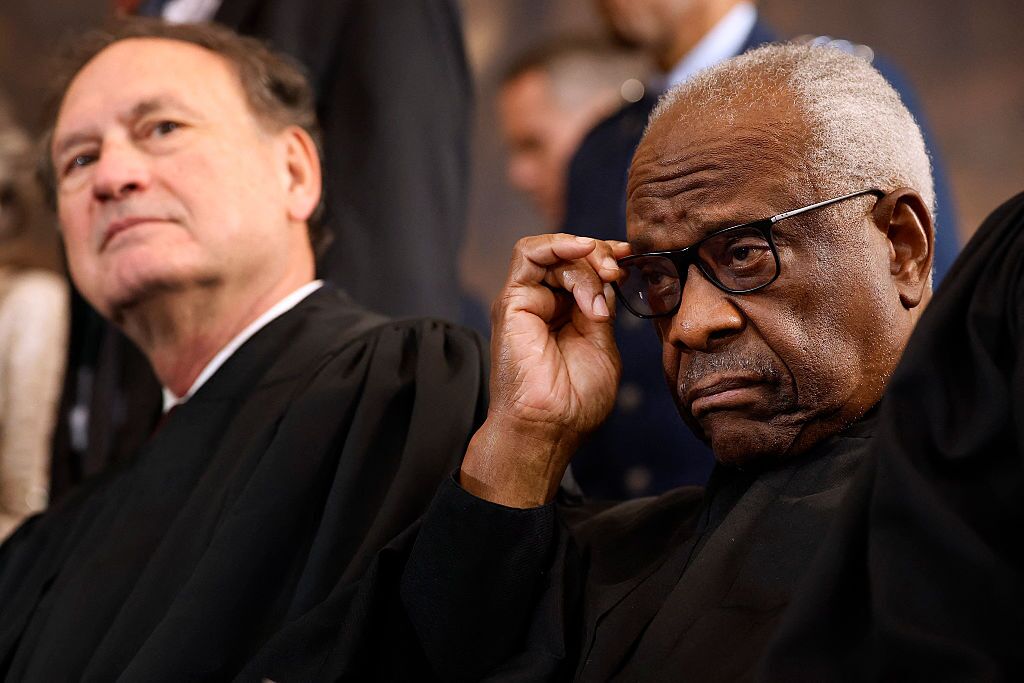
If Democrats retake the U.S. Senate after the (ongoing) midterm elections, we should expect any number of drastic reactions from Republicans desperate to cling to power. Among them could be a last-ditch effort to extend their control of the Supreme Court by rushing a lame-duck confirmation process in November or December, should Justices Clarence Thomas and/or Samuel Alito (ages 78 and 76, respectively) see it as their last chance anytime soon to be replaced by another conservative.
As we fight to protect our democracy, we must be ready to hold the line.
Any of the justices could announce in November their intention to retire at the end of the term next summer, thereby opening the vacancy to be filled immediately.
Sure, it would be a challenging effort after a long campaign season, and Republicans are likely to still have the votes to replace either of the most conservative justices with a younger successor before the end of 2026.
But even just for trying, this would massively backfire for the conservatives in the long term.
There hasn’t been a lame-duck Supreme Court confirmation since the 19th century—well before the 12th Amendment standardized the congressional calendar. Such a move would no doubt be seen by the American people as a desperate and unprecedented effort to manipulate the membership of the Supreme Court by bending the rules when it suits them.
Moreover, Republicans’ success could become largely irrelevant if Democrats follow through on reforming the Supreme Court after retaking power.
Support for Supreme Court reform is higher than ever. A recent Marquette Law School poll found massive endorsements for the three most prominent reforms: 89 percent for a strict ethics code, 79 percent for term limits and 53 percent for increasing the number of justices on the bench.
Such support would surely only grow in the face of Republicans blatantly attempting to lock in control before losing power.
Recall when the Republican-controlled House recently considered a hopeless constitutional amendment to limit the number of justices to nine, they received only one vote from a Democratic representative.
A future administration would be poised to rein in the out-of-control Supreme Court that has eroded our civil rights for decades.
Even with two younger conservative justices on the bench, Congress has the power to expand the number of seats and allow a Democrat president to create a liberal majority on the bench for the first time since 1969. Structured term limits would likewise make it harder for future Republicans to rig the court as they have over the past few decades.
Any lame-duck confirmation would not only become moot but would fuel the very democratic court reforms Republicans fear.
A frantic lame-duck Supreme Court fight would only demonstrate Trump’s desperation to cling to his authoritarian power, and it’s a fight Democrats could potentially win.
What would a lame-duck confirmation process look like? Any of the justices could announce in November their intention to retire at the end of the term next summer, thereby opening the vacancy to be filled immediately.
Justice Stephen Breyer similarly announced his retirement in January 2022, set to take effect that June, and the Senate confirmed Justice Jackson on April 7, months before the retirement took effect. Thomas or Alito could follow the same process, with the Senate quickly confirming their successor(s) before Jan. 3 when the new senators are seated.
Justice Alito may have recently stated he’s not planning to retire during this term, but there’s every reason to still believe he could announce at any time that he’s retiring at the end of the term and still trigger the nomination process.
Given the other Trump picks this Republican-controlled Senate has greenlit, the Republican senators would likely not be cowed by their rejection at the polls. Not even Sens. Bill Cassidy (R-La.) and John Cornyn (R-Texas), who lost their primaries to Trump-backed challengers, nor Sen. Thom Tillis (R-N.C.), who isn’t running for reelection, were willing to vote against Todd Blanche, Trump’s personal lawyer, for attorney general—despite clear indications of Blanche’s intentions to further corrupt the Department of Justice toward Trump’s personal vendettas.
Senate Republicans have rubber-stamped Emil Bove, Justin Smith and Matthew Schwartz to powerful seats on the federal courts of appeal. All of them have personally defended Trump in criminal and civil matters and now can wield the power of the courts to protect Trump even when he abuses his presidential power in the most unconstitutional of ways. They have extremely conservative views, ready to carry forth the MAGA agenda long after Trump is in office (or likely even alive).
We should expect a Trump 2.0 Supreme Court nomination to follow a similar model.
Trump has issued many tantrums over the years when his first-term appointees Justices Neil Gorsuch, Brett Kavanaugh and Amy Coney Barrett have not ruled in his favor, even recently admitting that he regrets nominating them. He won’t make the same mistake twice and will instead appoint someone with proven allegiance to his will, of which he has many options. Even the lower-court judges Trump has appointed this term (who weren’t his personal attorneys) have demonstrated their loyalty through their records and by refusing to answer simple questions during their hearings about who won the 2020 election and whether Jan. 6 was an attack on the Capitol.
Even if there is a lame-duck Supreme Court nomination, a Senate controlled by Democrats could limit Trump’s ability to see any more of these extremist judges—including Supreme Court justices—confirmed during the last two years of his term, preventing untold harm to our democracy and the rule of law. A frantic lame-duck Supreme Court fight would only demonstrate Trump’s desperation to cling to his authoritarian power, and it’s a fight Democrats could potentially win. More importantly, regardless of the outcome, it would be clear that Republican lawmakers care more about imposing their own will than respecting the will of the voters.
We are ready for this fight, and we are well-positioned to give the Court the modernizing overhaul our republic deserves. Whatever might happen in the lame duck, voters should show up to the polls like our courts and democracy depend on it. Republican senators have already done so much damage to our courts by filling them up with more than 50 of Trump’s most loyal lieutenants. We can and must stop the harm being done to our democracy under this administration, even if it means one final fight for the fate of our justice system.
After that, we can finally fix our broken Supreme Court and end the corrupt conservative justices’ attacks on our civil rights and the rule of law.
*
A note from Ms. editors: We want to hear from you for The Majority, a new campaign collecting stories about how reproductive freedom has enabled readers to build the lives they want and need.

Poll after poll shows a majority of Americans support reproductive healthcare access. Yet public debate overlooks the lives shaped by abortion access, contraception, IVF, miscarriage care, maternal healthcare or comprehensive sex education—countless women who chose to pursue an education, have children, not have children, protect their health and chart their own future. What’s your reproductive freedom story? Add your voice. Together, these stories will help show not only why reproductive freedom remains a majority value, but also what it makes possible.