
Kolby KickingWoman
ICT
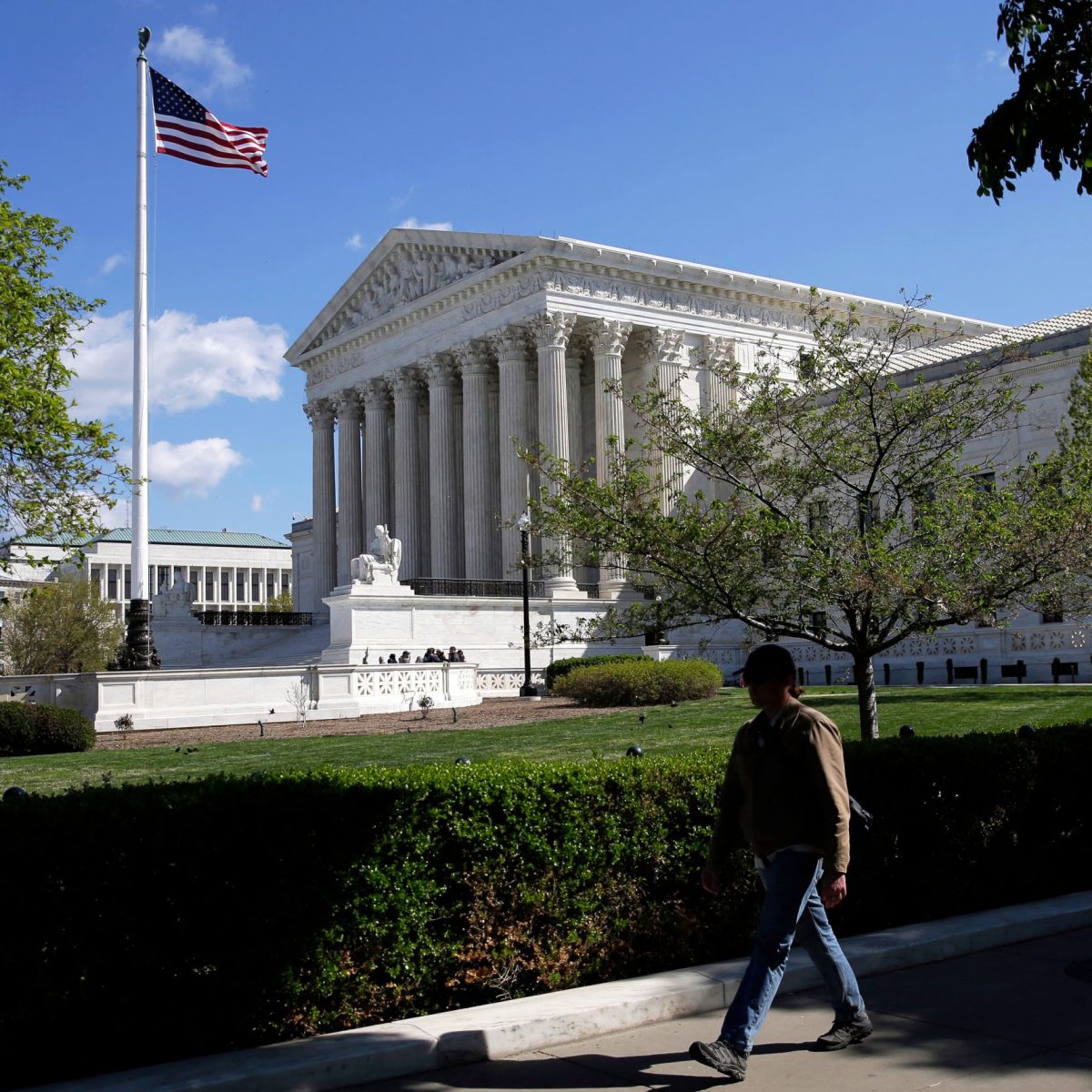
In the long and complicated history of the United States and tribal nations, the nation’s highest court has inserted itself across multiple chapters.
From cases establishing the principles of federal Indian law to tribal sovereignty to Native children and religion and much more, the Supreme Court has left indelible marks on Indian Country.
Originally established through the Constitution, the court didn’t start taking shape until the passage of the Judiciary Act of 1789, with its first assembly in 1790.
On average, the Supreme Court hears one to three federal Indian law cases in any given term. Among the three branches of government, the institution sits behind the executive and legislative branches in terms of importance of relationship to Indian Country, said Matthew Fletcher.
“The closest relationship is with the executive branch for the Department of the Interior, and probably the most important one is Congress, because Congress makes the laws,” said Fletcher, a citizen of the Grand Traverse Band of Ottawa and Chippewa Indians and a Harry Burns Hutchins Collegiate Professor of Law at the University of Michigan. “The only rule that the Supreme Court has is to enforce the laws that Congress makes for treaty rights, so I mean they go a little bit further than that, but since they only hear like one case a year on average.”
With that in mind, the relationship between Indian Country and the high court has had its ups and downs, with more of the latter, over the 250 years since the Declaration of Independence. The fraught connection between tribes and the Supreme Court can be due to a lack of understanding of tribes, tribal governments and a skepticism of tribal sovereignty.
“The Supreme Court’s job is to interpret the Constitution and there’s almost nothing in the Constitution to interpret in relation to Indian affairs,” Fletcher said. “The Constitution doesn’t apply to tribal governments, so you would think there’s not a lot for the Supreme Court to do but they interfere regularly in the internal workings of tribal nations.”
Fletcher argues that all eras of the Supreme Court have been terrible for tribal nations to some degree.
“It’s a bloodbath, and I think the worst, absolute worst period of time starts during the ’70s and goes up to about 2014. Just a brutal period of time for tribal interest in the Supreme Court. The court basically just decided it was going to run Indian Affairs from the bench and that was a really particularly bad time for tribes at the Supreme Court.”
Despite being dealt a number of losses, tribes have also been resilient in the face of those setbacks. When the Supreme Court issues narrow opinions or undermines efforts of the Interior Department to fulfill trust responsibilities, Indian Country finds a way.
“A tribe or a group of tribes can lose a really terrible case in the Supreme Court, but they figure out a way, figure out a way to get around it, and that’s really quite remarkable. Sometimes they have to go to Congress and get an act of Congress to reverse it or overturn it and I’m frankly shocked at how often tribes are able to do that,” Fletcher said.
Tribal leaders and scholars agree that it’s important to ensure Supreme Court nominees understand the legal framework that defines the relationships between tribes and the federal government and states.
Justices who don’t understand this legal framework are easily swayed by anti-tribal interests.
One justice who has taken it upon herself to learn and study federal Indian Law is Justice Sonia Sotomayor, who was appointed by former President Barack Obama, Fletcher said.

“She takes it seriously, so she does her research, she tries to find fair and balanced materials to cite to, she takes tribal arguments seriously, and she writes about that,” he said. “Often she’s writing not in the majority, especially early on in the 2000s and the early 2010s, but she forced the rest of the court to become a little bit more intellectually honest, and that to me is a huge part of this. She actually is educated.”
Another justice more recently appointed with a better understanding of federal Indian law than his colleagues is Justice Neil Gorsuch. Prior to the Supreme Court, Gorsuch worked for the U.S. Court of Appeals for the Tenth Circuit, which includes Colorado, Kansas, New Mexico, portions of Oklahoma, Utah and Wyoming – states with large numbers of tribes and Indigenous people.
He notably authored the opinion in McGirt v. Oklahoma with the first few sentences quoted across Indian Country after the opinion came down.
“On the far end of the Trail of Tears was a promise. Forced to leave their ancestral lands in Georgia and Alabama, the Creek Nation received assurances that their new lands in the West would be secure forever,” Gorsuch wrote.
Across the eras of the Supreme Court, there was often at least one justice with significant federal Indian law knowledge, Fletcher said.
“Every era of the court has one justice who kind of knows a little bit about Indian law and seems to be sympathetic and pays attention but usually are very ineffective,” he said. “I’m thinking of Justice [John Paul] Stevens, who was on the court during the end of the 20th century, same with Justice [Harry] Blackmun. There was a guy from my own law school, University of Michigan, named Frank Murphy, right around the World War II era, and before he was actually pretty good at Indian law, but other than that, not much.”
On the other side of the coin are justices who seem to incessantly rule in opposition to tribes. On the current court, Justices Brett Kavanaugh, Samuel Alito and Clarence Thomas more often than not rule against tribal interests.
During his tenure, Thomas, in particular, has seemed inclined to curtail tribal sovereignty.
“Justice Thomas has written probably close to a dozen separate writings since 2004. None of them are majority opinions and none of them are joined by any other justice, but he would eradicate the power of Congress to legislate Indian affairs,” Fletcher said. “He would gut the trust responsibility and he would eliminate tribal sovereignty. He’s stated all three of those things repeatedly. I would say he’s probably the worst one, but the saving grace is nobody goes along with him because he’s basically crazy. I mean, his positions are so far from the mainstream and so kind of pathetically sourced. I mean, they don’t make any logical sense and they’re not rooted in the history and tradition of the Constitution, so we don’t have to pay that much attention to him.”
Here are a handful of significant Supreme Court cases as it relates to tribes and Indian Country.
The Marshall Trilogy
Johnson v. McIntosh, 1823
The principles of the Doctrine of Discovery incorporated into United States law. Diminished tribal sovereignty as a result of the United States being “discovered.”
Cherokee Nation v. Georgia, 1831
The court ruled that tribes are not foreign states. Chief Justice Marshall’s opinion stated that tribes are “domestic dependent nations,” whose relations with the U.S. resemble that of a “ward to his guardian.”
This opinion by Justice Marshall is the origin of the trust doctrine in federal Indian law and defines the federal government’s responsibility to act on behalf of tribes
Worcester v. Georgia, 1832
The court found that Georgia’s laws “have no force” in Cherokee territory. Marshall defines tribes as “distinct political communities, having territorial boundaries within which their authority is exclusive.”
Marshall notes the Constitution gives Congress the exclusive authority to regulate Indian affairs.
Ex Parte Crow Dog, 1883
The court determined that the United States did not have criminal jurisdiction over crimes committed by one tribal citizen against another.
In response, Congress passed the Major Crimes Act in 1885, granting the federal government with “criminal jurisdiction over a set of enumerated ‘major’ crimes committed within Indian Country by one Indian against another.”
Carcieri v. Salazar, 2009
Relating to the Secretary of the Interior acquiring land and holding it in trust, the court found that the secretary could only do so for tribes that were federally recognized in 1934 under the Indian Reorganization Act.
If a tribe was not federally recognized in 1934, it was not entitled to have land taken into trust on its behalf.
Oliphant v. Suquamish Indian Tribe, 1978
The court ruled tribes do not have criminal jurisdiction over non-Indians who commit crimes within reservation boundaries and that the power to do so was divested by treaties and Congress.
California v. Cabazon Band of Mission Indians, 1987
The court ruled that state gambling laws that restricted gambling could not be applied to tribes. While Public Law 280 granted some states criminal jurisdiction on tribal lands, gambling is civil and regulatory in nature.
In response, Congress passed the Indian Gaming Regulatory Act in 1988, which divided gaming into three classes and outlined the tribes’ and states’ discretion in accepting or rejecting gaming on tribal land.
McGirt v. Oklahoma, 2020
The court ruled that a large portion of eastern Oklahoma remains tribal land, saying Congress never explicitly “disestablished” the 1866 boundaries of the Muscogee (Creek) Nation.
The decision was later limited in Oklahoma v. Castro-Huerta in which the court handed down an opinion that the state of Oklahoma has concurrent jurisdiction and the ability to prosecute non-Natives when the victim is Native and the crime is committed on tribal land.
This <a target=”_blank” href=”https://ictnews.org/news/america-250-tribal-nations-and-the-supreme-court/”>article</a> first appeared on <a target=”_blank” href=”https://ictnews.org”>ICT</a> and is republished here under a <a target=”_blank” href=”https://creativecommons.org/licenses/by-nd/4.0/”>Creative Commons Attribution-NoDerivatives 4.0 International License</a>.<img src=”https://i0.wp.com/ictnews.org/wp-content/uploads/2025/05/cropped-Favicon-Larger-Icon-.png?resize=150%2C150&ssl=1″ style=”width:1em;height:1em;margin-left:10px;”>
<img id=”republication-tracker-tool-source” src=”https://ictnews.org/?republication-pixel=true&post=330142&ga4=G-YFS314KT4J” style=”width:1px;height:1px;”><script> PARSELY = { autotrack: false, onload: function() { PARSELY.beacon.trackPageView({ url: “https://ictnews.org/news/america-250-tribal-nations-and-the-supreme-court/”, urlref: window.location.href }); } } </script> <script id=”parsely-cfg” src=”//cdn.parsely.com/keys/ictnews.org/p.js”></script>