
New Yorkers can’t record officers in police station lobbies under state law, the Court of Appeals ruled last week, drawing ire from civil rights attorneys and elected officials who say the decision ignores what the state legislation in question, which some of them helped write, was trying to accomplish.
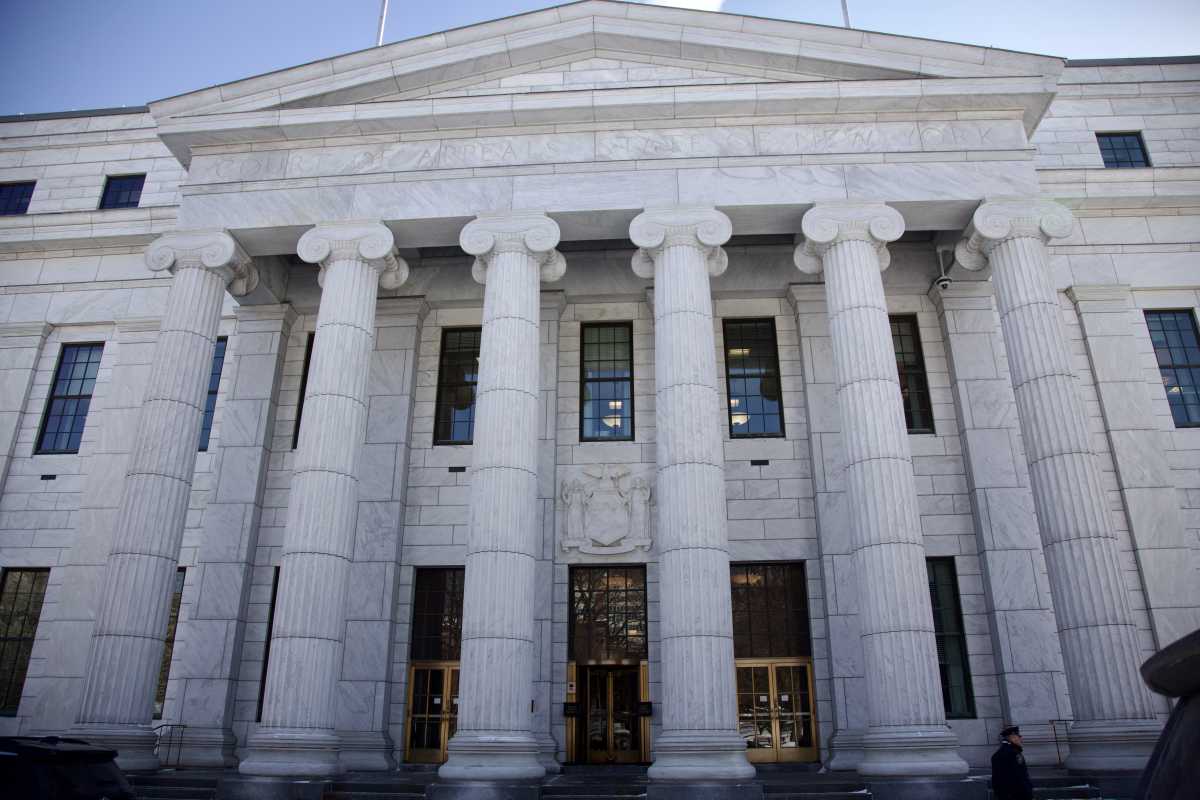
In a unanimous opinion written by Associate Justice Jenny Rivera, the state’s highest court ruled that because laws that permit recording police in public places, known as Right to Record Acts, don’t explicitly say people are allowed to record in public police station lobbies, people can’t capture video of officers there.
“We clarify that the New York State and City laws that codified a private right to record police activities do not apply inside a police stationhouse, including its publicly accessible lobby,” Rivera writes. “Surely, the State Legislature and City Council did not intend to invade personal privacy interests and jeopardize law enforcement and public safety by extending video recording to publicly accessible precinct lobbies, at least not without expressly stating so.”
The case stems from a suit brought by SeanPaul Reyes, a self-described independent journalist who posts videos under the name LongIslandAudit. Reyes sued after NYPD officers told him he couldn’t record police in a Queens precinct lobby in 2023, even after he cited the Right to Record Acts.
Rivera harped on the fact that the state and city laws, known as Right to Record Acts, don’t explicitly include where people are allowed to record police beyond saying that the recording is allowed in public places. She also said nothing in the legislative history – the public record associated with passing the laws – demonstrates that the laws were meant to include police precinct lobbies.
“The legislative history, read as a whole, establishes that the [laws] were not enacted to ensure the right to record in police stationhouses and precinct lobbies,” Rivera writes. “Police stationhouses were not the topic of legislative discussion at all.”
Public Advocate Jummane Williams, who introduced the state’s Right to Record Act legislation, told amNewYork after the decision came down that he had absolutely intended for the bill to include the right to record police in public precinct lobbies and found the court’s reasoning “nonsensical.”
“This was an important bill. Our intention is clear. Why we’re doing it is clear,” Williams said. “We’ve seen that recording can actually help everyone.”
The state and city laws were passed in the wake of the 2020 protests against police violence in an effort to ensure people would feel empowered to document police actions to hold officers accountable.
“There are a lot of things that can happen in police lobbies,” Williams said. “There could be misconduct for many things. There could be the type of misconduct that makes the news where somebody’s harmed, or it could be the type where people are just not getting this type of service that they should be getting.”
Civil rights attorneys from the New York Civil Liberties Union and the Latino Justice Project, which represented Reyes, said they believe the legislative history – and the text of the bills – did in fact suggest legislators passed them with the intent to permit people to record in police precincts.
“The court’s decision in this case is deeply disappointing, and the rationale for it is both troubling and ignores many of the facts that led to the passage of the Right to Record Acts in the first place,” NYCLU staff attorney Veronica Salama said. “When you look at their purpose, which is to give individuals the ability to document their interactions with the police … that the [laws] would exclude an area where the public regularly interacts with the police, in police station houses, is absurd.”
“ These are spaces intended for regular interaction between the police and the public,” Salama continued. “We know that misconduct occurs in police station houses.”
What’s more, the civil rights attorneys told amNewYork, they found this reasoning used by the high court troubling: If the law says “public places,” but doesn’t list out every public place that exists and that results in a court accepting arguments that exclude certain public places, they’re concerned that will that result in more judges agreeing with bad faith arguments to narrow what rights laws provide people just because every possible application of a law hasn’t been spelled out.
Williams agreed, saying that he was also “concerned” by this possibility and that bills would be “hundreds of pages long” if they included every possible scenario they might be applied in.
Former city attorney Stephen Louis said he doesn’t think that will be the case. He told amNewYork he found the high court’s decision reasonable and doesn’t think it’s going to have an adverse effect on future legislation or the interpretation of legislation. If the legislature had intended for people to be able to record in police precincts, he said, it’s a good reminder to legislators to ensure they’re being clear when they write laws so they’re certain their statutes will do what they want them to.
“The court was looking at a fairly narrow question about what these laws meant,” said Louis, who’s now a New York Law School professor. “I don’t find this crazy at all. At the end of the day, the law still applies to the more obvious scenarios, on the street, where it’s totally public. You don’t want the police doing what they had been doing sometimes, which was basically blocking third parties from filming, what’s been going on, so this seems to be a decent balance to me.”
Louis also said he felt the high court’s concern that recording in police precincts could create privacy and safety concerns for crime victims or domestic violence survivors coming into a station to report wrongdoing or request an order of protection was a valid one.
“Plaintiff’s interpretation of the RTRAs leads to absurd results,” Rivera writes. “[The] contention that the [laws] apply to precinct lobbies implicates significant privacy concerns … Video recording and dissemination of individual stationhouses located throughout the State could reveal confidential investigative information and jeopardize officers’ strategic responses to criminal activity.”
Civil rights attorneys said they don’t think that reasoning is realistic. There are private rooms for people with sensitive matters, like domestic violence, to speak with police in, they said, and if someone was so intent on recording a person recording a crime, they could do so on a public sidewalk as the person walked in.
What now?
Though there’s no higher court for attorneys to appeal this decision, the case over whether people can legally record in police station lobbies isn’t entirely closed.
This decision comes in an appeal from the case filed in Manhattan’s federal court, which asked the Court of Appeals to consider only half of the arguments in it. The question over whether the First Amendment protects people’s ability to hit record when they walk into a station is still open, and one the Southern District of New York is actively considering.
The courts, however, don’t seem to think that argument is going to work out so well for Reyes. Rivera cites a ruling from a Manhattan federal court judge that permitted the appeal on the state law question to move up through appellate divisions, where the court says it thought Reyes had a better chance of winning on his claim that the Right to Record Acts allowed this type of recording than the one that the First Amendment allowed him take video.
“[Manhattan federal] court concluded that plaintiff was unlikely to succeed on his First Amendment claim under a public forum analysis but likely to succeed on both [Right to Record Act] claims, holding that the [laws] ‘go beyond the protections of the First Amendment’ and contained no carve-out for precinct lobbies,” Rivera writes.
But, it might not matter what the courts have to say in this case. If legislators really want people to be able to record in police precincts, they can pass a new law that explicitly says people can do so.
Williams told amNewYork he’s considering working with legislators to do so in a way that accounts for the privacy concerns raised.
“I think we’re going to try to see if we can have some legislative fixes here in the future,” Williams said. “But, I am concerned that it’s going to be interpreted in bad faith again, that they may still try to get a workaround or redefine what public spaces are. But, we’re going to try to make sure that we can write the legislation in a way that that can’t happen.”