
To: Canada and the International Community
Iranian authorities committed the crimes against humanity of murder, torture, rape and other forms of sexual violence, enforced disappearance, imprisonment and persecution while undertaking a campaign to crush the September to December 2022 Woman Life Freedom uprising. This was a widespread and systematic attack against a civilian population demanding human rights and fundamental political change.
It became state policy to use lethal force to eradicate dissent. Iranian authorities unlawfully killed hundreds of protesters and bystanders, including dozens of children. Thousands more were subjected to arbitrary detention, enforced disappearance, torture and other ill-treatment. Rape and other sexual violence was perpetrated against some of those arrested, including children. Families of those killed faced persecution.
Systemic impunity has emboldened the Iranian authorities to commit further atrocities. The unprecedented mass protest killings of thousands in less than 48 hours in January 2026 bear the same hallmarks of the crimes against humanity in 2022, but at an even more staggering scale.
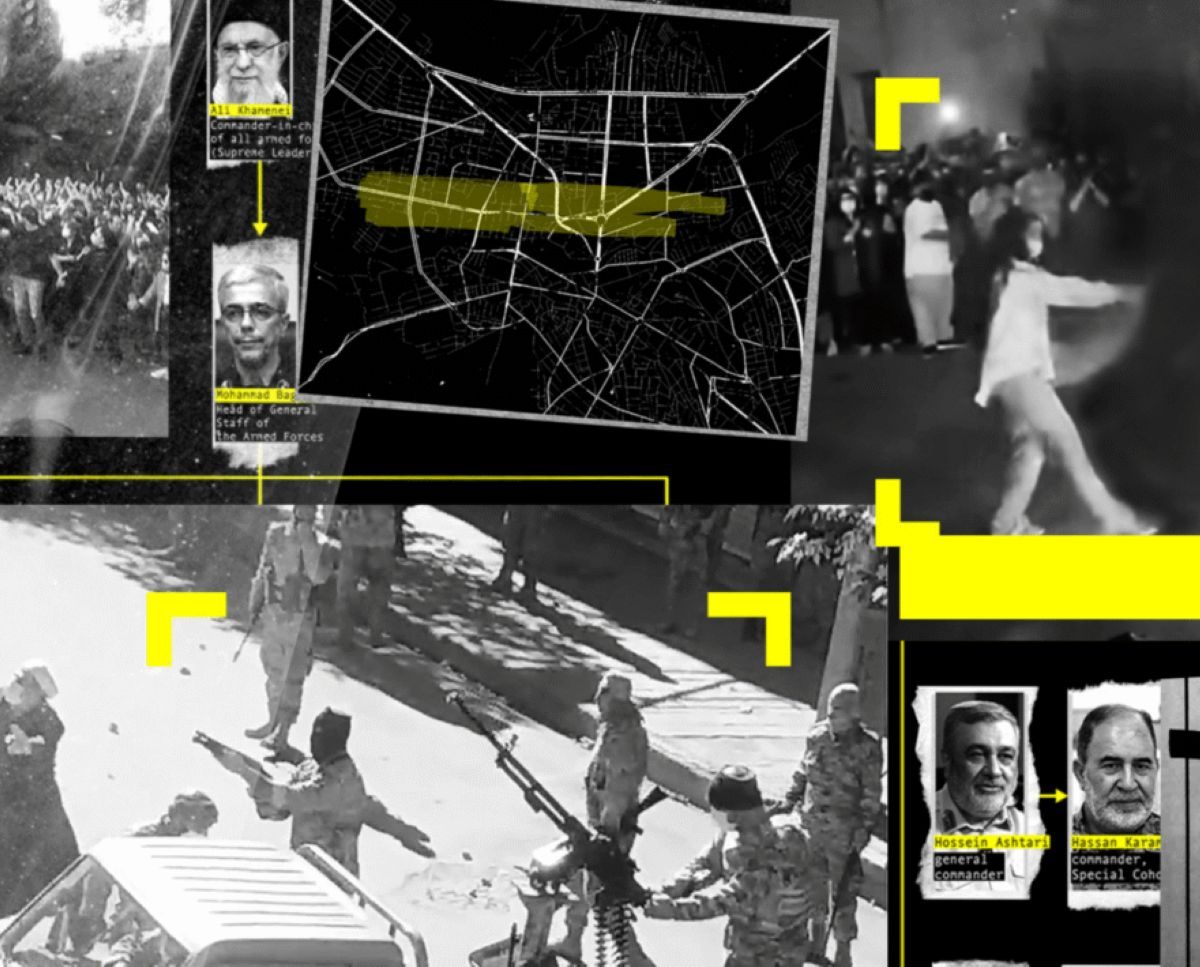
The security forces leading the violent dispersal of protests included the Police Command of the Islamic Republic of Iran (known by its Persian acronym, FARAJA) and the Islamic Revolutionary Guards Corps (IRGC). They implemented strategies devised by the Supreme National Security Council, the State Security Council, and provincial and county provision councils, and enforced by the minister of interior and provincial and county governors.
Impunity is built into the constitutional, political, legislative and judicial frameworks of the Islamic Republic system. The constitution, reinforced by numerous laws and policies, intertwines the judiciary with the security apparatus, ensuring they operate in unison to suppress dissent. The constitution places the judiciary under the direct control of the Supreme Leader, who is not only the commander-in-chief of the security forces, but also appoints the head of the judiciary, who in turn appoints senior judges and prosecutors.
Iran’s legislation criminalizes peaceful assembly, permits the use of unlawful lethal force to disperse protests and generally exempts state agents from civil and criminal liability.
Given the lack of prospects for truth, justice and reparations domestically, the gravity and scale of crimes committed and the high risk of recurrence, we urge the international community to adopt a meaningful approach to atrocity prevention and internationalize justice efforts for the crimes against humanity committed in Iran including by:
• Creating an international criminal justice mechanism aimed at prosecuting those most implicated in crimes against humanity in Iran, acting through the UN General Assembly;
• Calling on the UN Security Council to refer the situation in Iran to the Office of the Prosecutor of the International Criminal Court; and
• Undertaking criminal investigations, under universal or other forms of extraterritorial jurisdiction, against Iranian officials allegedly responsible for crimes against humanity and other crimes under international law, including those named in the enclosed annex, with a view to issuing arrest warrants and pursuing prosecutions where sufficient evidence exists.
Any further delay by the international community in pursuing international justice dangerously contributes to the normalization of mass protest killings in Iran and heightens the risk of future atrocities.