
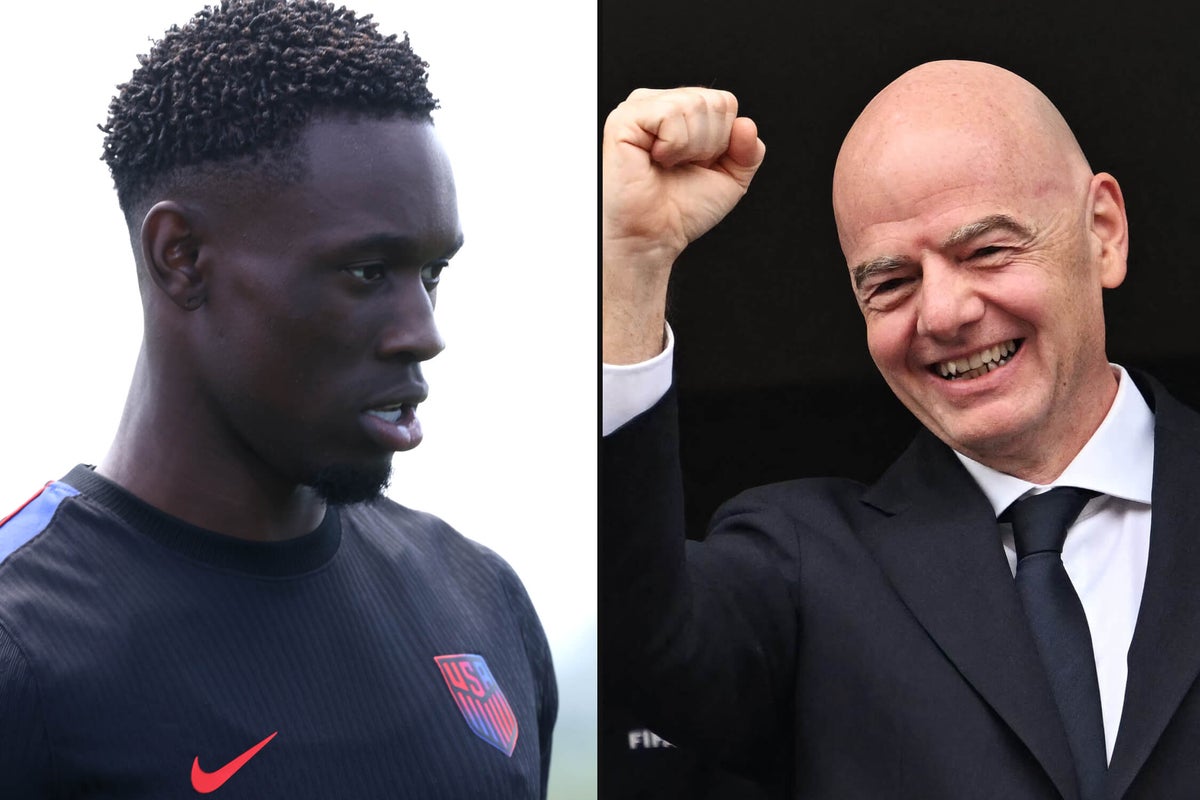
After The Athletic revealed that Folarin Balogun’s one-game ban for his red card against Bosnia and Herzegovina was being suspended, allowing him to play in the United States’ World Cup round of 16 tie against Belgium, French newspaper L’Equipe reported that France will try to get Michael Olise’s yellow card from their game against Paraguay at the same stage of the tournament wiped from the disciplinary slate, too.
Might as well. He’s a famous player at this World Cup. Chance your arm. Ask FIFA nicely and solemnly suggest that it’s probably bad for the product if a famous player isn’t playing at the tournament. That argument has seemingly worked out quite nicely for the USA.
U.S. Soccer made an official complaint to FIFA but the White House also confirmed to The Athletic that U.S. President Donald Trump called his FIFA counterpart Gianni Infantino and asked for the decision to be reviewed.
Get free access to the most comprehensive World Cup coverage in The Athletic app
Balogun is now available to the co-hosts for their match on Monday (early Tuesday UK time).
Trump posted on Truth Social to thank “FIFA for doing what was right, and reversing a great injustice!”
Job done.
The Belgian FA spoke for most of us when it released a statement saying it was “astonished”, also pointing out that “Article 66.4 of the same FIFA disciplinary code clearly provides that a red card (sending-off) automatically results in a suspension for the team’s next match, as has been the case for all previous red cards issued during this FIFA World Cup”.
Speaking later at a press conference to preview the game against the Americans, their head coach Rudi Garcia said: “The Belgian federation isn’t just defending itself or the national team; it’s defending football in general — its integrity and its ethics.”
UEFA, European soccer’s governing body which has often clashed with FIFA, did not waste the chance to take aim too. They described the decision as “incomprehensible” and “crossed a red line”.
Flo Balogun’s red card is being suspended. Here’s why that’s controversial.
Henry Bushnell and Jayne Orenstein
A decision like this clearly raises questions over the integrity of world football’s biggest event.
Maybe we shouldn’t be particularly surprised. After all, Cristiano Ronaldo should have been banned from the first two games of this tournament after being sent off for violent conduct against the Republic of Ireland in the qualifiers. That little pre-tournament amnesty also allowed Argentina’s Nicolas Otamendi and Moises Caicedo of Ecuador to play, with their suspensions also waived.
The Ronaldo decision was partly justified on the basis that he had never been sent off in international football before, but also so the teams in question “can compete with their strongest possible squads on the biggest stage of men’s international football”.
This has been the ratings World Cup, the tournament most impressed by celebrity in the game’s history. Watch any game on TV and wait for a slight lull in play so that the cameras can cut to a famous person in the crowd. Tom Cruise, Brad Pitt, Shakira, Penelope Cruz, Rosalia, David Beckham.
And this is the case on the pitch too. Balogun has been the USMNT’s standout player of a finals that seem to have captured the American imagination like no other before it. Perhaps the real fools are those who naively assumed that he would actually be suspended against Belgium after being sent off in the win over Bosnia and Herzegovina.
Balogun was the 12th player to receive a red card at this World Cup. All the others either served a suspension at the tournament or, because their team were eliminated, will do so in their next competitive game(s).
But almost all of those were players most people haven’t heard of.
Probably the most famous was Miguel Almiron, who was notably dismissed for covering his mouth during Paraguay’s second group match against Turkey. He was consequently banned for the meeting with Australia in match three, which they drew 0-0, meaning they finished third in their group. That meant they faced Germany in the first knockout round: had they won that game, they would’ve had the rather more straightforward prospect of Egypt in the last 16.
That Paraguay beat Germany on penalties is immaterial: the point is that they were disadvantaged because a key player was suspended, as both they and he should have been.
One of the other players who received a red card was Qatar’s Assim Madibo, dismissed for the challenge that broke Canada midfielder Ismael Kone’s leg. That tackle wasn’t actually dissimilar to Balogun’s: clumsy, but clearly not intended to cause serious injury. The difference was the outcome. Madibo’s suspension was increased to an absurd five games.
You could make a sensible and cogent argument that Balogun’s offence didn’t merit a dismissal. Fair enough. You can certainly say that referees shouldn’t judge VAR decisions based on slow-motion replays, which made the American’s challenge look much worse than it was.
Indeed, U.S. Soccer’s representations included a view that the VAR presentation to the referee on the field relied excessively on freeze-frames and slow-motion images.
But it’s not that the decision has been deemed incorrect after a thorough process, it’s that the ban has been suspended without any real explanation.

Folarin Balogun has been a difference-maker for the USMNT (Michael Steele/Getty Images)
A ludicrous aspect of this situation is that there is no active appeals process available for red cards at the World Cup. FIFA was clear about this after Balogun got his. If there was, then we might have just ended up in this same place, but at least there would have been something vaguely approaching transparency.
What if Lionel Messi or Kylian Mbappe punches someone in the semi-final? Will they be suspended for the final? They will look at this decision, combined with the Ronaldo amnesty, and not unreasonably think that they could probably get it overturned.
What if Laurent Blanc or Michael Ballack had been playing in this tournament? They were two star players, both of whom missed a World Cup final, for France in 1998 and Germany in 2002 respectively, because of disciplinary transgressions. The pair of them might well have played in 2026.
If any element of the U.S. administration has leant on FIFA, then does that constitute government interference? That’s enough to get national associations suspended. In fact, there was an example of that a couple of weeks ago, when Nepal was banned from all football activities on the basis that its national sports council suspended its federation and tried to influence its leadership elections.
The fact that there is no process, nothing to outline why this decision was made, means the appearance of influence looks abysmal for FIFA.
After Infantino spent the past couple of years with his arm around Trump, handing him prizes for peace, people already thought that FIFA would do whatever the White House asked of it. This, in the minds of many, will only confirm it.
The suspicion that FIFA is just doing whatever is convenient or expedient for it, regardless of what’s actually good for football, will remain forever.