
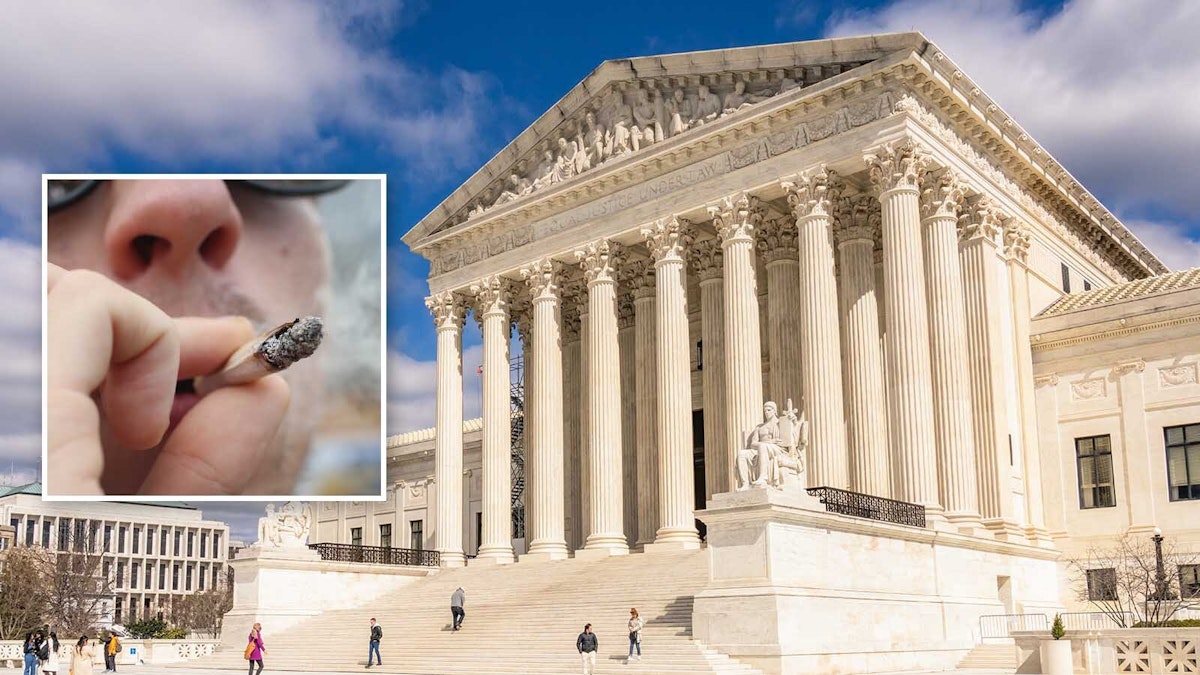
The U.S. Supreme Court on Thursday held that marijuana use alone isn’t enough to let the federal government charge a person with a felony for possessing a gun.
A federal law known under its short statutory code of 922(g)(3) bars habitual users of unlawful drugs from knowingly possessing guns. People convicted under that law can face 15 years in prison and lose their carry rights for life.
In the case of a Texan with dual Pakistani-U.S. citizenship, some marijuana in his house, an every-other-day habit of using, and a gun, the government can’t prosecute him without violating his Second Amendment rights, says the unanimous Thursday opinion written by Justice Neil Gorsuch.
The opinion upholds an earlier Fifth Circuit Court of Appeals ruling and also dismisses the Trump administration’s arguments in defense of the drug-user gun ban.
Wyoming is one of 10 states where marijuana remains illegal.
This opinion should matter to Wyomingites as well as any other American, firearms law expert George Mocsary told Cowboy State Daily on Thursday.
“We should care here in Wyoming because the case is ultimately about whether government can take away a constitutional right, including one we care a lot about here, based on a broad label rather than proven dangerousness,” said Mocsary. “The court said it can’t.”
The case isn’t just about marijuana, but about the government’s ability to hinge one’s rights on its own broad characterizations of certain people as dangerous, added Mocsary, who is a professor of law at the University of Wyoming and founder and director of the UW Firearms Research Center.
He emphasized that guns are part of ordinary life in Wyoming, from self-defense to hunting, ranching, and protection in remote areas.
“Once the government can disarm people simply by declaring a category dangerous, the same reasoning could be invoked against other common conduct said to correlate with risk, including something as ordinary as repeated speeding,” he said.
Mocsary said the court preserved an important distinction: the government can regulate dangerous conduct, but not “simply convert broad public-safety concerns into categorical disarmament of peaceable citizens.”
Unanimous
In the unanimous opinion, Gorsuch wrote that the Trump administration’s arguments that the ban on marijuana users possessing guns is rooted in the nation’s historical gun-laws tradition is unpersuasive.
That’s a reference to recent case law saying the government has to justify gun restrictions as on par with the nation’s historical tradition.
The federal government had tried to show that the ban equates to historical laws exposing habitual drunkards to restrictions like guardianships, commitments, and tougher bond arrangements.
But those standards targeted people who were so habitually drunk, they were “practically incapacitated” and couldn’t conduct their affairs. Those laws would also involve a pre-judgment test to determine if a person fit that description, Gorsuch countered.
For this case’s defendant Danial Hemani, “the government claimed Mr. Hemani faced up to 15 years in prison and disarmament for life,” since he had a gun in his home and admitted to using marijuana about every other day.
“As the government construes 922(g)(3) and seeks to apply it here, the law automatically bans an individual from possessing a gun from the moment he becomes an unlawful user of any controlled substance until he ceases being one,” wrote Gorsuch. “(In the government’s view) it doesn’t matter what controlled substance an individual uses, in what amounts he does so, or whether his drug use has ever made him a danger to himself or others.
“It doesn’t even matter why he keeps a gun or how safely he does so.”
The opinion courses over the heavy drinking habits of many of the Founding Fathers, the increasingly permissive stance the federal government has taken toward marijuana over the past 13 years, and the logical lapse between the government’s Controlled Substances Act and drug-user gun ban.
The Controlled Substances Act was passed to protect Americans’ “health and general welfare,” so some of its various drug categories can have “little or nothing to do with (drugs’) potential to induce violence.”
That severs the gun possession ban’s reliance on the Controlled Substances Act from a presumption that banned drugs make all users dangerous, the opinion notes.
Concurrences
Justice Clarence Thomas wrote a concurring opinion to say that a federal ban on gun possession isn’t justified under the Constitution’s Commerce Clause, because merely possessing a gun isn’t the same as sending or receiving one through interstate commerce.
Justice Ketanji Brown-Jackson wrote and Justice Sonia Sotomayor joined their own concurrence, agreeing with the outcome of the case but disputing the newer, more permissive gun-rights test the majority used to reach it.
Clair McFarland can be reached at clair@cowboystatedaily.com.