

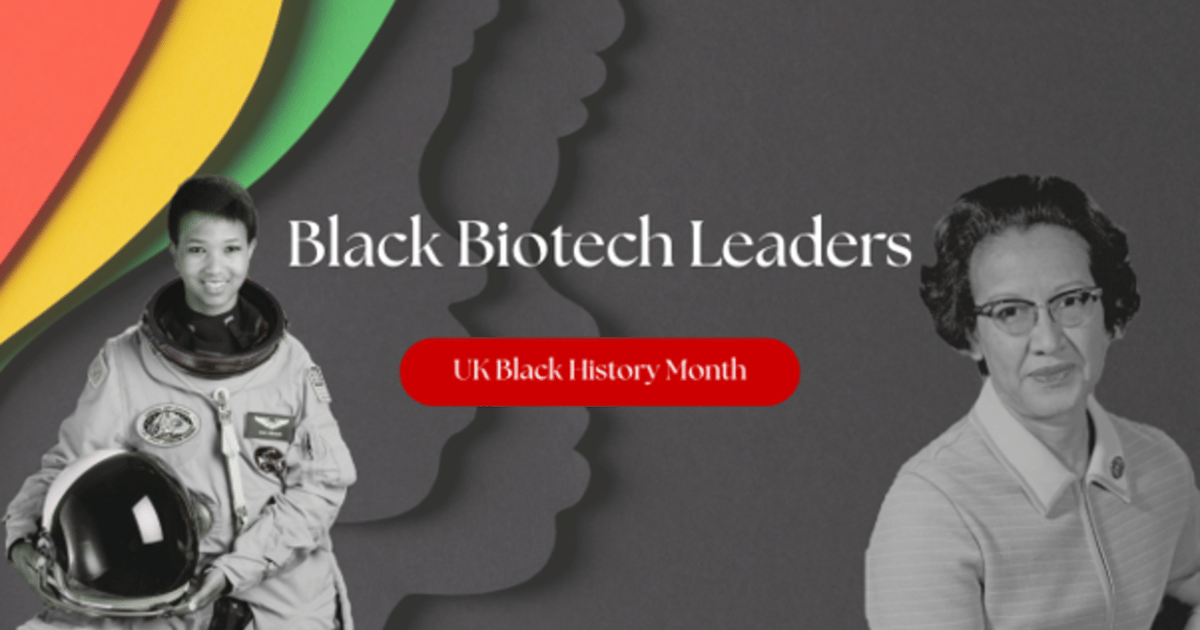
Since 1987, October in the UK has been celebrated as Black History Month, a time to instill pride and reflect on those who are often overlooked by the history books. Even more poignantly, this year marks one hundred years since the first ever Black History Week was recorded and celebrated in the US.
To celebrate this occasion, BioXconomy speaks to Black industry leaders within the biotechnology space to highlight their experiences, champion their victories and talk about the challenges and prejudices they have faced.
Karen Akinsanya, president of R&D at Schrödinger
Reigning from Surrey in the UK, Karen Akinsanya has been considered an expert in research and development within the pharmaceutical industry for decades. However, when she first started out with her PhD from Imperial College London, she wasn’t always taken as seriously as her credentials should have allowed.
“Early in my academic and biopharmaceutical career, people sometimes made assumptions about me before I had said a word because of my race, gender and, back then, age,” Akinsanya noted to BioXconomy. “I witnessed daily the impact of inaccurate assumptions. Fortunately, because science and R&D are data-driven disciplines, people tend to take an evidence-based approach to evaluating people, too.”
“Once I start talking and sharing what I know and have accomplished, initial assumptions based on appearance usually fall away quickly.”
Akinsanya was quick to prove her mettle when, in her first industry position at Ferring Pharmaceuticals, she argued to the head of its R&D department that genetics should be used to discover new drug targets. This led to an immediate promotion, where she led a team to focus on the treatment of endocrine diseases. Both being a leader and a minority in the workforce shaped how she built her teams.
“As a leader, I try to eliminate biases and leverage input from everyone on the broader team. Discovery is a team sport. It depends on data, but also on leadership, collaboration and empathy,” advises Akinsanya. “A team whose members share one background tends to share the same blind spots. The patients we serve are diverse in age, genetic background, wealth and gender, so the people designing their medicines should be as well.”
During her illustrious career, Akinsanya had several breakthroughs during her 12 years at Merck & Co. (known as MSD outside North America) research laboratories and her eight years at Schrödinger.
“At Merck, I was part of teams that dosed patients with a new medicine for the first time, which was exhilarating,” Akinsanya explained. “The recent US Food and Drug Administration (FDA) approval of Merck’s PCSK9 inhibitor was a proud moment for me and the team that fought early on to keep alive the challenging effort to develop an oral alternative to injectable antibody treatments. Seeing work that began at the bench reach patients is hard to beat.”
“At Schrödinger, it has been exciting to work with the team to advance our MALT1 inhibitor, SGR-1505, [which] has demonstrated a 100% response rate among evaluable patients with Waldenström macroglobulinemia in early clinical testing.”
Merck’s PCSK9 inhibitor, marketed as Lipfendra, is for the treatment of high cholesterol (known as low-density lipoprotein, or LDL) in the blood, like in conditions such as familial hypercholesterolemia. Continuing from her work on protein enzyme inhibitors, Akinsanya’s MALT1 protease inhibitor is in early Phase I trials and has received fast-track designation as an orphan drug for Waldenström macroglobulinemia; a rare form of non-Hodgkin’s lymphoma.
With such a successful history, Akinsanya is looking forward to prospects at Schrödinger.
“We use physics-based computation alongside machine learning to evaluate vast numbers of molecules before testing them in the lab. The aim is to find better molecules faster against therapeutic targets that have been hard to drug,” elaborated Akinsanya.
“I’m most excited by the impact of computational tools and predict-first approaches on the drug design and development life cycle. As a translational scientist, I also see exciting opportunities to improve our understanding of biology, pathophysiology and patient response to treatment.”
Steven Fuller, founder and director of Race in STEM
Steven Fuller founded Race in STEM, a global community for people of color and culture. He came to the sector through careers in entertainment, education and sales, and has spent around 10 years supporting biotech companies globally with recruitment, restructuring, coaching and diversity, equity, and inclusion (DEI) platforms. Through Race in STEM, he builds partnerships with organizations that support underrepresented communities, including Google, MasterCard and Imperial College.
For Fuller, the case for diversity is simple.
“Diversity in biotechnology and science, technology, engineering, and mathematics (STEM) fields is crucial simply to get the best,” he told BioXconomy.
He points to the lack of women and people of color in the C-suite, and says the effect reaches patients. “Consider the impact here on clinical trials,” he said. “Seeing people of color in these positions could improve the perception and increase trust for medicine.”
Looking back over his time in the sector, Fuller sees more awareness of what representation looks like, which has fed into more career opportunities and progression. He cites the Covid-19 vaccine effort as proof of what mixed teams can deliver.
“When you consider most recently COVID-19, and how many came together to identify a vaccine, it was incredible,” he said. “There were multiple ethnicities, and all genders coming together.”
Fuller is most interested in two areas. The first is AI in drug discovery, which he believes could shorten the path to treatment. “Being able to pull things together at a speed which 10 years ago wasn’t possible could provide treatment and save lives quicker,” he said, adding that humans must stay in control.
The second is personalized medicine and inclusive genomics, shaped by watching how medicine has affected loved ones. “The ‘one drug for everyone’ clearly doesn’t work, and work must be done,” said Fuller. “Personalized medicine being tailored to an individual shows that real work is being completed and that the patient’s body is being understood, providing real trust.”
Ayokunmi Ajetunmobi, assistant professor of biotechnology, University College Dublin
Known as AJ by his colleagues and friends, Ajetunmobi started his career in life sciences at Trinity College Dublin, where he obtained his PhD, before becoming an adjunct assistant professor at University College Dublin, Ireland. However, his academic career was not always plain sailing.
“The main challenge I faced was one of representation, especially in academia. There were no leading professors in my immediate environment or in the wider scientific consciousness who were Black. There has never been a Black Nobel Laureate in Physiology or Medicine,” Ajetunmobi explained. “Nonetheless, in moments of hesitation and doubt, having figures whose stories you can relate to and learn from is powerful, and I lacked that opportunity.”
Diversity is not simply an inclusion issue. It is fundamental to better science, stronger innovation and greater impact for patients. Diversity helps us ask better questions, make better decisions and ultimately create more impactful outcomes.
Through this experience, AJ learned the power of science communication and how important role models are in the medical and biotechnology industries.
“I’ll never forget the day I found out about Jane Cooke Wright, a black surgeon and cancer biologist, who pioneered the use of human tissue culture for targeted chemotherapy of cancer patients,” Ajetunmobi illustrated. “I read about her in a book I bought for my daughters about inspirational women. It was the first time I had ever heard of her, despite having a PhD in clinical medicine and spending over a decade in academia.”
“That moment was a pivotal inflection point; a realization that to overcome the challenges of poor representation, I and other Black scientists must get better at discovering and telling our own stories, and championing those whose impact should resonate more widely.”
It was through his passion for science communications and storytelling that Ajetunmobi joined forces with BioXconomy to co-host the Dose of Discovery podcast. One story that AJ is particularly proud of within his own career is his work in cell and gene therapies with Great Ormond Street Hospital (GOSH), for the treatment of rare blood cancers in children.
“I led a team that supported the research of professor Waseem Qasim, proving the safety of genome editing technologies for therapeutic development,” Ajetunmobi reflected. “His team delivered the world’s first use of genome edited cells to treat paediatric leukaemia and developed improvements to this field using CRISPR and emerging technologies.”
Ajetunmobi then chose to diversify from academia into industry partnership, elevating the next generation of biotechnology scientists.
“I’m head of ventures at Pioneer Group, a specialist investment and operating platform that helps founders across Europe turn breakthrough research into scaling businesses that solve significant unmet clinical needs,” elaborates Ajetunmobi. “I’m most excited about the curative potential of novel modalities including oligo therapeutics, mRNA technology, and advanced therapies.”
Anji Miller, associate director at LifeArc
Anji Miller has more than 20 years’ experience translating early-stage academic research in the life sciences, spanning intellectual property, licensing and company formation. At LifeArc, she leads the organization’s translational training and skills work, directs its fellowship programs, and leads the skills agenda for the Innovation Hubs for Gene Therapies.
Miller frames diversity as a driver of scientific quality rather than a box to tick.
“Diversity is not simply an inclusion issue. It is fundamental to better science, stronger innovation and greater impact for patients,” she said. “Diversity helps us ask better questions, make better decisions and ultimately create more impactful outcomes.”
However, representation alone is not enough, Miller said. That conviction was one motivation behind cofounding GEDITT (Global Equity, Diversity and Inclusion in Technology Transfer), which she helped establish with colleagues from around the world.
“We recognized that the academic innovation and technology transfer community was still facing significant challenges in diversity, representation and inclusion,” she explained. She is particularly passionate about strengthening innovation ecosystems in the Global South, where she says talent is plentiful, but access to training, funding and expertise is not.
Miller acknowledged that while DEI is now discussed far more openly, gaps remain at the executive level.
“There are still times when I find myself being the only Black person, or the only woman, in a meeting, boardroom or conference session,” she said.
She believes the barrier is often awareness rather than ability. “One of the biggest challenges I see is not a lack of talent, but a lack of awareness and access,” said Miller. Many graduates, she noted, have little idea how to move into careers such as technology transfer, commercialization or business development.
That gap informed the LifeArc Fellowships, which grew in part from her own move from laboratory scientist to innovation professional. “There were few structured pathways into the profession,” said Miller. The fellowships aim to give scientists training, mentoring and industry exposure to bridge that gap. “The conversation has evolved from simply improving representation to creating genuine pathways for success.”
Looking ahead, Miller is most excited by advanced therapies, particularly CGTs, which have been her specialist focus throughout her career.
“Gene therapy is no longer science fiction,” she said. “We are now seeing treatments that can address the underlying cause of disease rather than simply manage symptoms.”
She cautioned that manufacturing complexity, high costs and skills shortages still stand in the way, and that the technology could deepen inequalities if access stays limited.
“Scientific breakthroughs only achieve their full impact if patients can actually access them,” said Miller. The aim, she added, is for these therapies to be “not only scientifically possible, but also accessible and available to the people who need them most.”