
Fifteen years of arbitrary detention. Two UN bodies vindicating him. A man starving himself because every other peaceful avenue has been closed, writes Kamal Fadel.
THERE ARE MOMENTS when one person’s suffering exposes the failure of an entire international system. The case of Sahrawi human rights defender Naâma Asfari is one such moment.
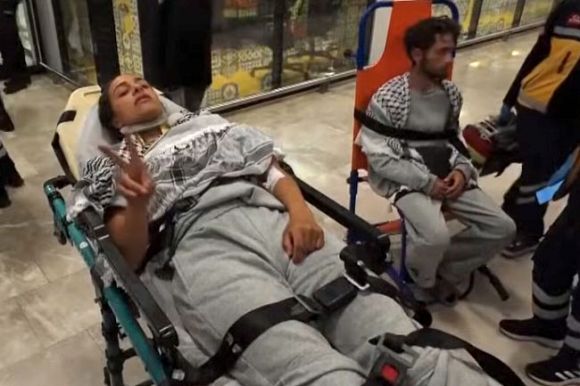
Asfari has spent more than a month refusing food in a Moroccan prison cell. As his open-ended hunger strike began on 8 June 2026 under the banner of “The Battle of Dignity” stretches on, the 56-year-old is on the brink of death.
Front Line Defenders has warned of his rapidly deteriorating health as the strike entered its fourth week. He has been moved to the prison infirmary in Kenitra. And still, silence from Rabat — and a remarkably muted response from governments that routinely proclaim their commitment to human rights and the rules-based international order.
If the international community allows Naâma Asfari to die in prison, it will not simply be the tragic death of one political prisoner. It will be a failure to uphold the universal principles on which international law is built and a test, failed, of our collective commitment to human rights and the peaceful resolution of conflicts.
Who is Naâma Asfari?
Asfari is no ordinary prisoner. He is one of the most prominent Sahrawi human rights defenders and Vice-President of the Committee for Liberties and Respect for Human Rights in Western Sahara (CORELSO). For decades, he has advocated peacefully for the right of the Sahrawi people to self-determination, a right recognised repeatedly by the United Nations (UN) and the International Court of Justice (ICJ).
His methods have never been those of violence. Like Mahatma Gandhi, Nelson Mandela in his early campaigns of civil disobedience, Martin Luther King Jr and countless prisoners of conscience throughout history, Asfari has relied on non-violent protest to confront injustice and the denial of basic rights to the people of Western Sahara. Today, after years behind bars, his own body has become his final instrument of protest.
In 2009, Morocco imprisoned him for four months for possessing a set of keys bearing the Sahrawi flag. That detail alone tells you everything about the space Morocco allows for peaceful Sahrawi dissent.
On 7 November 2010, on the eve of the violent dismantling of the Gdeim Izik protest camp, Asfari was arrested. He was held incommunicado for several days, blindfolded, tortured and forced to sign statements under duress. In 2017, the Salé Court of Appeals sentenced him to 30 years in prison on the basis of those confessions.
The international verdict on this process could not be clearer. In 2016, the UN Committee Against Torture concluded, in Case No. 606/2014, that Morocco had violated multiple articles of the Convention Against Torture in its treatment of Asfari — including the prohibition on using statements obtained through torture as evidence. In 2023, the UN Working Group on Arbitrary Detention issued Opinion No. 23/2023, finding the detention of the Gdeim Izik prisoners arbitrary and calling for their release.
Morocco has implemented none of it. Not one measure. For nearly a decade, the rulings of the very UN bodies whose authority Morocco formally accepts have been ignored.
A strike born of exhausted patience
A hunger strike is among the most desperate forms of peaceful resistance, undertaken only when every other avenue has been exhausted. That is precisely where Naâma Asfari now finds himself.
He did not arrive at an open-ended strike lightly. He tried everything else first: a warning strike on 30 April 2026 to break what he called “systematic indifference”, then three consecutive 48-hour strikes through May. No response. Only then, on 8 June, did he begin refusing food indefinitely.
His demands are strikingly modest for a man risking his life: implement the UN decisions in his case. End the medical neglect. Transfer him to a prison near Western Sahara so his family can see him — his wife, the French activist Claude Mangin, has been barred from visiting him for eight years.
He is not asking Morocco to do anything it has not already been directed to do by international bodies whose authority it formally accepts. That is what makes the silence so damning. A state confident in the justice of its case would have nothing to fear from Red Cross (ICRC) access, from a visit by the UN Special Rapporteur on Torture, or from independent medical care. Morocco’s refusal to grant any of these speaks louder than any denial.

What this tells us about the wider conflict
Asfari’s ordeal is a window onto Morocco’s posture in Western Sahara as a whole. A state that will not honour binding findings on the treatment of a single prisoner cannot credibly claim good faith in a negotiation over the fate of an entire people.
If Rabat is willing to let a peaceful, internationally recognised human rights defender waste away rather than implement a UN opinion, what confidence can anyone have in its commitment to a genuine political process on self-determination?
Indifference on this scale is not neutrality. It is a choice.
History has shown that prisoners of conscience often become symbols of struggles much larger than themselves. Nelson Mandela in apartheid South Africa, Václav Havel in Czechoslovakia and Aung San Suu Kyi under military rule all demonstrated that imprisoning peaceful voices rarely silences the cause they represent. Naâma Asfari now stands among those who have chosen peaceful sacrifice over violence.
The moral duty to act
An international petition addressed to UN Secretary-General António Guterres, alongside an urgent appeal by Sahrawi human rights organisations, sets out what must happen now.
Governments that consistently champion human rights – including Australia, the member states of the European Union, the United Kingdom, Canada and others – should publicly call on Morocco to comply with the recommendations of United Nations human rights bodies.
They should urge the immediate and unconditional release of Asfari and the Sahrawi political prisoners; implementation of Opinion 23/2023; urgent medical care; immediate humanitarian access for the ICRC and the detainees’ families; an end to reprisals against the detainees’ relatives; and an urgent visit by the UN Special Rapporteur on Torture.
France, in particular, cannot look away. Asfari’s wife is a French citizen who has tirelessly campaigned for the release of her husband. Paris’s silence is complicity at its worst.
Every day that passes increases the risk that this peaceful protest will end not in justice but in death.
Fifteen years of arbitrary detention. Two UN bodies vindicating him. A man starving himself because every other peaceful avenue has been closed.
History will not ask whether we knew, as the statements of human rights organisations, the appeals of the detainees’ families and the UN opinions make ignorance impossible. It will ask what we did. There is still time to answer that question well. But not much.
Naâma Asfari’s life is in the hands of those with the power to demand his freedom.
Kamal Fadel is the Polisario Representative in Australia and New Zealand. You can find him on Twitter: @Alfudail.
Support independent journalism Subscribe to IA.


Related Articles