
When England touched down in Miami on June 1 to prepare themselves to be comfortable with being uncomfortable, nobody could have foreseen the car crash that was about to unfold.
It was supposed to give them the best platform to mount a serious challenge at the World Cup, with the idea that the warm-weather camp would equip them to better handle the heat they would endure throughout the tournament.
Only that wasn’t the case.
The year was 2014, Roy Hodgson was England manager, Ray Lewington was his assistant and Gary Neville, three years on from retiring as a Manchester United player, was on the coaching staff.
Their plan was simple: put the hard yards in under duress from extreme heat and humidity, in the hope it would pay off when they landed in Brazil to begin their World Cup campaign, with one of their group matches taking place in Manaus, the extremely humid gateway to the Amazon rainforest.
When Hodgson’s England squad — along with a backroom staff totalling 77 people — landed in the U.S., the intent to ensure it was a success was evident. They had even spent time in the Algarve, Portugal, prior to arriving in Miami.
But in the space of their first week in Miami, there were suspended friendlies, adverse weather conditions, a medial knee ligament injury sustained by Alex Oxlade-Chamberlain and emergency knee surgery for Lewington.
It was nothing short of a disaster masterclass. England lost their first two World Cup group-stage fixtures, against Italy and Uruguay, exiting the tournament before the knockout rounds — the first time that happened to England at a tournament they qualified for since 1958.
So, fast forward 12 years, and you may have wondered why the Football Association (FA) once again selected Miami as the ideal destination to prepare for the 2026 World Cup, which is being jointly hosted by the United States, Canada and Mexico.
They again landed in Miami on June 1, the first day of hurricane season in Florida, and headed to the Belgrove Resort & Spa, a luxury hotel in West Palm Beach (which will be used by Portugal during the World Cup) to begin a 10-day camp.
And just like Hodgson before him, Thomas Tuchel spoke about the need for his players to suffer and to be comfortable being uncomfortable. Only this time, they are seeking to avoid injuries, suspended friendlies — and the technology being used is far more advanced than it was in 2014.
England’s preparations for this World Cup started long before June 1.
You need to go back to their week-long camp in Girona, Spain, last summer, where the players were put through a series of fitness tests, including cycling for 45 minutes in a heated tent with a minimum temperature of 35C (95F).
The squad was also required to ingest a biometric tablet that would aid the monitoring of their core body temperature to help the FA increase its knowledge on how to cool each individual player down, as well as when they should take cooling breaks.
In Florida, they are wearing Whoop fitness trackers designed to continually monitor a series of health metrics, including resting heart rate, heart rate variability and VO2 max.
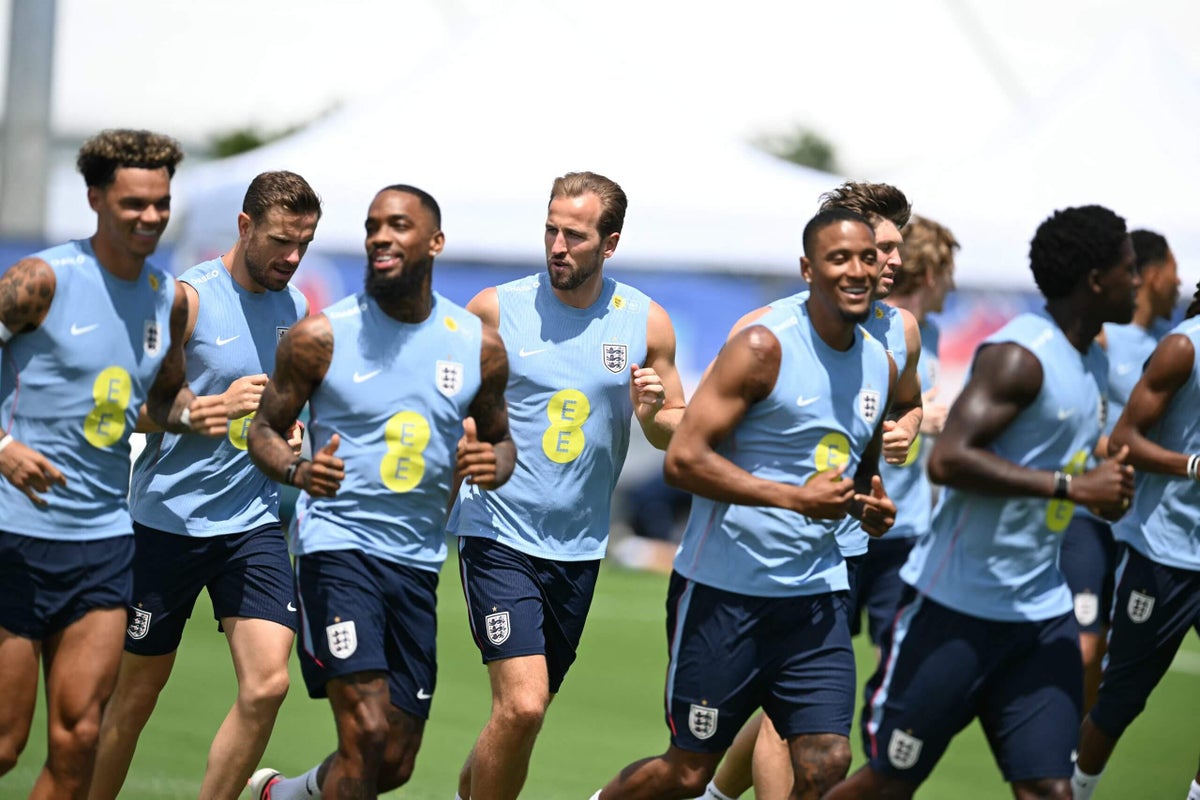
Unlike England’s first training session on June 2 in 2014, which was abandoned due to floods from an early-morning hurricane, the sun was beating down on their pre-tournament training base at Gardens North County District Park in Palm Beach Gardens.
To avoid jet lag slowing the players down over the first few days, Tuchel encouraged them to holiday in the same time zone, which is something many of them did. Dan Burn, the Newcastle United defender, spent the week with his family at Walt Disney World Resort in Orlando, for example.
And although they were not expected to be in Florida until June 6 due to their involvement in the Champions League final, Arsenal’s Eberechi Eze and Noni Madueke spent time with James Karr, the director of strength and conditioning at Barry University Athletics, before joining up with the squad.
Tuchel has also been doing his homework by speaking to other coaches with experience in the United States.
Phil Neville, the former Manchester United defender and until May head coach of the MLS side Portland Timbers, revealed in a column for The Times that the England manager had been in touch with him over playing conditions in the U.S.
One slight setback to England’s preparations, however, was the friendlies taking place in Tampa and Orlando. They were originally planned for Miami, but the venues could not be finalised.
It meant playing on a newly-laid pitch against New Zealand at the Raymond James Stadium on Saturday, which Tuchel said he was concerned about. They avoided any injuries, but free-flowing football it was not.
That said, it was not quite as dramatic as England’s 2-2 draw against Ecuador in a friendly in 2014, with Raheem Sterling being sent off and Oxlade-Chamberlain sustaining his knee injury.
Their second game, a goalless draw against Honduras, was held up for 40 minutes by lightning strikes during the first half. A beer can was also thrown at Daniel Sturridge from the crowd.
The current crop of England players will travel to Orlando, specifically the Inter&Co Stadium, to play Costa Rica on June 10 before a behind-closed-doors friendly against Miami FC at their pre-tournament base.
When they haven’t been training, the players have had access to the Belgrove Resort & Spa’s luxury facilities, including Dutchman’s Pipe, a golf course designed by Jack Nicklaus, as well as pickleball and padel courts.
In an interview with the FA’s content team, Elliot Anderson revealed Harry Kane organised a round of golf with PGA star Brooks Koepka, which was also attended by Jordan Pickford, John Stones and Jason Steele.
“Harry sorted it — he must know him,” Anderson told the FA. “It was mint. He was so good, and he put me to shame. I was nervous on the tee box but I did alright.”
The weather in Florida during England’s stay thus far has been temperamental. After blazing heat on Tuesday, intermittent heavy rain showers followed throughout the next few days, with Friday’s session again taking place in intense heat.
To help the players cool down, England have introduced Therabody’s palm-cooling devices into the camp and they will stay with them throughout the tournament.
“The science shows that when you put something on your body that’s zero degrees Celsius, then it is probably going to slow the blood flow down,” Dr Jason Wersland, the founder of Therabody, tells The Athletic.
“That is not what you want to do, so we want to get to six or seven (degrees Celsius), but we want it to stay constant at that temperature for a period of time. In this case, it’s about 90 seconds.”
Wersland adds that it “takes about six to 10 seconds” for your blood flow to circulate in your body and that the blood flow can be accessed through the palms of your hands, underneath your eyes, on your cheeks, the bottom of your feet and the back of your neck.
“So, if you’re holding something cold in the palms of your hands, and the blood flow is flowing through that area every six to 10 seconds, you’re cooling the blood in your body, which your body doesn’t have to do anymore,” he says.
“And now it’s saving that energy for output instead of trying to downregulate your temperature.”
During the two three-minute hydration breaks against New Zealand, England’s players placed ice packs around their necks to help regulate their body temperature.

Thomas Tuchel speaks to England’s players during a cooling break in the game against New Zealand (Eddie Keogh – The FA via Getty Images)
Although the training sessions in Palm Gardens have been intense, it is more about building their fitness levels up to cope with the stress their bodies will be put under during the World Cup, as opposed to going through endless hours of analysis and game-specific work.
“We have spoken a bit about it probably being a World Cup of set pieces, but we haven’t looked at anything in particular, knowing we still have a couple of warm-up games before we get to that game,” Burn said after the New Zealand friendly.
“I think, when we get to Kansas, we will go over it in a bit more detail.”
The pre-tournament camp in Florida had been planned before Tuchel’s appointment in October 2024, but the former Chelsea manager has leaned into it and has sought to extract as much as possible from being able to gel the squad together uninterrupted by the demands of the World Cup.
As is par for the course, however, the merits of this camp will be tested once their World Cup campaign gets underway against Croatia in Dallas on June 17.