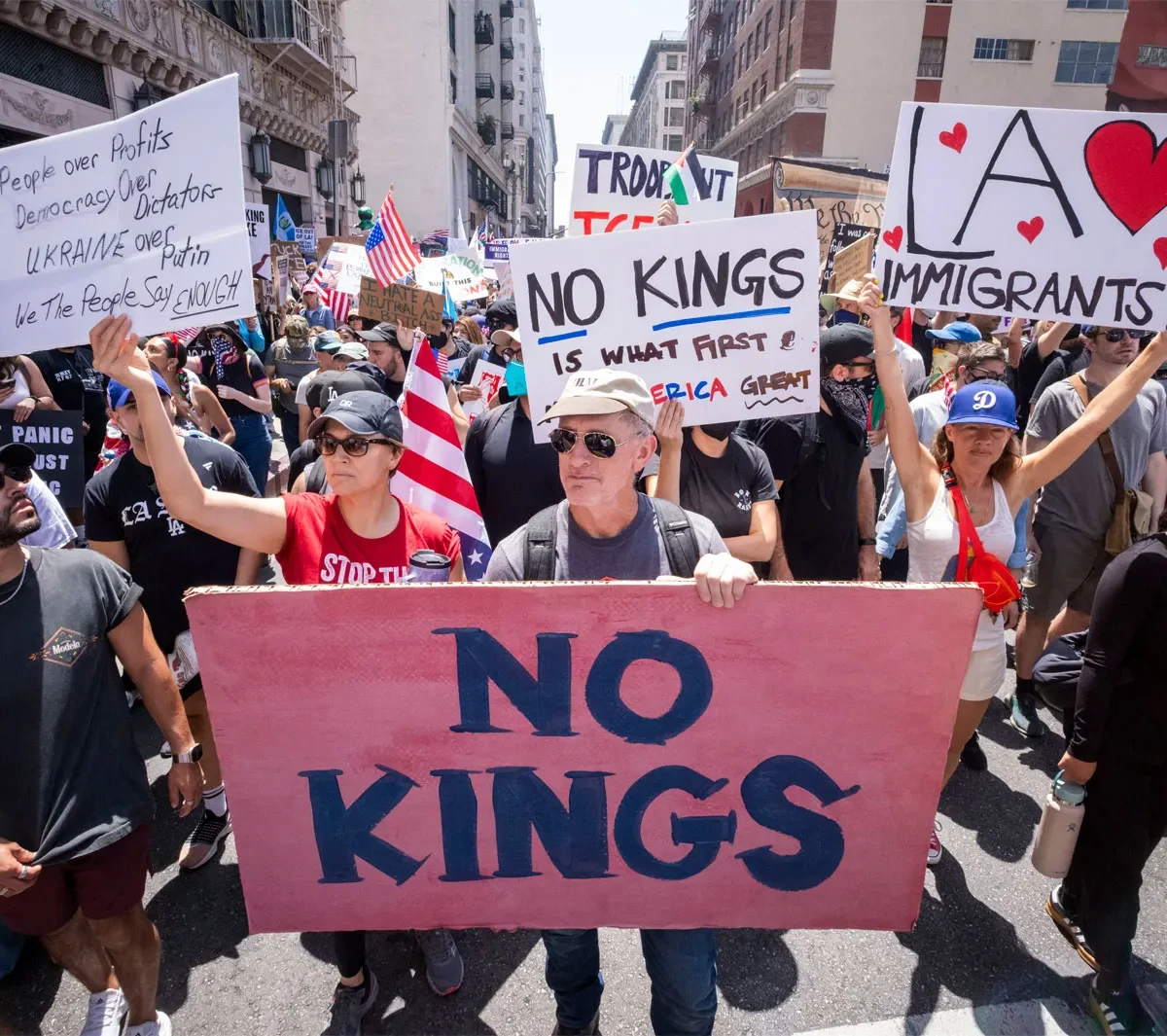
“No Kings” protests, any of three major rallies organized to protest the second term of U.S. Pres. Donald Trump. The first round of protests were held on June 14, 2025, to coincide with Pres. Trump’s birthday and a military parade in Washington, D.C., commemorating the 250th anniversary of the U.S. Army. The second day of “No Kings” protests occurred on October 18, 2025, drawing even larger crowds, and the third day is scheduled for March 28, 2026. The first two demonstrations were some of the largest single-day protests to occur in U.S. history, with more than five million protesters attending in June and almost seven million protesters attending in October.
The protests are called “No Kings” rallies in opposition to the forceful policies President Trump has promoted from the executive branch.
“The president thinks his rule is absolute. But in America, we don’t have kings — and we won’t back down against chaos, corruption, and cruelty,” the organizers explain on a website for the rallies.
“No Kings” protests have been largely organized by liberal organizations within the United States, such as the 50501 Movement, Indivisible, and MoveOn. Nonpartisan groups such as the American Civil Liberties Union (ACLU) have also helped facilitate protests. The “No Kings” moniker was coined by 50501 Movement, which on its website emphasizes the “3.5% rule”—the idea that if 3.5 percent of a population becomes involved in a movement, significant political change may be achieved.
Although protests have been mainly concentrated in the United States, “No Kings” rallies have occurred around the world. In countries that have a constitutional monarchy, such as the United Kingdom, the protests went by names such as “No Tyrants” or “No Dictators.”
Organization and scope of the 2025 protests
June 14 protests
Major cities such as Chicago, New York City, and Philadelphia saw large-scale demonstrations, and sizable protests occurred in smaller cities and suburban locales. In Philadelphia alone, about 100,000 protesters marched. Attendees waved American flags and signs that called for democracy over fascism.
Although the majority of protests were peaceful, some were deemed unlawful assemblies, and law enforcement used violent dispersion tactics at a number of rallies. In Los Angeles and Seattle, for example, police used tear gas to scatter protesters. Los Angeles had already been the site of widespread unrest in response to federal immigration raids, and Trump had ordered the National Guard to report to the city on June 7, 2025, to protect federal immigration officers from what he termed a “rebellion.” This, coupled with “No Kings” protests, led to violent scenes; police, many on horseback, sometimes used batons and tear gas on protesters, claiming that the protesters were throwing bricks and fireworks at law enforcement officials.



(Read more about National Guard deployments throughout history.)
In Minnesota an armed assassin killed a Democratic state representative and her husband and gravely wounded a state senator and his wife in the hours before the protests were scheduled to occur. As state and federal law enforcement staged a manhunt for the shooter, who was considered armed and dangerous, many “No Kings” events were canceled, and Gov. Tim Walz encouraged protesters to stay indoors. However, thousands of people attended more than 40 demonstrations in the state.
At a rally in Salt Lake City, Utah, a crowd control volunteer shot 39-year-old fashion designer Arthur Folasa Ah Loo, who was later pronounced dead. In northern Virginia a man drove his car into a group of protesters, hitting at least one person. Similar cases of motorists hitting protesters occurred in San Francisco and Los Angeles. Individuals also committed violent hit-and-run incidents against protesters in smaller cities such as Scranton, Pennsylvania, and Riverside, California.
October 18 protests
In the months following the first round of protests, immigration raids intensified, the government shut down (on October 1), and the National Guard was deployed to Washington, D.C., and Memphis, Tennessee. (Trump had ordered troops’ deployment in Chicago and Portland, but both orders were initially blocked by judges. In Portland an appeals court overturned that decision.) When Trump was asked about the second round of protests, he said to reporters, “I hear very few people are going to be there, by the way.” However, the second round of protests was discernibly larger than the first, indicating both increased public awareness of the administration’s actions and increasingly unfavorable views of Trump’s policies.
The rallies in October featured an influx of protesters dressed in inflatable frog costumes, which had become a symbol of resistance in Portland, Oregon, at local demonstrations against U.S. Immigration and Customs Enforcement (ICE). Other participants dressed as inflatable chickens, dinosaurs, and similar wacky characters to dispel some Republicans’ characterization of protesters as violent and lawless. Portland City Council Member Sameer Kanal stated that day, “We have chickens and frogs defending democracy.” “No Kings” protesters carried signs that included pithy phrases such as “Democracy not Monarchy” and “No One Paid Me to Be Here,” the latter a jab at Republican talking points regarding paid protesters. Republicans were generally critical of the protests, with House Speaker Mike Johnson referring to the day as the “Hate America Rally.”
Across the country, the participants demonstrated peacefully. One of the most notable sites of conflict, however, occurred in Portland, where about 500 “No Kings” protesters gathered after the march outside an ICE facility, a site of protests since June 2025. Counterprotesters were also present in the crowd. Federal agents stationed on the roof of the facility met the crowds with tear gas, smoke bombs, and flash-bangs. Local law enforcement also patrolled the area, warning protesters that they would be arrested if they blocked streets. During the course of the action, three protesters were arrested.
Impact of the 2025 protests
“The day came off with potentially millions of people in the streets…and with very few incidents of injuries, arrests, property damage, or anything else that might play into the narrative that the movement is not disciplined, is not nonviolent, and is not democratic in its ethos.” —political scientist Erica Chenoweth in an NPR interview regarding the June 14 “No Kings” rallies
According to the ACLU, about four to six million protesters attended “No Kings” rallies in June—an unprecedentedly high number. This number was surpassed by the reportedly seven million protesters who attended “No Kings” protests in October. The protests stood in stark contrast to the scale of protests that occurred during Trump’s first presidential term in 2017. The previous record was held by the 2017 Women’s March, which saw more than 3.3 million protesters across the U.S. Harvard University’s Crowd Counting Consortium estimated that the first three months of Trump’s second term saw about three times as many protests as his entire first presidency. This finding did not include the “No Kings” protests or other rallies in April, May, or June.
October’s “No Kings” rallies notably drew a greater number of former Republicans who had grown wary of Trump’s policies. Observing the rapid intensification of immigration raids and National Guard deployments that had taken place during the summer, many protesters expressed concerns about the future of the United States. One protester in New York City held a sign that stated simply, “We protest because we love America, and we want it back.”
The 2026 protests
A third “No Kings” protest took place on March 28, 2026, drawing an estimated eight million participants across more than 3,300 sites nationwide, making it the second-largest protest in U.S. history. The demonstrations broadly focused on executive overreach, with protesters rallying against the 2026 Iran War, the rising cost of living, and ongoing immigration enforcement activities.
Read more about the Largest Single-Day Protests in the United States.