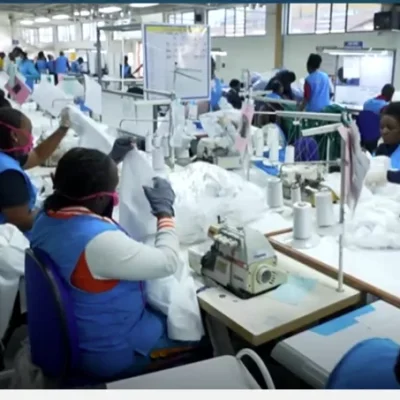


John Quinn‘s Majority State Ownership of Oil and Mining Sectors in Africa examines how nationalising natural resources shaped the economic and political trajectories of post-independence African states. James Herndon praises the book’s meticulous analysis, arguing it offers a compelling reassessment of overly simple narratives around the “resource curse” and state ownership on the continent.
In the 1980s, a young Peace Corps volunteer in Zaire named John Quinn found himself stranded at Kisangani airport with no flights to Kinshasa in the offing. As it happened, then-President Mobutu had commandeered the plane for an impromptu shopping spree in Europe. Having seen firsthand the consequences of leaders who conflate the private and public spheres, Quinn spent much of his subsequent academic career explicating the corrosive effects of government-controlled firms. His recent book Majority State Ownership of Oil and Mining Sectors in Africa: The Resource Curse Undermined serves as a capstone on those decades of research. It offers a concise summary of how and why independent African countries took wildly different trajectories, then closes with informed speculation about where they may head in the future.
Resource nationalisation’s promise
Having long watched colonial powers drain wealth from their lands, in the 1960s new nations from Angola to Zambia saw a direct path to development: nationalisation. If resources like oil, cobalt, and copper belonged to “the people,” then naturally the government should acquire the companies extracting that bounty. Instead of paying dividends to foreigners, profits would pay for local services and infrastructure. And what better way to build human capital than by ensuring jobs went to locals? But when those neat, optimistic plans collided with reality, the results ranged from deleterious to catastrophic.

Instead of the profit motive, patronage determined the allocation of jobs, investments, and currency. Tribe mattered more than expertise in hiring. Instead of reinvesting profits, inept management frequently raided the coffers. And while their misallocation certainly enabled personal corruption, they also wasted actual government spending by subsidising loss-making firms in other sectors. Direct control over the nation’s primary exports meant that the government allocated foreign currency according to its needs, not the market’s. Seizing these firms allowed ruling parties to avoid compromising with opposition groups over mundane necessities like taxes, while rendering the property of every citizen less secure. All this occurred during the Cold War, with the Soviets urging nationalisation and the Americans acquiescing for fear of losing allies.
Across Sub-Saharan Africa, Majority State Ownership status correlated with slower economic growth, less wealth, stagnant agriculture and manufacturing, more conflict, and diminished civil rights […] But Quinn highlights two inconvenient truths: First, official statistics can obscure as much as they reveal, and second, establishing casualty demands far more than showing a difference on average.
Having outlined the incentives and mechanisms that doomed “majority state ownership” (MSO) of oil and mineral exports, Quinn tallies the damage statistically. Across Sub-Saharan Africa, MSO status correlated with slower economic growth, less wealth, stagnant agriculture and manufacturing, more conflict, and diminished civil rights. Economists have used the term “resource curse” for decades to summarise these trends. But instead of simply affirming the narrative, Quinn highlights two inconvenient truths: First, official statistics can obscure as much as they reveal, and second, establishing casualty demands far more than showing a difference on average.
Unpacking the data on state vs private
Economist studying the effects of resource booms have long observed “Dutch Disease,” when growing exports drive up the value of a currency, rendering agriculture and manufacturing less competitive. But how to test this theory for countries with a fixed exchange rate, whether a peg to the dollar or membership in the CFA frac zone? Here Quinn resorts to both the real exchange rate (which accounts for prices) and black-market rates. Likewise, a surge in world prices can stimulate production of any commodity, so the book’s analysis of agriculture covers both value-added and volume. Of course, some statistics do not just mislead but simply lie: Rwandan and Ugandan gold exports reflect smuggling, not production.
While Cameroon’s years of one-party rule from 1966 to 1990 were hardly idyllic, Nigerians suffering recurrent coups might well have envied their neighbours’ stability.
While Quinn’s deft handling of the numbers makes his thesis credible, he wisely admits that observational data at the country level will never yield precise cause-and-effect inferences. The regimes that opted for control of natural resources typically chose other “inward-oriented policies” across their economies. By using MSO status as a proxy for those policies, the book’s case studies yield convincing insights. Cameroon and Nigeria share a 2,000-kilometer border and a history of reliance on oil exports, but the former allowed its petroleum industry a relatively free hand while the later opted for state control. From 1966 to 2000, Cameroon’s per capita GDP grew at 1.6 per cent per year. A dispiriting outcome but consider the alternative: Nigeria shrank by 2.5 per cent annually per capita in those years. It went from being a major exporter of cotton, palm oil, and cocoa, to a net food importer. Cameroon privatised their banana industry and saw exports soar. And while its years of one-party rule from 1966 to 1990 were hardly idyllic, Nigerians suffering recurrent coups might well have envied their neighbours’ stability.
When a huge trade surplus left China with excess foreign currency, lending those funds abroad allowed it to earn a return without sparking domestic inflation. Those same investments also provided employment for Chinese nationals and ensured continued access to natural resources.
While researchers have long warned students that “correlation does not equal causation,” the “Causal Revolution” that swept the social sciences in recent decades imposed new rigor on sweeping claims like “State ownership of natural resources inhibits economic growth and democratic progress.” And throughout the book, Quinn provides a litany of confounding factors. In Equatorial Guinea, the Nguema family’s pervasive reach would have rendered any firm, public or private, complicit in state corruption. Droughts in the Sahel battered farms regardless of who owned the mines. Better management at copper mines in Zaire would not have prevented the loss of rail access when Angola and Mozambique descended into civil war. Such factors will aways prevent neat counterfactuals. But Quinn refuses to succumb to epistemological nihilism because the anecdotal and statistical evidence, while imperfect, is overwhelming. Whatever allure it held in 1960, the nationalisation of oil and mining sectors failed in social, economic, and political terms.
The boom in Chinese investment
Although many countries’ petroleum industries remain under state control, since 2000 much of Sub-Saharan Africa has moved towards trade, privatisation, and openness to foreign investment. The results compelled economists to publish research papers with titles like “What Is Driving the ‘African Growth Miracle’?” But no sooner had markets triumphed than state-led development reappeared in the form of surging Chinese investment. Quinn provides a concise and objective summary of China’s actions and motivation: when a huge trade surplus left China with excess foreign currency, lending those funds abroad allowed it to earn a return without sparking domestic inflation. Those same investments also provided employment for Chinese nationals and ensured continued access to natural resources. China became Sub-Saharan Africa’s largest import and export partner in 2006 and 2012, respectively.
In February of 1960, British Prime Minister Harold Macmillan delivered an epochal speech to the South African parliament:
“The wind of change is blowing through this continent, and, whether we like it or not, this growth of national consciousness is a political fact…. As I see it the great issue in this second half of the 20th century is whether the uncommitted peoples of Asia and Africa will swing to the East or to the West.”
A lifetime after Macmillan’s address, the issue remains salient. Near the book’s close, Quinn concedes that quick privatisation cannot substitute for genuine institutional reform. But recent news suggests that perhaps Africa will achieve both: a private Nigerian refinery became the world’s largest exporter of aviation fuel on its way to a blockbuster public offering. Quinn has written a valuable primer on state ownership in Africa’s economic past. It’s now up to African leaders to make sure it stays there.
Note: This review gives the views of the author and not the position of the LSE Review of Books blog, nor of the London School of Economics and Political Science.
Main image: Tolu Owoeye on Shutterstock.
Enjoyed this post? Subscribe to our newsletter for a round-up of the latest reviews sent straight to your inbox every other Tuesday.