
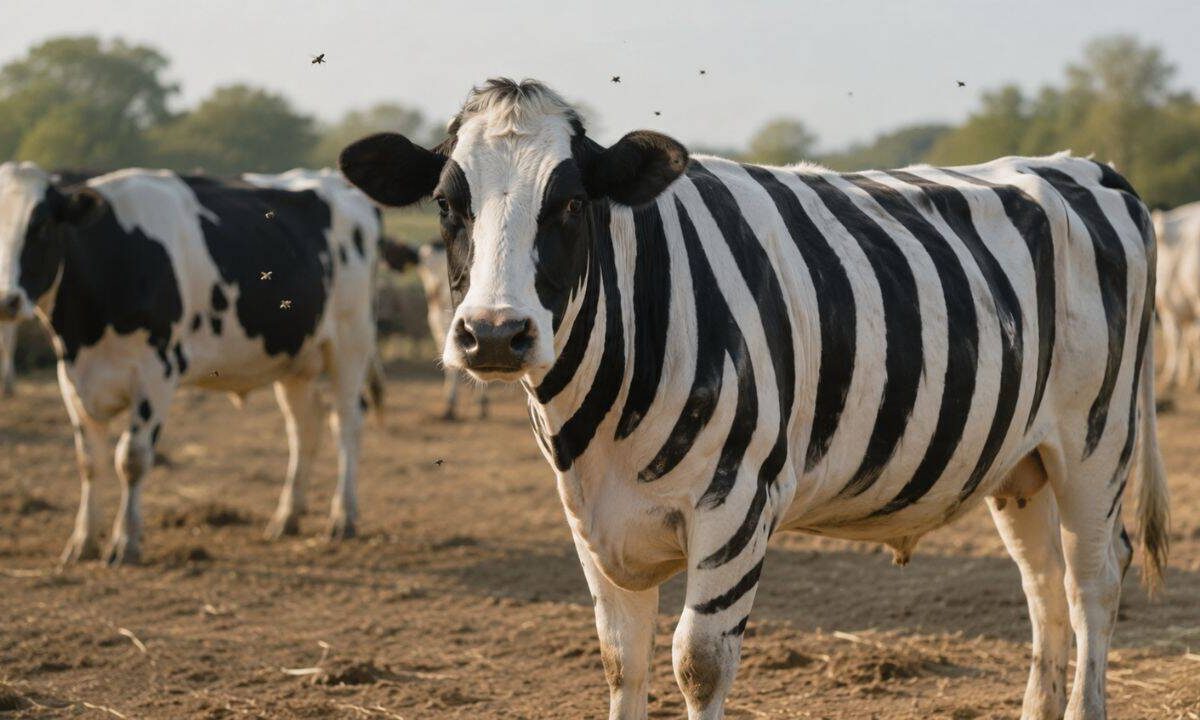
Scientists painted black cows with white stripes to test whether zebra markings deter biting flies, and the results offered a striking clue about one of nature’s most debated patterns. A field experiment in Japan found that cattle painted with zebra-like stripes attracted around half as many biting flies as unpainted animals. The striped cows also spent less time flicking tails, stamping legs and performing other movements used to fend off insects.For decades, zebra stripes have inspired competing explanations. Some researchers suggested they helped animals blend into landscapes, confused predators during a chase, or regulated body temperature under the African sun. Yet a growing body of evidence has pointed in a different direction. The latest findings add support to the idea that the zebra’s distinctive coat may have evolved largely as protection against blood-feeding flies.
How zebra-like stripes reduced biting fly attacks on cows
According to the study published in PLOS ONE, titled “Cows painted with zebra-like striping can avoid biting fly attack”, an experiment was carried out using six Japanese Black cows, animals whose coats are naturally dark. Researchers painted some of them with white stripes designed to resemble those of zebras, while others either remained unpainted or received black paint that did not alter their appearance. The aim was straightforward: determine whether the visual effect of stripes alone changed how flies behaved.After observing the animals and counting insects landing on their bodies, the pattern became clear. Cows painted with black-and-white stripes experienced roughly 50 per cent fewer biting fly landings than either of the comparison groups. The black-painted cattle showed no meaningful reduction, suggesting it was the striped pattern rather than the paint itself that made the difference.
Zebra stripes reduced fly-repelling behaviour in cows
The effect extended beyond insect numbers. Biting flies are a persistent nuisance for livestock and can trigger a range of defensive behaviours. Cattle often respond by shaking their heads, stamping their feet, twitching their skin or repeatedly swishing their tails.As per the study, animals carrying zebra-like markings displayed these behaviours less frequently. Their total fly-repelling movements fell by about one-fifth compared with the other cows in the study. That reduction may seem modest, but for grazing animals exposed to insects for long periods, less time spent reacting to flies can mean less stress and disruption.As the researchers wrote, “painting zebra-like stripes on cows can decrease the incidence of biting flies landing on individuals by 50%.”
Why zebra stripes may help keep biting flies away
The purpose of zebra stripes has puzzled scientists for generations. Ideas ranging from camouflage to predator confusion have been tested repeatedly, often with mixed results. In recent years, however, evidence linking stripes to fly avoidance has become increasingly persuasive.Previous experiments found that horseflies and other biting insects tend to avoid striped surfaces. Studies using striped cloth coverings on horses also reported fewer fly landings. The Japanese cattle experiment stood out because it tested the concept directly on living animals rather than on models or artificial targets.Researchers have not yet settled on exactly why insects dislike stripes. Some theories suggest the contrasting bands interfere with how flies perceive brightness or polarised light. Others propose that stripes disrupt the insects’ ability to judge speed and distance during the final moments before landing. Whatever the mechanism, the pattern appears to make a host less attractive at close range.
What the zebra stripe study could mean for livestock farming
The findings carry implications beyond the zebra itself. Biting flies cost livestock producers significant amounts through reduced feeding, lower productivity and animal stress. Control methods often rely on pesticides, yet insect populations can gradually develop resistance to those chemicals.According to the study, a painted stripe is hardly a permanent solution for modern farming. The markings used in the experiment faded after several days and would need regular renewal. Even so, the results hint at a low-tech alternative inspired by evolution rather than chemistry.More importantly, the study strengthens a growing scientific view that zebra stripes may be less about hiding from predators or coping with heat than about avoiding relentless insect attacks. The black-and-white coat that has fascinated observers for centuries could be serving a surprisingly practical purpose: acting as a living insect repellent.