

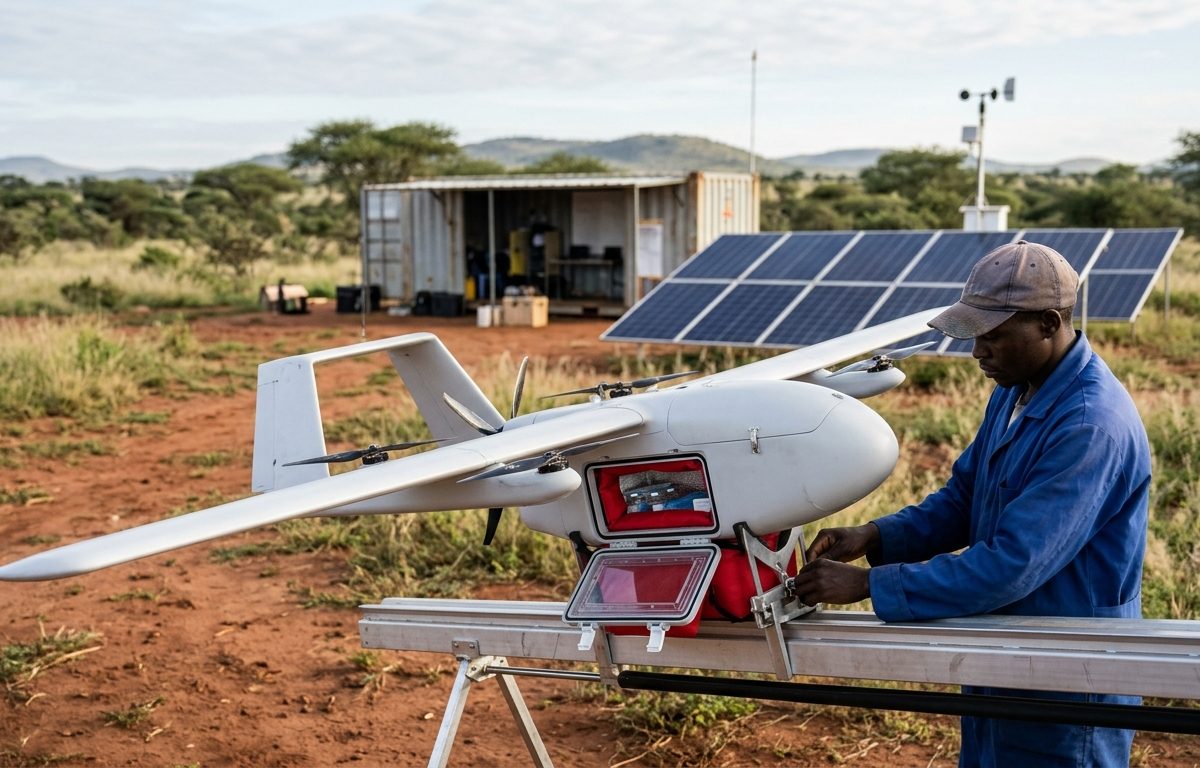
A small network of uncrewed aircraft base stations can substantially improve emergency hospital access and delivery speed across Kenya, but high fixed personnel expenditures cause unit transport costs to significantly exceed ground alternatives, according to an economic evaluation in Health Economics Review. Expanding to seven stations would cover 75 percent of transfusing facilities and 93 percent of population demand. Beyond seven stations, marginal coverage gains diminished sharply, showing that concentrating flight operations in limited high-utilization hubs yields the greatest operational efficiency.
The authors framed their analysis around operational realities and regulatory boundaries governing blood delivery in low- and middle-income countries. While uncrewed aircraft systems are widely promoted to improve access to emergency medical commodities, existing economic evaluations have focused predominantly on aircraft performance metrics. Previous assessments paid limited attention to base station placement, facility utilization rates, and staffing models, which serve as key determinants of unit cost due to high fixed operating expenses. Furthermore, effective clinical demand is strictly constrained because blood can only be administered in healthcare facilities legally authorized and clinically equipped to manage severe adverse transfusion reactions. The authors therefore evaluated how these factors jointly shape the cost-efficiency of uncrewed blood delivery in Kenya.
To examine these interrelated dynamics, the investigators modeled uncrewed aircraft deployment across Kenya under three base station placement scenarios: existing blood bank sites, urban centers with populations exceeding 30,000 residents, and unrestricted town and village locations. Across each modeled configuration, the researchers estimated both geographic accessibility and population-weighted coverage of transfusing hospitals. They directly compared uncrewed aircraft flight times against road travel times within identical service areas, while projecting delivery volumes and unit transport expenses based on local hospital catchment populations, utilization assumptions, and staffing structures designed for continuous 24/7 emergency operations.
The geographic analysis highlighted stark trade-offs between network expansion and operational efficiency. Achieving complete geographic coverage across all regions of Kenya would require approximately 28 base stations. However, many of these additional launch facilities would operate at low utilization levels while incurring high operating costs. In contrast, the modeled scenarios demonstrated that early hubs capture the vast majority of national requirements. Establishing three stations met up to 81 percent of population blood demand, and seven stations reached 93 percent. Beyond seven stations, further expansion delivered negligible increases in coverage of transfusing facilities, demonstrating that full territorial coverage introduces steep economic penalties.
In transit speed evaluations, uncrewed aircraft demonstrated substantial logistical advantages over conventional surface transportation, achieving a mean delivery time approximately one-third of equivalent road travel durations. Crucially, the most pronounced speed advantages occurred in dense urban and peri-urban corridors rather than remote areas. This finding proved notable because straight-line distance calculations alone typically suggest that uncrewed aircraft offer limited benefit over road transit across shorter urban distances.
Despite these speed advantages, economic modeling revealed that operating uncrewed aircraft networks requires significant recurring expenditures. The researchers estimated that maintaining a single base station entails annual operating costs of US$61,500, with a 95 percent confidence interval of $58,200 to $106,000. Crucially, personnel expenses represented the dominant expenditure category, with staffing accounting for 59 to 84 percent of total base station costs. Because maintaining emergency response capability requires qualified technical and operational personnel on duty around the clock, staffing costs remain fundamentally fixed regardless of whether a station handles high or low flight volumes.
These fixed operating structures exerted a pronounced influence on transport costs per delivered unit. Under base assumptions of three units of whole blood transported per flight, the estimated cost for uncrewed aircraft transport was $7.59 per unit, with a 95 percent confidence interval of $5.40 to $34.22. By contrast, conventional road transport cost an estimated $0.78 per unit, with a 95 percent confidence interval of $0.63 to $1.01. The dominant influence of fixed staffing costs explains why expanding uncrewed delivery into low-demand areas rapidly drives up unit expenses. The authors concluded that while uncrewed aircraft achieve notable speed gains in high-demand corridors, health planners must weigh cost-efficiency constraints against the equity value of serving remote, underserved populations.
Subject of Research: Facility location, utilization, and cost-efficiency analysis of drone blood delivery in Kenya
Article Title: Uncrewed aircraft systems for blood transport in Kenya: a facility location, utilization, and cost-efficiency analysis
Article References: Ochieng, W. O., Lor, A., Young, M., Wameyo, A., Ye, T., Chattopadhyay, S., Taylor, A. W., & Kapil, V. (2026). Uncrewed aircraft systems for blood transport in Kenya: a facility location, utilization, and cost-efficiency analysis. Health Economics Review. https://doi.org/10.1186/s13561-026-00873-2
Image Credits: AI Generated
DOI: 10.1186/s13561-026-00873-2
Keywords: Uncrewed aircraft systems, Drone blood delivery, Health economics, Kenya, Facility location analysis, Cost efficiency, Blood transfusion services, Transfusing hospitals, Emergency medical commodities, Base station placement, Staffing expenditures, Road travel time, Flight time comparison, Population demand coverage, Low- and middle-income countries, Fixed operating costs, Catchment populations