


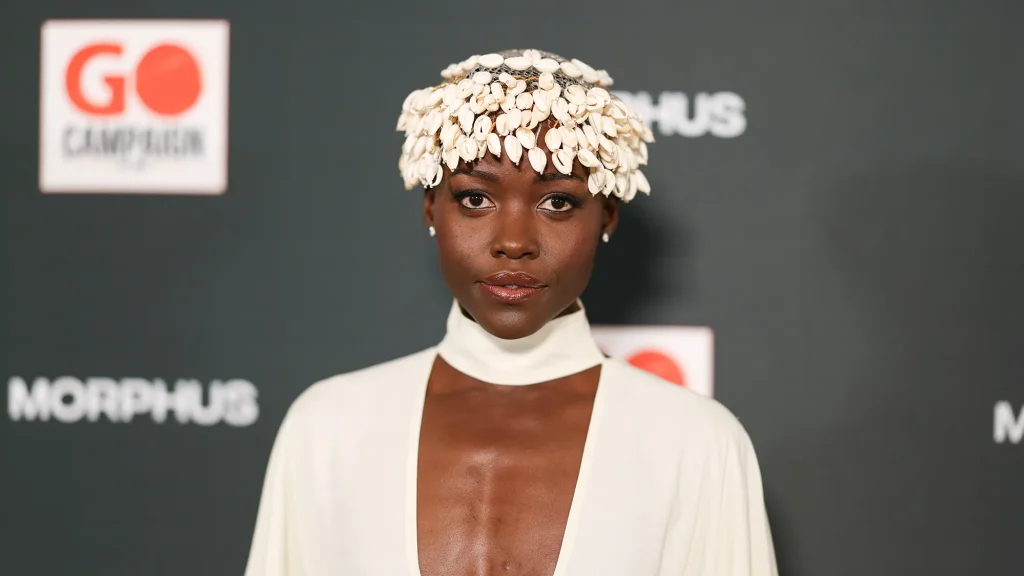
The upcoming epic adaptation of The Odyssey has become the latest battleground in Hollywood’s ongoing culture wars. At the center of the storm is the casting of Oscar-winner Lupita Nyong’o in the dual roles of Helen of Troy and her sister, Clytemnestra.
What should have been routine casting news quickly exploded into a culture-war spectacle after Elon Musk amplified criticism on X.
But beneath the trending hashtags lies a deeper question: why does Hollywood only care about “accuracy” when Black actors are cast?
Helen of Troy and the Politics of Beauty
In Greek mythology, Helen is described as “the face that launched a thousand ships,” a poetic symbol of legendary beauty. Critics opposing Nyong’o’s casting claim audiences cannot view a Black woman as embodying this ideal.
Conservative commentator Matt Walsh argued online that no one considers Nyong’o “the most beautiful woman in the world,” a statement Musk publicly endorsed.
The backlash was immediate. Supporters pointed out that the criticism revealed less about mythology and more about Eurocentric beauty standards that have dominated Hollywood for decades.
Actor Alec Baldwin defended Nyong’o publicly, praising her beauty while condemning the hostility directed toward her.
Yet this moment is not new, it is part of a long historical pattern.
Hollywood’s Long History of Whitewashing Black Stories
For generations, Hollywood routinely cast white actors in roles rooted in African, Middle Eastern, Asian, or Indigenous cultures — often without controversy.
Black historical figures, biblical characters, and ancient civilizations were frequently portrayed through a white European lens. Egyptian rulers, African leaders, and even characters geographically tied to non-European cultures were recast to fit Western expectations.
Ironically, one of the most visually accurate mainstream portrayals of ancient Egypt came not from Hollywood but from music icon Michael Jackson. His Remember the Time music video depicted ancient Egyptians as Black Africans — a representation supported by many historians who acknowledge Egypt’s deep African identity.
At the time, there was little outrage demanding “racial accuracy” in reverse.
Hollywood’s silence then contrasts sharply with today’s reaction: white actors portraying Black or non-European figures rarely spark global controversy, but Black actors portraying Eurocentric roles often trigger intense online backlash.
The Achilles Debate and Gender Politics
The casting debate does not end with Nyong’o. Actor Elliot Page, set to portray Achilles, has also become a target of criticism.
Achilles has traditionally been framed as mythology’s ultimate warrior archetype — hyper-masculine, powerful, and heroic. Critics argue that casting a trans man challenges that image.
Supporters counter that mythology has always evolved through reinterpretation. Greek myths themselves exist in multiple versions shaped by centuries of storytelling, adaptation, and artistic license.
The Double Standard Nobody Wants to Admit
Hollywood history reveals a consistent imbalance:
| When White Actors Are Cast in Non-White Roles | When Black Actors Are Cast in Eurocentric Roles |
|---|---|
| Called artistic freedom | Called “forced diversity” |
| Rarely sparks mass outrage | Sparks viral backlash |
| Treated as normal Hollywood practice | Treated as cultural controversy |
The outrage cycle follows a predictable formula. Calls for “accuracy” suddenly appear not as neutral artistic concerns, but as gatekeeping tools that protect traditional racial hierarchies within storytelling.