
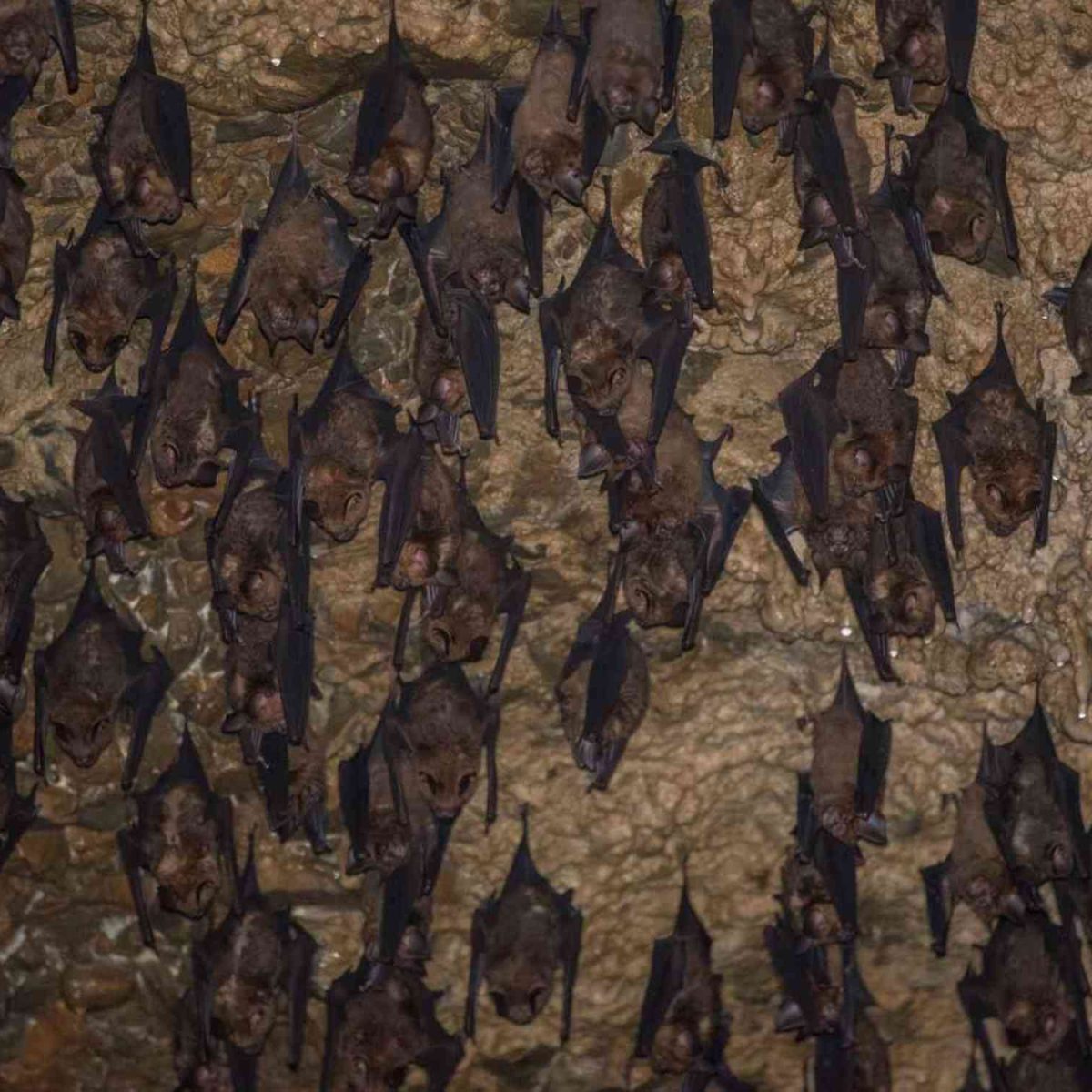
Long-fingered bats can travel dozens of miles in a night. They cross valleys and ridgelines in the dark, guided only by sound, and have been recorded at roosts far from where they were born. Biology says they should be good at moving.
What biology won’t let them do is live without a cave. No substitute exists – not a tree hollow, a cliff face, or a building. That single constraint turns out to rewrite what climate change means for these bats across sub-Saharan Africa.
Cave-bound by design

A team led by Dr. Mariëtte Pretorius at the University of Pretoria (UP) examined what climate change means for sub-Saharan Africa’s cave-roosting bats. They focused on long-fingered bats. These animals roost in caves.
Other bat species switch to tree hollows, buildings, or rock crevices when conditions change. Long-fingered bats can’t. If the cave isn’t there, they have nowhere to go.
The team pulled together 551 records of where these bats have been found across the continent. Habitat models then projected where the environment would still suit them from 2061-2080, drawing on six widely used climate models.
Ranges set to shrink
The numbers came back stark. Suitable habitat for long-fingered bats shrank by 36–64% by mid-to-late century, depending on the scenario. In the worst projections, almost two-thirds of the current range becomes unsuitable.
What remains is squeezed into a few zones: southern Africa, the eastern African highlands, and Madagascar. Everywhere else, conditions move beyond what these bats can handle – too hot, too dry, or with rainfall patterns that no longer fit their breeding cycles.
Scientists had begun to expect cave-dependent species to lose this much habitat in a warming world. The harder problem the study lays out is geological.
Where rock meets climate
A bat that needs a cave can’t just fly wherever the climate is comfortable. The cave has to be there too. And caves form only in limestone and similar soluble rocks in landscapes known as karst.
Pretorius and her colleagues overlaid the future climate-suitable areas onto a map of where karst actually exists in sub-Saharan Africa. The question was simple: of the climatically suitable places, how many also have the right rock?
The answer was about five percent. A sliver. Once land likely to be cleared or developed by 2050 was factored in, the overlap dropped to around two percent.
A trap closing slowly
Even if a bat colony could pick up and fly to a region where the future climate suits them, in 98% of cases the geology underneath won’t give them a cave to roost in. Nowhere to land.
Until this study, no one had quantified that mismatch at a continental scale. Earlier work, including a paper by the same group on Natal long-fingered bat (Miniopterus natalensis) migration routes, examined individual sites.
Linking those three layers – climate, rock, and land use – in a single continental model is new territory. Long-term survival depends on places where all three align: a workable climate, cave-bearing geology, and land that stays intact.
Migration paths fraying
Long-fingered bats don’t stay in one cave year-round. They travel between roosts – one for hibernation, another for raising young – and females in the Natal long-fingered bat are known to migrate regionally to give birth in maternity caves.
Those journeys depend on a connected landscape. The bats use lines of trees and natural cover to navigate, and they need foraging habitat along the way. As land-use change carves up that landscape, those connections break.
A climatically suitable cave is useless if a bat can’t reach it. Climate alone shrinks the options. Geology cuts them further. Break the corridors between roosts, and colonies may lose the ability to persist at all.
Where to focus protection
A handful of regions came out as priorities: the Drakensberg mountains in southern Africa, the Highveld plateau, and parts of the eastern African highlands. All three hold climate-suitable, cave-bearing land expected to stay relatively stable through mid-century.
Madagascar shows up too, with its limestone formations and rich long-fingered bat diversity. These are the places where protection would give the bats their best chance – not just individual caves, but the corridors between them and the foraging land around them.
Long-fingered bats consume large quantities of flying insects each night, including agricultural pests. Earlier research on the same species linked their migration timing to stable climatic cues. Lose them, and pest pressure on crops would likely climb.
The path forward
Conservation planning for African bats has tended to focus on protecting known roosts. The new work argues that this approach won’t be enough by itself in a warming climate.
Without considering where future climate will be hospitable and where the geology can host caves, even well-protected sites may end up stranded. The analysis gives southern and eastern African conservation groups a map of where to put limited resources.
It also opens questions about whether the same problem applies to other species that depend entirely on caves across the continent.
For the bats themselves, the picture is sharp. Their way of life depends on usable climate and usable rock at once, and both are becoming harder to find together.
The study is published in Austral Ecology.
—–
Like what you read? Subscribe to our newsletter for engaging articles, exclusive content, and the latest updates.
Check us out on EarthSnap , a free app brought to you by Eric Ralls and Earth.com.
—–