
José Alemán was 19 when he first became a political prisoner in Venezuela, in 2014.
A student activist, he organized peaceful protests and visited working-class communities to discuss the country’s political crisis. His first detention lasted less than a month.
But Venezuelan intelligence officers imprisoned him again in January 2018, this time for almost two years. Alemán said they planted weapons in his car, accused him of terrorism and took him to a regional facility operated by Venezuela’s intelligence service.
“They used all kinds of torture,” Alemán said. “Electric shocks, isolation and beatings. They suffocated me with buckets of water,” in a procedure known as waterboarding.
Facing the possibility of up to 24 years in prison, Alemán accepted exile in Spain.
His experience is one of thousands documented by Venezuelan human rights organizations. With no independent justice system at home, victims like Alemán turned to the International Criminal Court, or ICC, as one of their few possible paths to accountability.
“We are not looking for revenge,” Alemán said. “We want justice. And we want this to stop happening.”
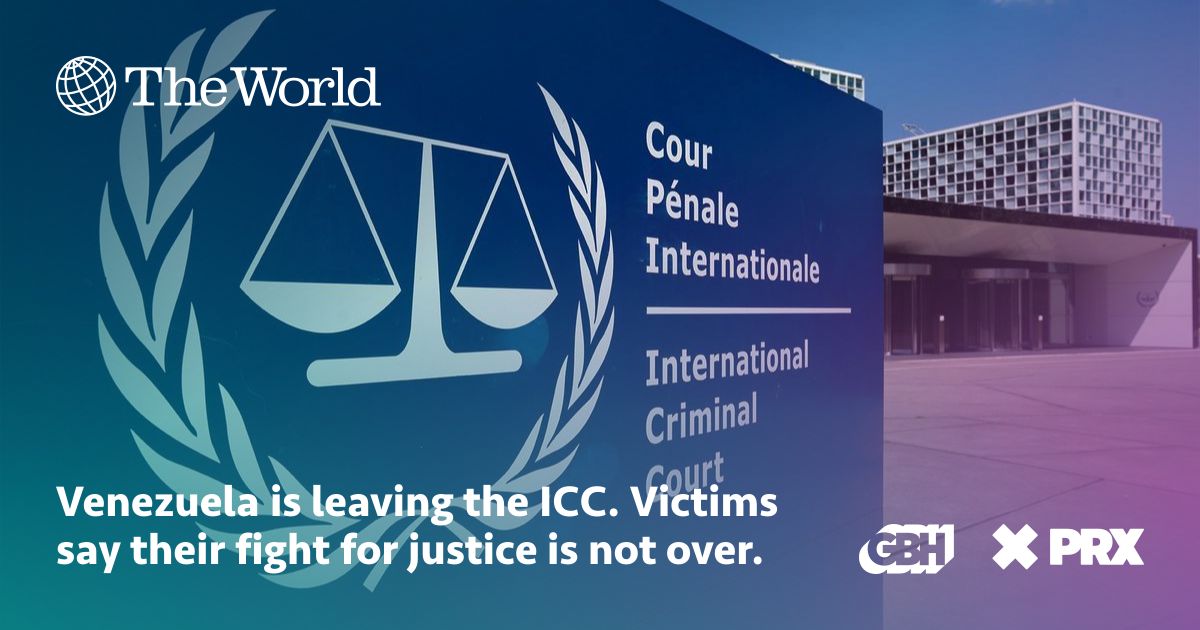
On July 24, the government of interim President Delcy Rodríguez formally notified the United Nations that Venezuela would withdraw from the Rome Statute, the treaty that established the ICC. The decision will take effect after one year. Rodríguez’s government accused the court of political bias.
The move received immediate support from the Trump administration, which is campaigning to dismantle the court. Secretary of State Marco Rubio called the ICC “corrupt and worthless” and urged its members to withdraw.
Chad announced days later that it also planned to leave. Burkina Faso, Mali and Niger had already begun separate withdrawal processes.

A Venezuelan flag waves in the wind atop the National Assembly palace in Caracas, Venezuela, Jan. 20, 2026.Matias Delacroix/AP
Years of evidence, but no public warrants
The ICC began examining alleged crimes in Venezuela in February 2018. It opened a formal investigation in November 2021, focusing on alleged crimes against humanity including imprisonment, torture, sexual violence and political persecution.
Rodrigo Diamanti, president of the human rights organization Un Mundo Sin Mordaza, said Venezuelan civil society spent more than a decade helping build the case.
“Since 2014, we have been documenting the horrible crimes committed by the Venezuelan regime and trying to compile a strong case to be presented to the court,” he said.
Diamanti said more than 8,000 victims participated in one stage of the proceedings—an unprecedented level of involvement. Many testified despite risks to themselves or relatives in Venezuela.
But nearly five years after the formal investigation began, no arrest warrants or charges have been made public.
“Victims risked their freedom by giving these testimonies,” Diamanti said. “And after all of that, right now, we haven’t seen any results from the ICC.”
Their frustration deepened because of controversy surrounding ICC prosecutor Karim Khan, who opened the formal investigation.
Khan’s sister-in-law, attorney Venkateswari Alagendra, appeared on the legal team representing the Venezuelan government before the court. Appeals judges later ordered Khan to step away from the Venezuela case, finding that the family and professional connections created reasonable grounds to question his impartiality.
For Diamanti and other advocates, the appearance of a conflict reinforced doubts about Khan’s strategy of cooperating with the Maduro government while it was under investigation.
“Never is a criminal going to put himself on trial,” Diamanti said, criticizing the prosecutor’s effort to encourage domestic investigations while the Venezuelan state itself was under scrutiny.
Khan was later removed as ICC prosecutor in July 2026 after a separate misconduct investigation involving allegations of sexual harassment, which he denied.
That disappointment has provided ammunition for Washington’s campaign. Rubio has argued that the ICC investigated Nicolás Maduro for years “with no result.” Maduro is now being prosecuted in a US court.

The motorcade believed to be carrying former Venezuela President Nicolas Maduro and his wife, Cilia Flores, travels along FDR drive after leaving Manhattan federal court in New York, July 22, 2026.Adam Gray/AP
But the two cases involve different allegations. Maduro faces drug-trafficking and weapons charges in the United States. The ICC is investigating alleged crimes against humanity committed against Venezuelans.
Mark Kersten, an international law expert at the University of the Fraser Valley in British Columbia, said Rubio’s claim that the court accomplished nothing may also be too simple.
The ICC can seek sealed arrest warrants that remain confidential until there is a realistic opportunity to detain a suspect, Kersten said. He emphasized that he does not know whether any exist in the Venezuela case.
“There could be arrest warrants in contexts like Venezuela that are not public,” he said. “They’ll be made public when there’s, for example, a real opportunity that someone will be arrested.”
Kersten also said the ICC has limited staff and funding to investigate complex crimes worldwide. Moving too quickly can produce weak cases that later collapse.
Venezuela was already preparing to leave
Although Washington strongly supported the withdrawal, the idea did not originate with the Trump administration.
In December 2025, Venezuela’s government-controlled National Assembly approved legislation repealing the national law that had ratified the Rome Statute. The vote did not remove Venezuela from the ICC, but it signaled the Maduro government’s intentions months before he was removed and Rodríguez took power.
Oscar Murillo, general coordinator of the Venezuelan human rights organization Provea, said the Trump administration gave Rodríguez political cover to complete a process that was already underway.
Kersten said Washington and Venezuelan officials have different but overlapping reasons to weaken the court.
Venezuelan officials may fear warrants related to alleged crimes against humanity. Washington, on the other hand, rejects the possibility that the ICC could investigate American troops or officials for actions carried out abroad.
US influence over Venezuela is another key factor. Kersten describes the Rodríguez government as operating under heavy tutelage from Washington, especially on foreign policy.

Chevron representative Mariano Vela signs an agreement to allow the company to expand its oil operations in Venezuela as acting President Delcy Rodriguez looks on, at Miraflores presidential palace in Caracas, Venezuela, April 13, 2026.Ariana Cubillos/AP
“They must have been encouraged, or told very unequivocally, that the expectation from the Trump administration is that they withdraw from the ICC,” he said.
The investigation can continue
Venezuela’s withdrawal does not erase the existing case.
The country remains an ICC member for one year after notifying the United Nations. Even after withdrawal takes effect, the court can investigate alleged crimes committed while Venezuela was under its jurisdiction.
Human rights attorney Génesis Dávila, who represents Venezuelan victims before international bodies, said the decision cannot erase Venezuela’s “criminal record.”
“All the crimes against humanity committed by those responsible can still be prosecuted,” she said.
The precedent of the Philippines shows that withdrawal does not necessarily prevent future arrests. The Philippines left the ICC in 2019, but the court retained jurisdiction over alleged crimes committed while it was a member. Former President Rodrigo Duterte was later surrendered to The Hague after political conditions inside the Philippines changed.
The ICC has no police force and depends on governments to arrest suspects. Kersten said elections, defections or divisions within governments can create unexpected opportunities to enforce warrants.
“It is not the actions of the ICC that result in arrest warrants being enforced,” he said. “It is domestic changes or domestic realities.”
‘Where else can victims go?’
Many Venezuelan victims still have faith in the court.
José Vicente García, a former city councilor from Táchira state, said he was detained by Venezuela’s intelligence police and held in an underground facility for months.
He described being bound to a chair, beaten and threatened with a gun during a 24-hour interrogation. He said he was then held for months in a cold, white cell where he could not see daylight, speak with other prisoners or determine the time.
García said the delays are frustrating, but preserving evidence and independently recognizing that abuses occurred are meaningful steps.
“When a victim feels that someone is listening to their story, that the facts are being investigated and that the evidence is being preserved, that is already a first step toward justice,” he said.
García supports the US-backed political transition in Venezuela but opposes Rodríguez’s decision to leave the court. He said Washington’s interests and the needs of Venezuelan victims should be treated separately.
Jesus Alemán, the student activist, also remains frustrated but unwilling to abandon the institution.
“The process is so slow that sometimes it causes despair and discouragement,” he said. “But I believe it is the only tool we have to seek justice.”
For him, Venezuela’s political transition still offers a possible opening. A future democratic government could cooperate with the ICC, help enforce warrants and pursue cases in Venezuelan courts.