
Suboptimal adherence to antihypertensive therapies affects nearly 60 percent of individuals with hypertension in low-resource settings, heavily driven by medication access challenges and the indirect costs of traveling to clinics. To address these systemic hurdles prior to deploying clinical interventions, an investigative team assessed the acceptability and feasibility of the Peers and Technology for Adherence, Access, Accountability, and Analytics model, known as PT4A. This planned framework links community-based medication refills, peer support, and digital health records into an integrated delivery system across rural and semi-urban communities.
The study was situated within the chronic disease management infrastructure of the Academic Model Providing Access to Healthcare, an established collaborative partnership involving the Moi University College of Health Sciences, Moi Teaching and Referral Hospital, and a consortium of North American universities. Operating across 69 health facilities in western Kenya, the broader clinical program provides longitudinal care to more than 40,000 patients with hypertension using task redistribution, community engagement, and an electronic medical records infrastructure adapted from the open-source OpenMRS platform. For this qualitative pre-implementation exploration, researchers focused on three distinct geographic sites: Webuye in Bungoma County, Kitale in Trans Nzoia County, and Turbo in Uasin Gishu County. Together, these three localities encompass an estimated population of 3.3 million people facing a notable cardiovascular disease burden, with urban healthcare facilities frequently serving dispersed surrounding rural communities.
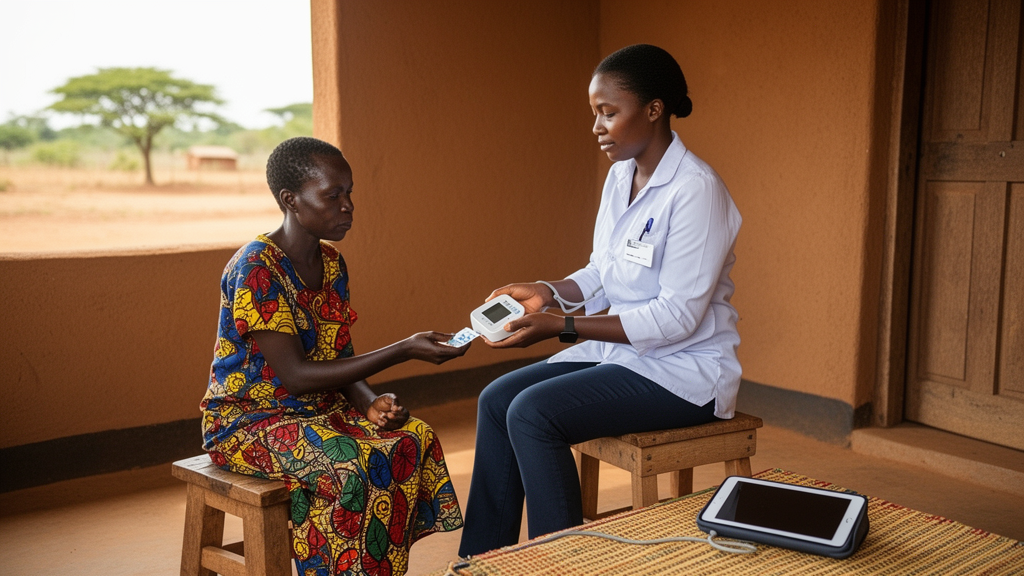
To rigorously examine operational dynamics before rolling out the clinical protocol, the research team adopted the PRECEDE-PROCEED implementation research framework to guide their formative assessment. The planned PT4A delivery mechanism organizes care around eight sequential operational stages aligned with routine healthcare facility encounters. Under this workflow, a patient is first approached and informed about the program during a clinic visit, provides informed consent, and is introduced to an assigned peer mentor. The patient and peer subsequently confer with a qualified pharmacist or pharmaceutical technologist to establish an individualized prescription refill schedule. The peer logs participant delivery rosters, travels into the community to hand off medications packed by the pharmacy, conducts structured pill counts, assesses therapy compliance, and offers psychosocial counseling, while coordinating mobile teleconsultations with primary clinicians whenever acute clinical challenges or referral needs emerge.
Data collection relied on qualitative engagement comprising 12 focus group discussions and four key informant interviews conducted between July and August 2021. Across the three study counties, investigators approached 114 prospective individuals, enrolling a total sample of 109 participants after five individuals declined due to personal schedule conflicts. The participant cohort included 52 patients diagnosed with hypertension divided into gender-stratified discussion groups of 23 men and 29 women, 28 community members consisting of 20 men and eight women, 25 practicing healthcare workers spanning physicians, clinical officers, nurses, and pharmacy staff, and four public-sector health administrators.
All qualitative inquiries utilized structured, piloted question guides administered in English and Kiswahili by experienced qualitative researchers, with focus groups running approximately 90 minutes and individual key informant interviews lasting roughly 60 minutes. Analysts achieved content saturation when successive focus group discussions and administrative interviews ceased yielding novel thematic codes. The research team applied collaborative consensus-building, investigator triangulation, and member checking to organize codes under three overarching themes: the fragility of trust regarding interpersonal safe spaces and confidentiality, cautious optimism regarding service delivery improvements balanced against operational hazards, and community ownership of local chronic disease management.
The first major analytical domain revealed a nuanced contrast between personal patient trust and institutional confidentiality concerns. Patients and local community residents almost universally categorized peer mentors as approachable, caring, and empathetic allies whose shared lived experiences with hypertension fostered non-judgmental environments. Participants reported feeling comfortable discussing symptoms and daily adherence struggles during home visits, noting that receiving medications directly from someone who traveled from the facility reinforced their personal resolve to remain on therapy. However, clinical personnel and administrative informants articulated substantial reservations regarding peer integrity.
Under the second thematic domain of cautious optimism, stakeholders acknowledged clear structural advantages in decentralizing chronic disease services while raising logistical caveats. Participants also viewed the point-of-care mobile health tool—which operates on electronic tablets integrated into the regional medical records system—as an effective safeguard for verifying refill deliveries, calculating adherence analytics, guiding medication forecasting, and arranging timely clinician teleconsultations without interrupting patients’ daily livelihood activities. By bringing pre-packaged maintenance medications closer to homes, the model promised to relieve the heavy indirect transportation expenditures that frequently interrupt therapy continuity in resource-constrained rural areas.
Despite recognizing these technical and logistical benefits, stakeholders highlighted persistent vulnerabilities related to peer competency, communication, and rural infrastructure. Clinicians and public health administrators cautioned that community members might mistakenly perceive lay peers as qualified practitioners, colloquially dubbing them small doctors and seeking medical guidance outside their authorized scope of practice. Health workers voiced additional apprehension that lay workers might miscommunicate complex clinical advice or distribute misinformation. Furthermore, community respondents questioned whether lay individuals possessed adequate digital literacy to operate tablet interfaces smoothly during home visits.
The third thematic domain centered on shifting disease ownership from centralized healthcare facilities into community hands. Informants across all cohorts indicated that visible peer involvement could demystify hypertension, counteract pervasive social stigmas linked to chronic illnesses, and normalize routine blood pressure screenings. Public sector administrators emphasized that utilizing locally embedded peers leverages preexisting sociocultural norms, fostering community trust and enabling residents to hold peers accountable for their assigned duties more effectively than external healthcare professionals could. Patients similarly expressed that home-based visits by peers would naturally educate neighbors and family members, cultivating a communal support system that encourages individuals who might otherwise avoid clinical care out of fear, discrimination, or misunderstandings about lifelong therapy.
In evaluating these qualitative findings, the authors situated stakeholder feedback within established conceptual models of interpersonal trust, which balance benevolence, technical capability, and ethical integrity. While benevolence was strongly validated by patients’ appreciation of peer empathy and dedication, capability and integrity emerged as primary targets requiring institutional mitigation. The study team concluded that mitigating healthcare worker anxieties requires rigorous, recurrent training modules covering health information technology workflows, alongside strict, formalized guidelines governing patient privacy and ethical conduct. Establishing explicit operational boundaries can prevent role creep while reassuring clinical professionals that peer distribution strategies supplement rather than supplant facility-based clinical oversight.
The researchers underscored several methodological and contextual limitations that contextualize their results. The qualitative design inherently captures personal beliefs, prior encounters, and individual perspectives from participants residing solely within western Kenya, which may not fully represent rural populations in alternative global settings. The investigative team also noted that lay peers themselves were excluded from this specific pre-implementation inquiry, although their operational feedback was incorporated into adjacent phases of the clinical initiative. Finally, western Kenya benefits from decades of established informatics infrastructure through the long-term presence of the AMPATH network, meaning implementation dynamics may differ in regions lacking established electronic health systems.
Ultimately, this qualitative pre-implementation assessment demonstrates that integrating peer-led medication delivery with digital health technologies offers an acceptable strategy to overcome hypertension adherence barriers in low-resource settings, provided structural risks are addressed proactively. By systematically identifying stakeholder priorities, operational friction points, and social dynamics prior to clinical deployment, the investigative team established actionable parameters to refine training curricula, reinforce data governance, and adapt logistical routing. The study highlights the indispensable value of conducting collaborative, multi-stakeholder formative assessments before rolling out complex health innovations, ensuring that decentralized chronic disease interventions remain scientifically sound, operationally feasible, and culturally grounded in the communities they intend to serve.
Subject of Research: Pre-implementation stakeholder evaluation of a peer-led medication delivery and mobile technology strategy for hypertension adherence in western Kenya
Article Title: “ You become free, you can tell her anything ”: Perceptions of a peer-based medication delivery implementation strategy to improve hypertension medication adherence in western Kenya
Article References: Watiri, C., Wachira, J., Njuguna, B., Gjonaj, J., Kangogo, K., Korir, M., Laktabai, J., Manji, I., Pastakia, S. D., Tran, D. N., & Vedanthan, R. (2026). “You become free, you can tell her anything”: Perceptions of a peer-based medication delivery implementation strategy to improve hypertension medication adherence in western Kenya. PLOS Global Public Health, 6(11), e0006143. https://doi.org/10.1371/journal.pgph.0006143
Image Credits: AI Generated
DOI: 10.1371/journal.pgph.0006143
Keywords: hypertension, medication adherence, peer support, digital health, western Kenya, global public health, qualitative research, mHealth, AMPATH, chronic disease management, community health, implementation science, health informatics, PRECEDE-PROCEED, teleconsultation, blood pressure control