

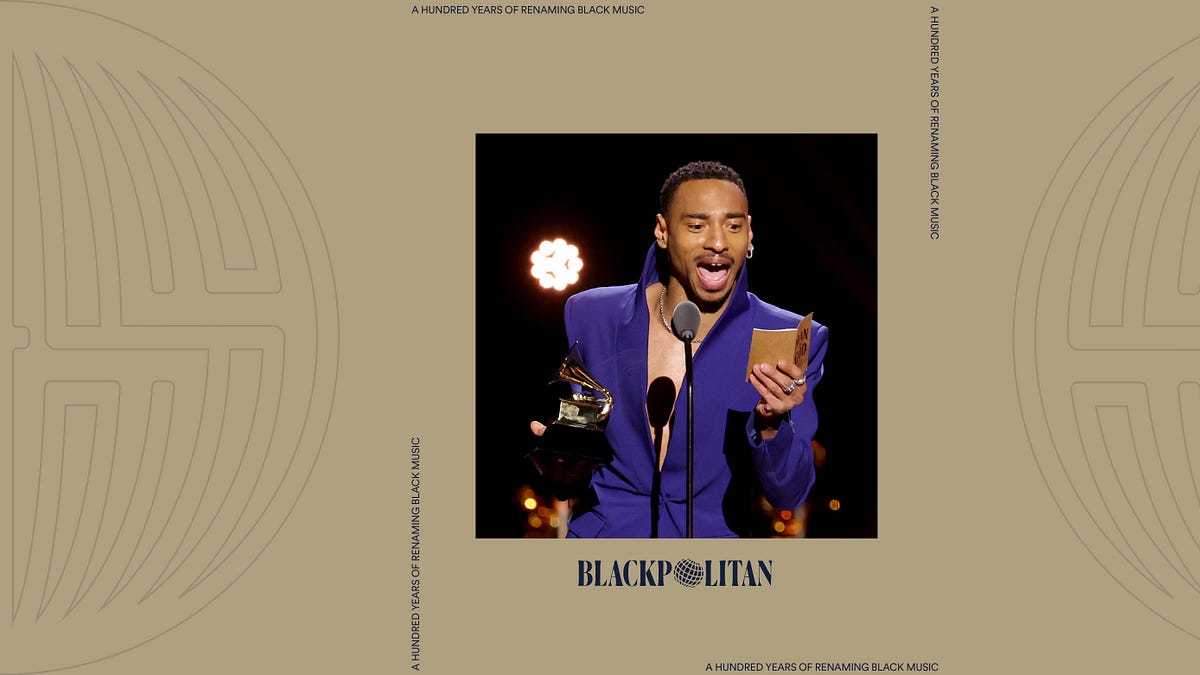
Halfway through Durand Bernarr’s speech, the singer realized his acceptance speech was still on his phone, and his publicist had to track him down the aisle while still open on the Notes app. Previously nominated four times, didn’t have a record label and referred to his fans as his cousins, who amassed his YouTube following one video at a time since 2008. The trophy he received on the first of February was for Best Progressive R&B Album, for Bloom, and he brought both his parents to see the night he was waiting for. He started by wishing everyone a happy Black History Month for the rest of his life.
By the end of June, months after his win and weeks after the release of his successor’s album BERNARR, a discussion about him and the singers like him was already trending on Twitter. It began with a post about how one can be both a global pop star and still embrace R&B, stating that both genres can co-exist and not take out one for the other. It cited a list of singers from Whitney to Michael, Beyoncé, Janet, Mariah, Diana, Donna, and SZA. The replies that followed promptly disentangled that tweet, one of which was aimed directly at Bernarr and claimed that he never rejected his R&B roots, and those replying only wanted him to remain exactly where he was, as the one asking him to stop only wanted him to do R&B.
Six years prior, Tyler, The Creator, backstage at the Grammys following IGOR’s win for Best Rap Album, described the victory as a backhanded compliment. He disliked the term urban because, to him, it was a politically correct replacement for the n-word, the niche music industry’s binary for any song created by a POC that was “urban enough.” The same year, the Recording Academy voted to rename Best Urban Contemporary Album to Best Progressive R&B Album, the title of the trophy Bernarr would receive in 2026, while Republic Records announced the end to any department’s or artist’s use of the term urban. The Academy retained the language in the Latin category, and the changes that had occurred in the trophy’s engraving were enough for the label to stop considering the term. The phrases that fueled the racist folks’ fire were the same that the industry utilized to box its Black performers in.
Let’s take it back to 1920, where the vaudeville performer Mamie Smith’s “Crazy Blues” had been released in a crystal-clear OKeh recording, and it had sold approximately seventy-five thousand copies in the first month. It marked the first time the record men realized Black people would buy their fellow Black people’s music. The talent scout responsible for discovering Smith, Ralph Peer, would go on to create the first RPM catalogs, dividing them into popular, hillbilly, and race categories based on the customers’ skin color and not the music itself. Blues, Gospel, and Jazz, therefore, were all put under the same label, race, with no distinction besides who bought them.
The man who created a new standard for record charts and replaced race records with rhythm and blues could not read music. Jerry Wexler, a young executive at Billboard, got his colleague to change the trade journal’s Race Records chart to Rhythm & Blues in 1949. He later wrote in his memoir Rhythm and the Blues that “race was a word used by black people for themselves,” that “Race Records just didn’t sound right to me,” and that “I felt that we needed a name that reflected more enlightened times.” Both things he said were true—a white man named Jerry Wexler got to choose the name, and the name he chose embodied his own complicated feelings about his own prejudice. Four years later, Wexler would buy Atlantic Records and begin to make the music his charts once celebrated.
The flag kept getting changed, but the hand holding it remained the same. The chart that once spotlighted Mamie Smith became the Rhythm & Blues chart, the Soul chart, the Black chart, the R&B chart, the R&B/Hip-Hop chart—run up by the trade to hide the one before it, not once in a hundred years covering any of the artists it purported to honor.
Whitney Houston was booed at the Soul Train Music Awards by fans of the very music she was there to celebrate. They had decided that her music was too pop, that her image was too white, that this talented but provincial singer who’d sold tens of millions of copies of “I Wanna Dance with Somebody” simply did not belong to them. Decades later, Houston would tell the story on television, surprised and a little confused by the treatment, saying that she’d grown up listening to Soul Train just like everyone else. The most vicious rebuke of the “R&B audience” is that it really is an audience, that it wants what it wants and is not particularly interested in any explanation. No R&B artist, Houston seemed to be saying, gets to grow beyond its audience, to move from one niche to another, more accepting one, without selling out. It is the nastiest way of reading Houston’s piece, and it may be the correct one. A young black woman discovers there are two kinds of R&B: the kind that sounds like her own life, and the more popular kind, which is for everyone else.
MTV did not feature black singers for its first few years, a policy that ended when CBS threatened to pull all its shows from the network and “Thriller,” the single, came out in ‘83. Michael Jackson had seen his Off the Wall get snubbed by the Grammys the year before, getting one R&B trophy and no love from the pop categories, and he was ready to make the album of his lifetime. King of Pop would be the name he got to use when no one else would let him, a moniker so large no one could corral him. One of the summer posts noted this development as well, observing that Michael Jackson isn’t called the King of Pop for nothing and that the pop world was the exit from the smaller room the business had built for him.
Sony created Mariah Carey for the world, a pure pop and adult-contemporary singer, and they reacted negatively when she transformed towards hip-hop soul and added Ol’ Dirty Bastard to the remix of “Fantasy” in 1995. The most explicit expression of this thread’s inner tension was Carey criticizing the same system that putatively signed her. By naming the genres that a record would fall under before its release, a label determined which radio formats the song would target, what awards its author could receive, and how much money would be poured into the campaign. Artists who oppose the R&B genre are attacking the machinery that put Anita Baker and those who consume her music on the same platform. Janet Jackson sounded similar when she announced the name of the project Control, and Diana Ross scored significantly by jumping from the carefully tailored Chic productions to the pop charts as disco was taking off.
In the summer of 1979, Chicago radio stations hosted an event that drew a crowd of thousands to a local baseball stadium, where a group of boneheads set a stack of disco records on fire during the seventh-inning stretch. The dancefloor anthem that had conquered the hearts of millions had outgrown its home, and soon after, Donna Summer, its most renowned presenter, was exiled from the airwaves. This happened because the R&B community and radio stations could no longer accept such a project as part of their programming.
SZA posted the title of her first single on SoundCloud in 2014 with the note “Not R&B,” and she has been vocal about her thoughts on the matter ever since. The only reason her music is categorized under R&B is because of her skin color, and she resents the lack of versatility that the label implies. Justin Bieber has been creating R&B, folk, and other types of music and has continued to gain fame as a pop idol. Meanwhile, co-signing singers like Summer Walker and Ari Lennox are committed to the R&B genre, and the star has nothing against it. She means that it does not describe her music adequately, but that is the only problem. It highlights the most critical aspect of tension in this thread, in which the most exacting authorial intentions collide with the reluctance of radio jockeys, critics, and industry executives who automatically categorize Black singers as R&B vocalists.
Beyoncé paid tribute to Linda Martell, the first Black woman to perform at the Grand Ole Opry, on Cowboy Carter, her newest album, and allowed her to declare that genres are a “fun little concept,” simple in theory but frequently limiting in practice. At the same time, the star has struggled to fit into the much narrower confines of country music. For years, the Recording Academy has been reluctant to present her with the genre’s highest honor, the Grammy for Best Country Album, despite her being repeatedly nominated. It went to her album Cowboy Carter in 2025, making her the first Black artist to win the award, but she made it quite clear that the music was intended to be a Beyoncé album rather than a country one. Renaissance, the act preceding Cowboy Carter, was a house-inspired opus that drew heavily from the Black and queer dancefloor culture that had once devoured the ballpark. Again, Beyoncé proved that she could force an industry to reevaluate itself from within rather than simply exiting and starting over.
Bloom jogs through the funk and soul and rock and the pop-R&B of the early 2000s, fifteen tracks Bernarr recorded without a major label on his back and with a particular nod to the 1995 Waiting to Exhale soundtrack, which he made with his friend, and the real subject of his range, is a gospel-trained vocalist who’s been singing backup for Erykah Badu for ten years. When discussing his range, he talks about touching on genres that we created. He name-drops Linda Martell with the same kind of dismissive wink that Beyoncé does. He won inside Progressive R&B, the category Race Records got rebranded multiple times, and he wears the victory like a homecoming he feels he’s due.
Bernarr is right to name the system, and he is not the first to do so. Black singers have been doing it for decades, singing about the ways in which the label dictates the formats in which they can be heard, the radio stations to which they can sell their songs, the playlists they can land on, the space they have to maneuver within the greater music ecosystem. The credit, when it comes, goes one direction, and the criticism comes the other. A white singer can meander effortlessly through pop, folk, and soul, and be lauded for her range, while a Black singer who touches on the same styles will be told to narrow her focus, questioned about her inability to stay within the confines of R&B. To hear the former described as a “chameleon” is to miss the point entirely; the labels that want to sign her do so precisely because she can be shaped, molded, sound like everyone, and therefore belong nowhere. The people who feel cheated by the system are the ones who want the music to be bigger than the box first, and biggest of all are the ones who feel their own contribution to the tradition has been unfairly narrowed.
To feel cheated by the system is one thing. But to outgrow it and act like it never happened is another. Rihanna is an easy comparison to make; the way the marketing machine wants to file her under R&B for her skin tone, not her music, but a chameleonic pop star who refuses to be contained is a very different thing from a Black singer who has outgrown the R&B template. The problem with the latter is that she is still inextricably linked to the tradition, to a certain way of making music that can be frustrating to move beyond, even as one wishes to. The debt remains due, long after the annoyance at the accounting has passed. It takes its worst toll when the artist who most loudly proclaimed their departure from the box grows roots within, turns back around, and begins to guard it zealously.
Both the sense of debt and the feeling of being trapped are addressed in the very same statement, the one made by Bernarr to the journalist who asked him to discuss his growth as a songwriter, his range, this “versatility” that is so sorely coveted in these parts. He speaks of the need to engage with the different genres of Black music, to exercise this range he feels he has, and then proceeds to admit he hasn’t done it, not really. The next best thing, then, is these two records he has made since, the ones that finally let his R&B-adjacent ambitions, expressed so frequently in interviews, see the light of day.
The record he laid down right after that? It came out this past May, and he named it after his father, Bernarr Ferebee Sr. As a live audio engineer, his father’s credits include Whitney Houston, JAŸ-Z, Aretha Franklin, Stevie Wonder, and so many others to name. The very names the original thread used as proof that the pop world could embrace Black music and make it bloom were on the consoles in the control room of the man his son chose to name an album after. The coexistence the thread pretended to celebrate was right there in plain sight the whole time. The thread barely had to do any work. Bernarr simply put his father’s name on the spine and claimed the legacy in the name of his album.
The thread was not able to decide whether R&B is a home or a holding pen. It could not have, not while it was circling the word. The word needs to be both. The century turning on the phrase turns on the word itself, on something that has been far more tightly held and administered by people outside the music than within, by talent scouts and chart compilers and award show administrators and A&R execs, who have had far more influence on how it might be renamed or retained than the artists who make the sound. Every iteration of the fight left the hand right where it needed to be for whoever controlled the word to continue to control it.
Bernarr won his Grammy without question, in a category that had existed for a century, but still, it took another man, another black man, whose ancestors once physically laid hands on Race Records charts, to ensure that he would not win it in any other category. What Bernarr did with the trophy was use it to reject the terms entirely, to lay claim to the tradition in the name of his father and pass it on to his contemporaries, those he named in his speech. The people who are yelling at each other on Twitter need not worry about a word. The century turns on the phrase turns on the hand that administers it, and the hands of people like Bernarr, who are able to take it back, one record at a time, and reclaim it for themselves.