
The share of Africans who say rich countries should take primary responsibility for limiting climate change has doubled from 13% to 27%, according to an Afrobarometer climate survey of 35 countries released in Accra on 26 November.
The findings put a number on a shift in African public opinion just after the COP31 talks in Antalya, where Afrobarometer said countries failed to agree on parts of climate finance. Large majorities across 38 countries say wealthy nations must cut emissions now and help poorer countries pay to adapt.
What does the Afrobarometer climate survey show?
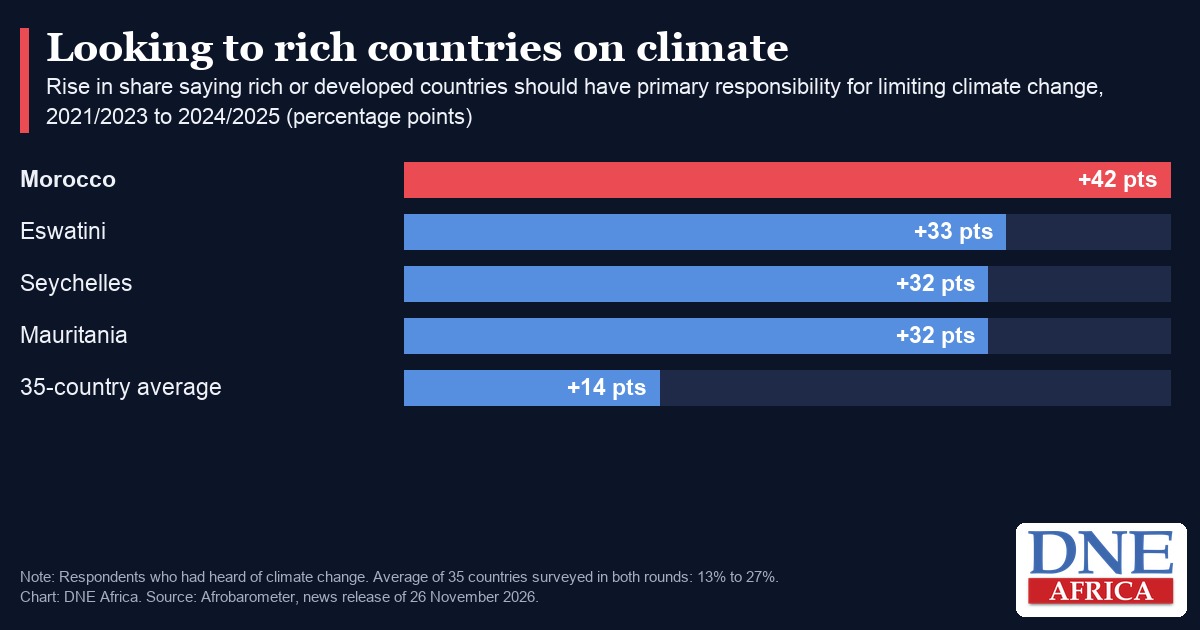
The Afrobarometer release compares two rounds of face-to-face surveys. Across the 35 countries polled in both 2021/2023 and 2024/2025, the proportion of people aware of climate change who say rich or developed countries should bear primary responsibility for limiting it rose from 13% to 27%.
The rise was widest in North Africa and a handful of small states. The Afrobarometer climate survey recorded the largest increases in Morocco (42 percentage points), Eswatini (33 points), Seychelles (32 points) and Mauritania (32 points). Only two countries moved the other way, and only slightly: Guinea, down 3 points, and Mali, down 2.
The survey network, which is based in Accra, interviews nationally representative samples in the language of each respondent’s choice. It gives country-level margins of error of plus or minus 2 to 3 percentage points at a 95% confidence level, and weights each country equally in multi-country averages.
Who do Africans say should act on climate change?
National governments are still named most often. Among respondents in the Afrobarometer climate survey who are “climate-change literate”, meaning they know human activity contributes to climate change, 37% across 38 countries say their own government should have primary responsibility.
Views differ sharply by country. Majorities in Nigeria (64%), Guinea (60%) and Chad (57%) look first to their own governments. In Morocco, Seychelles and Tunisia, 64% each say wealthy, developed countries should lead. Ordinary citizens are the most frequent answer in Uganda (48%), Zambia (44%), Togo (40%) and Ghana (37%).
Support for action is broad in the Afrobarometer climate survey. Among climate-literate respondents, 83% say rich countries must act now to limit climate change even if it is costly for them, and 85% say those countries have an obligation to help developing nations cover the cost of adapting. Some 73% say their own government should act now, even if it causes job losses or other harm to the economy.
How do the results compare with last year?
The 38-country averages match those in Afrobarometer’s pan-African climate profile published in November 2025, which drew on the same 2024/2025 round. That profile found that 56% of Africans had heard of climate change and 43% were climate-change literate, with awareness ranging from 27% in Nigeria to 91% in Seychelles.
The 2025 profile also found that half of respondents said droughts and crop failure had become more severe in their area over the past decade, and that 80% of climate-literate citizens said climate change was making life in their country worse. It noted that the belief that developed nations should lead “appears to be on the rise”. The new release measures that change across two survey rounds for the first time.
What does it mean for climate finance talks?
The Afrobarometer climate survey figures arrive as African governments press for more money for adaptation. The finance goal agreed at COP29 in Baku in 2024 aims to triple finance to developing countries to $300bn a year by 2035, from the previous goal of $100bn, according to the UN climate change secretariat. African negotiators sought a separate commitment to triple adaptation finance at COP31 but did not secure one.
Afrobarometer said citizens’ views “continue to back action” after the Antalya conference, which it said made progress on a just transition and adaptation but failed to reach agreement on aspects of climate finance and fossil fuels. The next round of talks, COP32, is due to be held in Addis Ababa, as DNE Africa reported after COP31. Afrobarometer also released a survey on Cameroon unemployment this week.
FAQ
What is the Afrobarometer climate survey?
It is part of Afrobarometer’s Round 10 surveys, carried out face to face in 38 African countries in 2024/2025. The 26 November release compares responses on climate responsibility with the previous round in 35 countries.
How many Africans say rich countries should lead on climate change?
Across 35 countries, 27% of people aware of climate change say rich or developed countries should bear primary responsibility for limiting it, up from 13% in 2021/2023, according to Afrobarometer.
Which country saw the biggest change in the Afrobarometer climate survey?
Morocco, where the share naming rich countries in the Afrobarometer climate survey rose by 42 percentage points. Eswatini, Seychelles and Mauritania followed with rises of 32 to 33 points.
Do Africans still expect their own governments to act?
Yes. Governments are the most common answer, at 37% across 38 countries, and 73% of climate-literate respondents say their government should act now even if it is costly for the economy.