
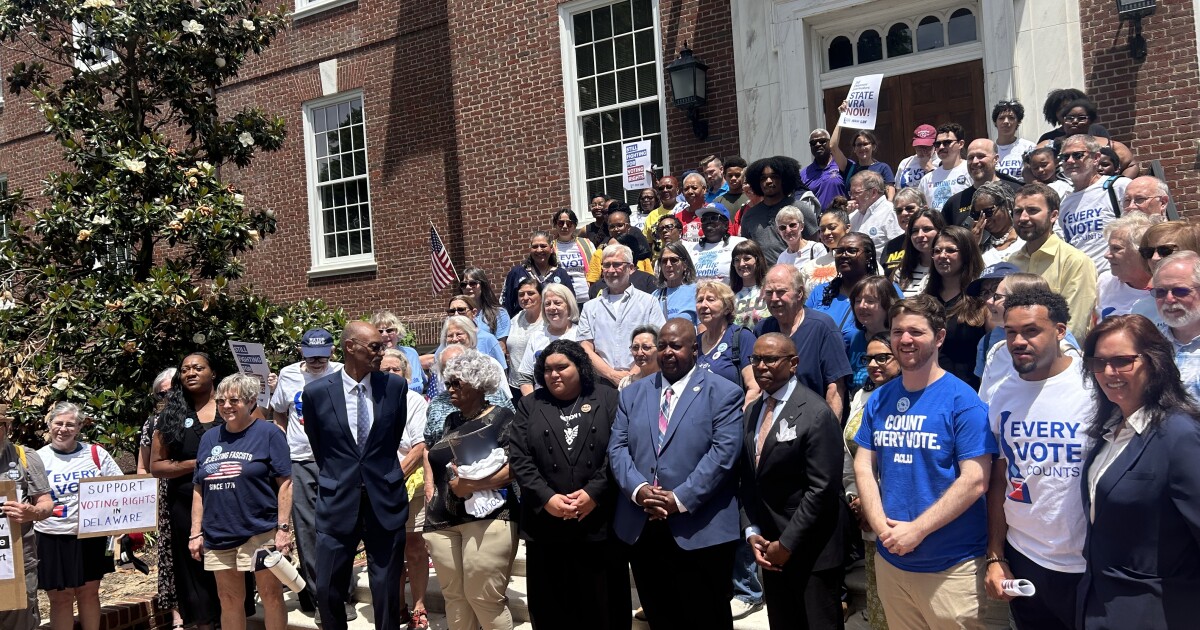
Delaware joins a movement to implement state-level voting rights protections. Voting rights advocates, Delaware residents, and lawmakers rallied at the statehouse to support the Delaware John Lewis Voting Rights Act’s introduction on Friday.
State Representative Larry Lambert introduced the measure, also called HB 444. He said it’s meant to give Delawareans protection against discriminatory voting practices. He said started working to draft the legislation last year with the Delaware ACLU.
“Some people think that this bill was sponsored and has been filed just in response to national headlines,” Lambert said. “It has not. We love and we honor the work that our Department of Elections do, and this bill about assistance for voters. This bill is about protection.”
Eight other states, like lNew York and Virginia, have already implemented such laws. Delaware is the first to propose the legislation since the Supreme Court’s decision in Callais v. Louisiana last month. Voting rights advocates say the decision dealt a huge blow to the Voting Rights Act’s section 2, which prohibits discriminatory voting practices. The April 30 court decision makes it harder to challenge electoral districts based on racial discrimination.
“We need to make sure we codify this into law as the Voting Rights Act at the national level is being gutted,” Lambert said.
Black people make up about 23% of Delaware’s population, the eighth highest in the country. Lambert said Delaware need to be proactive, as other states with higher percentages of minority populations have seen legal protections for their minority voters eroded.
The Supreme Court Callais decision makes way for Alabama to use congressional maps deemed racially discriminatory by lower courts, in a legal fight that’s continued since 2020.
“Who knows what’s going to happen between now and our elections in September, our primary elections in September, or our general elections in November,” Lambert said. “Now is the time of urgency to make sure that it is passed.”
The measure would prohibit election practices that suppress, dilute, or discriminate against voters, regardless of intent. It gives individuals, organizations and the Attorney General an avenue to bring motions forward to challenge potential discriminatory legal practices.
Without the law in place, challenges to discriminatory voter practices would rely on the constitution and Voter Rights Act.