
How Redistricting Is transforming Florida’s political landscape
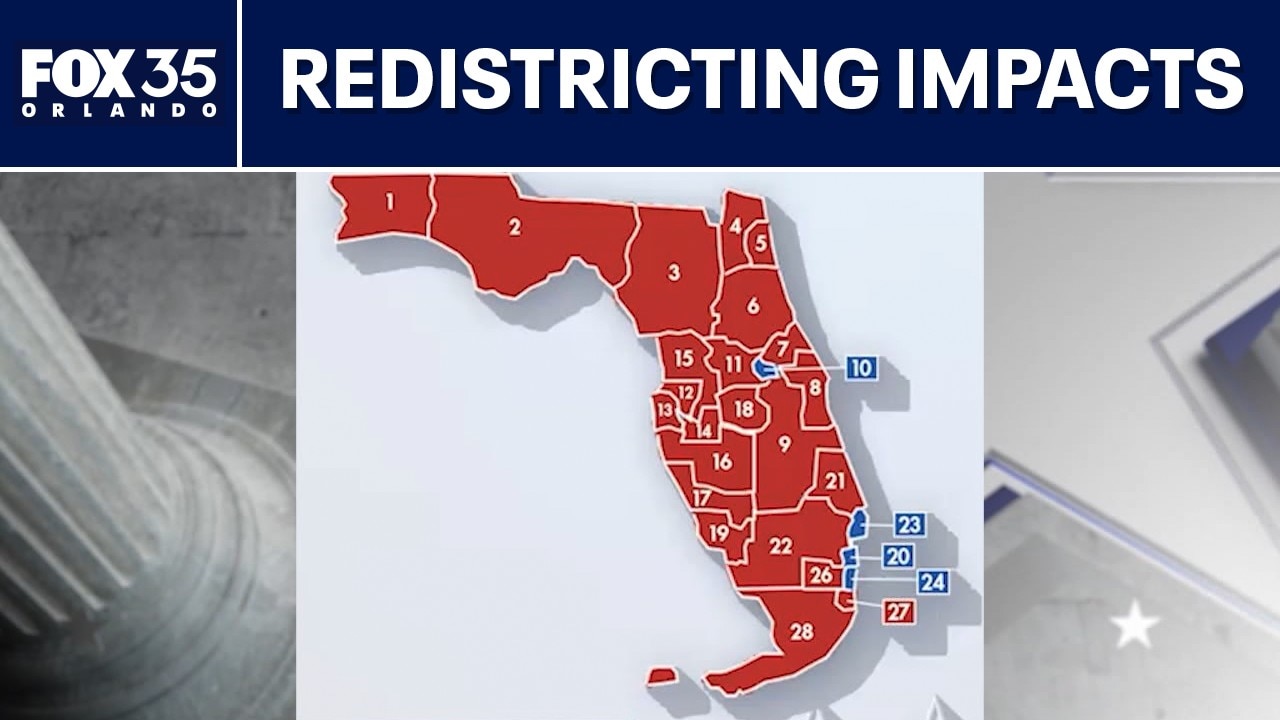
Florida is still seeing some of the ramifications of the congressional reshuffling due to the Florida legislature approving Governor DeSantis’ new voting maps. Kyle Kondik, managing editor of Sabato’s Crystal Ball at UVA Center for Politics, joined FOX 35’s Garrett Wymer live over Zoom to break down what this means for Florida.
ORLANDO, Fla. – Florida’s newly redrawn congressional map will remain in effect for this year’s midterm elections after the state Supreme Court declined to intervene in an ongoing legal challenge.
The ruling leaves little time for opponents of the map to secure changes before candidate qualifying ends this week.
What we know:
In a 6-1 decision issued Tuesday, the Florida Supreme Court ruled it does not currently have jurisdiction to review a lower court’s refusal to temporarily block the congressional map.
The challenge was brought by Equal Ground Education Fund and other voting rights groups, which argue the map violates Florida’s Fair Districts Amendment by favoring Republicans. While the lawsuit will continue through the courts, the districts will remain in place for the 2026 elections.
Candidate qualifying for U.S. House races closes Friday at noon, effectively ensuring the new map will be used this election cycle.
The backstory:
The dispute stems from a congressional redistricting plan pushed by Gov. Ron DeSantis after President Donald Trump encouraged Republican-led states to redraw congressional boundaries ahead of the midterm elections.
An aide to DeSantis drafted the map, which was approved without changes by the Republican-controlled Legislature during a special session in April.
CLICK TO DOWNLOAD THE FOX LOCAL APP
Supporters of the map argue it was necessary following a recent U.S. Supreme Court ruling that DeSantis said weakened legal justification for certain minority-opportunity districts, particularly Congressional District 20.
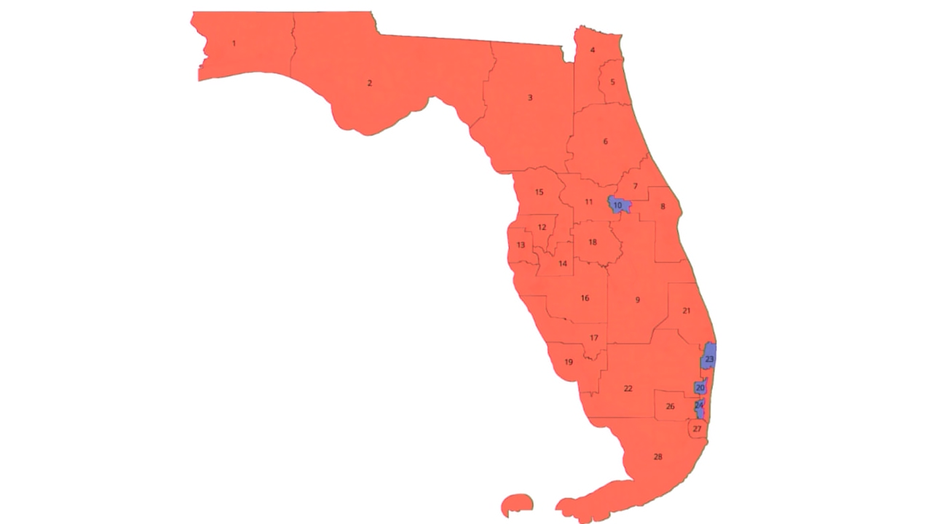
Gov. Ron DeSantis unveiled a congressional redistricting map. (Source: Office of Gov. Ron DeSantis)
Opponents contend the new boundaries were intentionally designed to increase Republican political power, violating Florida’s constitutional ban on partisan gerrymandering approved by voters in 2010.
What we don’t know:
The courts have not yet ruled on the central question of whether the congressional map violates the Fair Districts Amendment.
The First District Court of Appeal is still considering the underlying lawsuit, and further appeals remain possible after a final ruling on the merits.
What they’re saying:
Equal Ground Executive Director Genesis Robinson criticized the decision, arguing voters will face another election under a map her organization considers unconstitutional.
“The time to protect voters from irreparable harm is before another election takes place under this map,” Robinson said. “Florida voters deserve fair maps, fair representation, and a democracy that works for everyone now.”
SIGN-UP FOR FOX 35’S BREAKING NEWS, DAILY NEWS NEWSLETTERS
Justice Jorge Labarga, the lone dissenter, argued the Supreme Court should have taken up the case immediately because of the approaching election calendar.
“Unfortunately, for now, and with a filing deadline and an election fast approaching, we will not have the opportunity to review the issues of statewide importance raised in the petitioners’ efforts to enjoin Florida’s 2026 congressional map,” Labarga wrote.
Justice Adam Tanenbaum, writing separately in support of the majority, emphasized that elections will proceed as scheduled while the legal challenge continues.
“The people of Florida can rest assured that elections will take place this year,” Tanenbaum wrote, adding that plaintiffs will still have an opportunity to present their case in court.
Big picture view:
The decision represents a significant victory for DeSantis and Republican lawmakers, ensuring the newly drawn congressional districts remain in place for the 2026 midterms.
The case also highlights the continuing debate over redistricting in Florida, where voters approved anti-gerrymandering protections more than a decade ago, but where disputes over how those protections should be applied, continue to generate legal and political battles.
With the election calendar moving forward and candidate qualifying imminent, the practical impact of Tuesday’s ruling is that Florida’s 28 congressional districts will remain unchanged for this year’s races, regardless of how the broader legal challenge ultimately unfolds.
The Source: This story was written based on reporting by the News Service of Florida.