
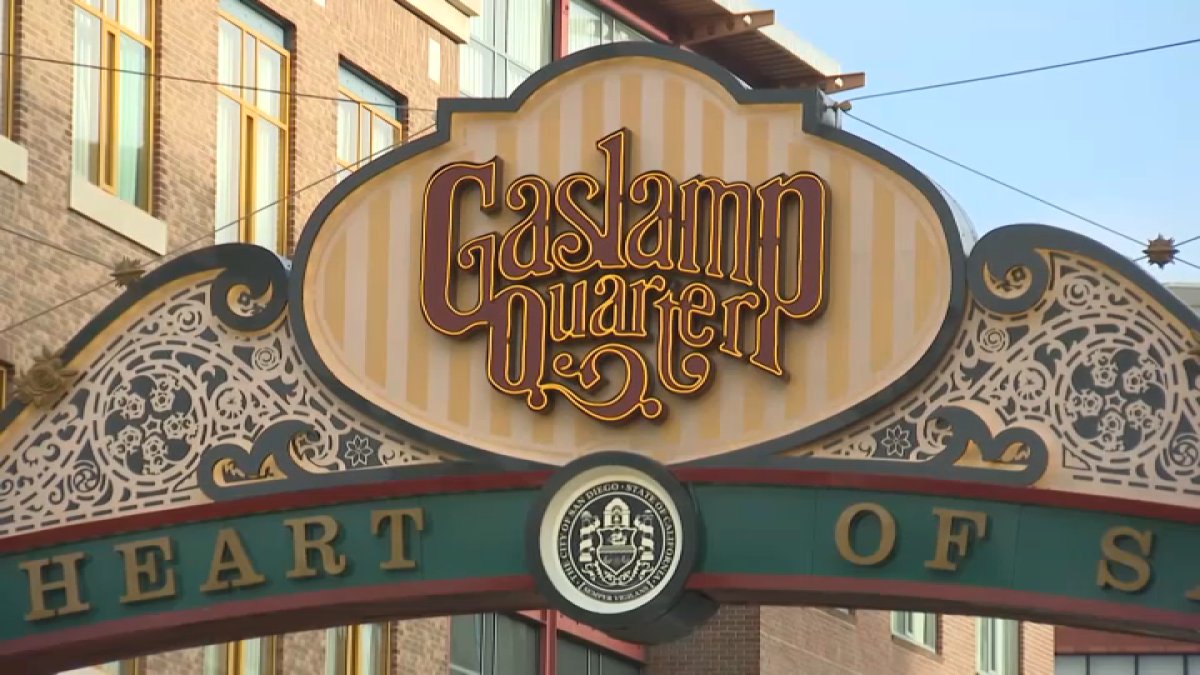
A federal judge has denied the city of San Diego’s motion to dismiss a civil rights lawsuit involving two people who accuse San Diego police bike officers of excessive force during an encounter in the Gaslamp Quarter.
The lawsuit, filed by George Medina and Araceli Urbina Viveros, challenges the San Diego Police Department’s use of chemical spray, arrest procedures and policing tactics in the downtown entertainment district.
The case stemmed from a July 2025 encounter near Fifth Avenue and G Street, where video shows officers taking Medina to the ground, punching him, kicking him in the ribs and using pepper spray.
At one point during the encounter, Medina was heard saying, “I’m not resisting.”
Video also showed Urbina Viveros recording the encounter on her cellphone before she is tackled by police.
Both sued the city and police department, alleging their civil rights were violated.
Their attorney, Dante Pride, said the federal court’s decision to allow the lawsuit to proceed is significant because it opens the door to challenging broader police policies and procedures rather than focusing solely on the actions of individual officers.
“What the court is allowing us to argue now is that it is not just a bad apple there might be something wrong with the tree,” Pride said.
Pride argued that the tactics used by San Diego police bike officers have become a larger concern in the Gaslamp Quarter.
“What we’ve seen is craziness absolute craziness. There is a YouTube channel just for San Diego Police bike cop policing tactics. That’s how insane it is,” Pride said.
According to Pride, both plaintiffs suffered post-traumatic stress disorder following the encounter. Medina also suffered broken ribs and other injuries.
Pride said neither of his clients was convicted of a crime in connection with the incident.
Police point to rising violence in Gaslamp Quarter
The lawsuit comes amid a significant increase in reported disorderly conduct cases and assaults on police officers in the Gaslamp Quarter.
According to SDPD statistics, disorderly conduct cases in the Gaslamp increased from 11 in 2021 to more than 1,000 in 2024. In 2025, the department recorded 985 complaints.
The same department study showed 200 reported assaults on police officers in the Gaslamp Quarter in 2025, nearly double the number reported the previous year.
In a statement released three months ago, the department defended its officers’ work in the downtown district, pointing to increased intoxication and violence.
We have seen an increase in the level of intoxication and violence in the Gaslamp. Our officers have an important job to do in the Gaslamp to maintain public safety and deserve to do their work in a safe environment.
When asked about the July 2025 encounter and the lawsuit, a San Diego police spokesperson said the department does not comment on ongoing court cases.
Federal case could put police policies to the test
With the city’s motion to dismiss denied, the lawsuit can move forward, potentially putting the SDPD’s use-of-force policies and arrest procedures under greater legal scrutiny.
Pride said the case raises fundamental questions about how officers interact with the people they are sworn to protect.
“When there’s an issue and a problem we deserve and expect the police will be there to help serve and protect us not to beat us,” Pride said.
The outcome could have implications for how San Diego police officers conduct enforcement operations in the Gaslamp Quarter and other parts of downtown.
This story was originally reported for broadcast by NBC San Diego. AI tools helped convert the story to a digital article, and an NBC San Diego journalist edited the article for publication.