
Frances Z. Brown and Nate Reynolds
Too often in the halls of Capitol Hill, and more broadly in Washington, Russia’s role in Africa is framed in polarizing and almost caricature-like terms. On the one hand, Russia is frequently portrayed as a potent, malign actor that demands a robust response across multiple fronts. On the other, it is sometimes dismissed as a weak paper tiger that is not worth challenging with meaningful resources. This compendium aims to inject nuance and complexity into this conversation.
The collection explores Russia’s role, its appeal, and its limitations across very different parts of the continent—from West Africa and the Sahel to Southern Africa. Bringing together contributions from a range of scholars based in or hailing from the continent, it dives into Russia’s interests and tools, and explains how they vary over time and between places. Given Moscow’s increased engagement on the continent since the 2010s, and especially since its full-scale invasion of Ukraine in 2022, this collection offers a timely look at its influence in these two key regions.
But equally, the compendium explores the agency and interests of African governments and citizens. As African actors navigate relationships with Moscow and other external powers, they are identifying new ways to promote their goals—and facing new risks.
In the end, the picture that emerges is complex. No single story encapsulates Russia’s role on the African continent, and likewise, no single story emerges of African governments’ and citizens’ agendas vis-à-vis Russia. In this opening overview, we highlight three key themes that emerge in multiple essays in the collection. Just as importantly, we also highlight three open questions that bear consideration as the narratives of Russia in Africa continue to unfold.
Key Takeaways
Opportunism continues to define Russia’s approach to Africa, as Moscow hones a set of tools designed to take advantage of instability and state fragility.
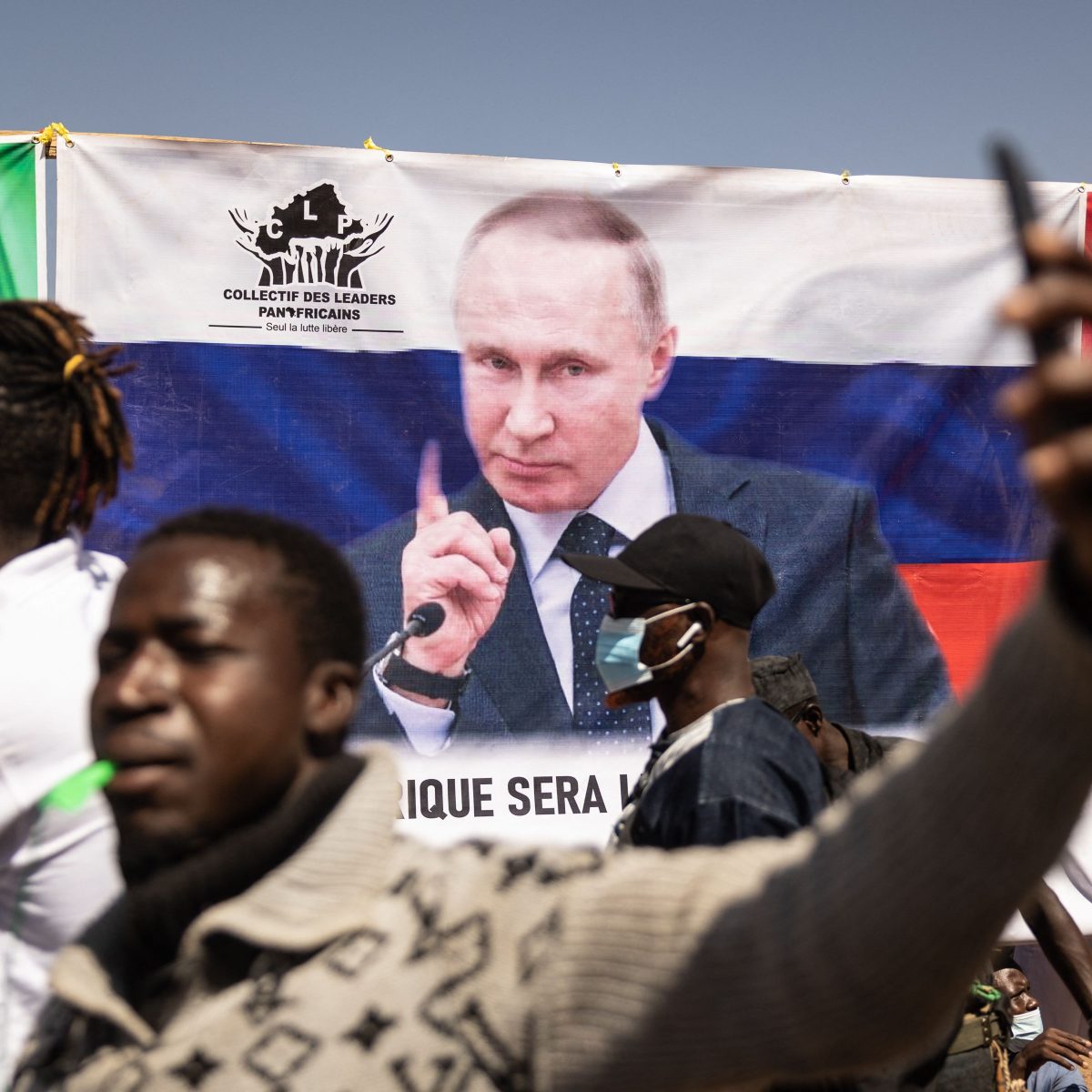
Since Russia expanded outreach to Africa over a decade ago, it has exploited political instability and weak regimes to build influence quickly and cheaply. In 2018, Russia shocked the West by deploying mercenaries and weapons to shore up Faustin-Archange Touadéra’s besieged regime in the Central African Republic. More recently, as Priyal Singh notes in his essay for this compendium, Russia has relied on a similar playbook in the Sahel. Beginning in 2020, political upheaval, insurgency, and the perceived failure of French-led security efforts created fertile ground for Russia to displace France as the dominant partner for regimes in Burkina Faso, Mali, and Niger.
It is unlikely a Kremlin strategist would have pinpointed these countries—all of which are landlocked and fall in the bottom ten of the UN’s human development index—as top priorities, but instability and opportunism drive Moscow’s engagement as much as grand plans. As multiple essays in this compendium show, Russia’s overall tool kit cannot compare to those of several other external actors, especially in terms of economic power. To compensate, Russia has developed and refined flexible security offerings that appeal to regimes anxious about their own survival. Mercenaries, weapons, and media operations are delivered, often in apparent return for opaque deals for natural resources and without the conditions that would be imposed by the West. Singh points out Russia’s relationships in the Sahel are inherently fragile. Moscow nonetheless seems content as long as it can weaken Western influence, gain access to markets and resources, and raise its profile as a global actor.
Instability and opportunism drive Moscow’s engagement as much as grand plans.
While Russia has important relationships with several stronger African states, some essays conclude that stability and security help temper Moscow’s influence. Singh argues that more stable states in Southern Africa value Russia as a historical and current partner, but they are uninterested in accepting Russian mercenaries or jettisoning economic opportunities with important partners such as China, the United States, and Europe. In their essays, Jean-Hervé Jezequel and Beverly Ochieng separately point to stability in coastal West Africa as a moderating force on Russian influence so far. Ochieng notes this dynamic ultimately encourages Russian opportunism, as Moscow expands disinformation campaigns and looks for openings to improve a weak hand.
African actors can—and do—instrumentalize Russian engagement on the continent and advance their own agency in the relationship.
In Washington, much has been made of Russia’s instrumentalization of African partners to achieve its agenda. Several of these essays provide further granularity on this trend, while also showing that the story varies between countries.
But many African governments are leveraging Russia to advance their own agendas in the context of an increasingly multipolar world. As Philani Mthembu argues, several Southern African states are “using Russia’s reemergence as a source of leverage to get better deals and options from their largest economic and political partners.” Mthembu recounts Mozambique’s recent hedging—maintaining Moscow as a key security partner even as the EU has expanded security support—as one example in practice. Ochieng documents how Togo is cultivating both Russia and the West, expanding security cooperation with Russia while its senior officials argue that it could serve as a foothold for U.S. counterterrorism goals in the region. For many African actors, “gaining Western attention” is a good in and of itself—and courting Russian engagement is one surefire means to do so.
Elsewhere on the continent, as Singh’s contribution recounts, several Sahelian regimes are leveraging Russia to advance their own priorities, generally of regime survival and concession-oriented deals. Some are also harnessing Russian information tools. In his essay, Bah Traoré shows how Sahelian regimes “actively develop their own strategies, using both Russian channels and domestic media to disseminate their messages, enhance their legitimacy, and shape the internal political narrative.” Traoré argues that this creates a symbiotic relationship: “Moscow provides dissemination tools and ideological framing, while local regimes adapt and leverage these messages to serve their own political goals and consolidate power.” Mthembu notes that sometimes particular African political actors use Russian engagement to gain tradespace in their own internal political party struggles.
Geopolitical competition in Africa is widening and intensifying as middle powers emerge as important external partners, in addition to traditional powers. The West must evolve its approach accordingly.
Russia is now part of a growing and crowded field of external powers looking to build influence in Africa. In his essay, Anouar Boukhars examines this phenomenon in the Sahel and West Africa, where a combination of instability, insurgency, and a demand for energy and critical minerals has attracted a wide array of external powers. Today, China, various European states, the Gulf states, Russia, Türkiye, and the United States are all active in the region, each with different strengths, creating a geopolitical landscape that is more complex than the binary frames of the Cold War. Boukhars concludes West African states now can negotiate better terms, though he warns Russia’s partners in the Sahel risk falling into “older patterns of dependency.”
As Mthembu notes in his conclusion, the West would be wise to accept the trend toward multipolarity rather than fight it. With some exceptions, discourse in Washington has often used an explicit counter-China and counter-Russia framing of policies toward Africa. But many countries see utility from a multitude of partners, and trying to force them into taking sides will be counterproductive. Multiple UN General Assembly votes to condemn Russia’s war in Ukraine, for example, pushed the West to spend political capital with neutral African states with diminishing returns in terms of isolating Russia. Mthembu argues that the Western focus on countering Russia has even paradoxically elevated Moscow in the eyes of some African leaders.
Success in geopolitical competition will ultimately hinge on the value proposition that the West offers African governments. This brings its own complexities and debates. Many of the regimes where Russia seeks to build influence are undemocratic, corrupt, and weak. Western countries will therefore face difficult choices on whether and how to engage them while upholding their traditional commitment to human rights and democracy.
Unfolding Trends to Watch
As Russia struggles to manage the security challenges in the Sahel, how will this affect its influence more broadly?
Having exploited insecurity to entrench itself in the Sahel, Russia is now outmatched by the complex and growing insurgency it inherited. Hannah Rae Armstrong’s essay, which looks at Moscow’s efforts in Mali, argues that Russia is repeating France’s mistakes, favoring a heavy military hand without a political strategy to address the root causes of violence. Even Russia’s battlefield successes have ultimately inflamed rather than reduced tensions. By late 2025, insurgents had encircled Bamako and put strain on fuel supplies.
Whether Russia’s struggles will damage its relationships with governments in Burkina Faso, Mali, and Niger is an open question. In his essay, Jezequel concludes that these governments are content for now but warns that “Russia may already have reached the high-water mark” in the region given ongoing security and economic challenges. There are clearly frictions that could become worse over time. Jezequel highlights political distrust, with Sahelian regimes wary of becoming too dependent on Moscow, given the deep hooks Russia has put into controlling Touadéra’s regime in the Central African Republic. Armstrong points to tensions between Malian forces and Russian contractors linked to atrocities. Public sentiment is another variable to watch. Russia enjoys strong support inside Mali according to polls, but France benefited from a similar dynamic before its failures triggered a backlash.
Moscow’s record also matters as it looks to build influence elsewhere. Mali is Russia’s largest deployment in the Sahel and the first major test for Africa Corps, the rebrand of the Wagner Group that put it under direct state control. As Moscow looks to expand influence, other countries will be watching. Russia needs to show that Africa Corps can deliver what is promised in the Sahel, even if that is only meeting the relatively low bar that Armstrong describes—“protect the junta and protect the mines.”
Can Moscow keep relying on history, symbolism, and a sovereigntist narrative to offset economic and other weaknesses?
As several essays show, historical memory has loomed large in the minds of African populations and governments. In many countries, Moscow’s Cold War–era support for liberation movements on the continent has a lasting impact, which is a theme of Ray Hartley’s essay on the evolution of South Africa’s relations with Russia since the end of apartheid. But Steven Gruzd and Friedrich von Treskow argue that “Moscow’s foreign policy is over-reliant on symbolism. Much of Russia’s influence rests on history and rhetoric, with few tangible benefits for African partners.” Further, several liberation-movements-turned-political-parties in Southern Africa have faced setbacks at the ballot box in recent years, including, as Hartley notes, in South Africa.
Meanwhile, somewhat parallel questions have emerged in the Sahel, where Russia successfully harnessed the narrative of “retaking sovereignty” in the wake of the expulsion of French forces. But several years on, the Russian presence in these countries has largely not improved security or economic conditions for populations. Citizens may well be asking how much sovereignty they have retaken under Russian influence, and whether Russian engagement truly advances their goals.
Even if Russia continues to fall back on symbolism and gestures, Mthembu suggests that this may not matter. He makes the case that Russia’s appeal goes beyond what it did for liberation movements: It has an attraction rooted in alternatives and leverage. Even small gestures have impact. Additionally, as Gruzd and von Treskow recount, Russia is still offering soft power initiatives focused on education and media. Compared with a U.S. administration that has largely retreated from the African continent—and from soft power initiatives—there is an argument that even symbolic gestures beat no gestures at all.
How might the sharp shifts in U.S. foreign policy under Donald Trump’s administration affect the dynamics between Africa, Russia, and the United States in the years to come?
Even as the collection unpacks current complexities in Russia-Africa dynamics, it surfaces a related question of how recent shifts in U.S. policy might intersect with this equation.
Thus far, the contours of the second Trump administration’s policy toward Africa are still emergent, and it is often hard to distinguish rhetoric from reality. Conceivably, some recent developments offer an opening for the United States to press its advantage vis-à-vis Russia. The Trump administration has cited commercial diplomacy as a top priority on the continent. This shift was welcomed by many African stakeholders and also offered the United States the opportunity to play off of Russia’s weakness as an economic partner. However, it remains to be seen how much of that stated U.S. emphasis on trade and investment will translate into real economic opportunities for African actors, particularly as the administration seeks to expand tariff regimes.
On another note, the story of Russia’s engagement in the Central African Republic—often seen as a cautionary one by African stakeholders—could provide an opening for the United States to offer itself as a more attractive alternative partner. But the administration may or may not choose to take this opportunity, as it has overall publicly downgraded emphasis on both Africa and competing with Russia. Similarly, the insight presented in several essays, that Russia exploits state fragility, would seem to present the United States with an imperative to focus on bolstering institutions, particularly in key states of coastal West Africa. But the administration has backed away from previous administrations’ emphasis on strengthening fragile states.
At the same time, the administration has signaled prospects for more transactional relations that are less focused on democracy and values, including in its counterterrorism outreach to the Sahel. It remains to be seen whether this will meaningfully challenge Russian counterterrorism presence in the Sahel, for example.
Conclusion
Overall, these essays point to a complicated and mixed record for Russia in Africa that defies the simple characterizations that are too often applied. Russia’s influence in Africa has undoubtedly grown, but there are outstanding questions about whether it can translate its gains into stable, lasting relationships; whether its tools and symbolic gestures will gain further traction; and whether it can outcompete a crowded field of external powers that can deliver more than Russia, should they choose to. From the perspective of African stakeholders, the story of interaction with Russia also eludes monolithic description, presenting both challenges and opportunities to exert agendas. The essays do not have the answers about what comes next, but they point to trends and questions, offering signposts to evaluate Russia’s engagement on the continent as it continues to unfold.