
RAPID CITY, S.D. (KOTA) – Hundreds of signatures now stretch across massive steel beams headed to the Sanford Underground Research Facility, each one marking a moment decades in the making as scientists from around the world gathered in the Black Hills this week to celebrate a major milestone for the Deep Underground Neutrino Experiment.
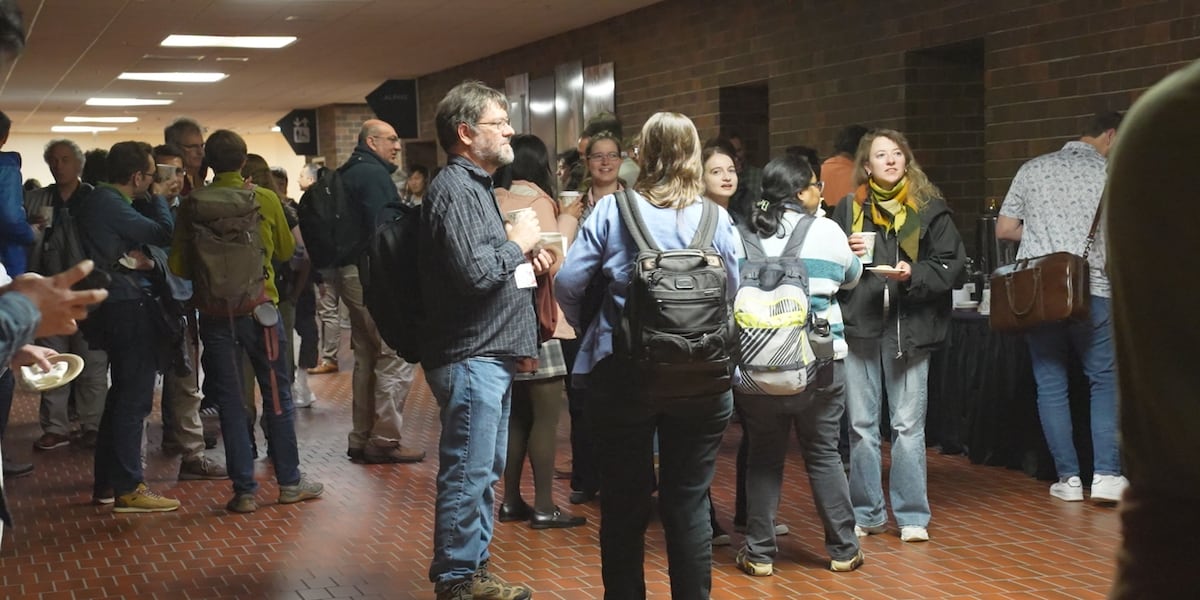
More than 250 physicists and researchers attended the international DUNE conference hosted by South Dakota Mines May 18-22, bringing together members of a collaboration that includes more than 1,500 scientists from over 220 institutions across 38 countries.
The gathering marks a turning point for the ambitious project being built nearly a mile underground in the former Homestake Gold Mine in Lead. Scientists received permission to proceed with construction of enormous detectors designed to study tiny particles called neutrinos.
“How do we come into existence at all? And this experiment is built with many unique capabilities to be able to explore that question,” said DUNE spokesperson Sowjanya Gollapinni.
Each detector will weigh nearly 20,000 tons, assembled piece by piece in caverns deep underground. The detectors will use liquid argon time projection chamber technology to capture neutrinos sent from Fermilab in Illinois.
“No one has ever done anything like that before. So this is not only really cutting-edge technology, it’s also huge logistics. It’s huge assembly of heavy objects. And it involves a lot of skilled people working together as a team seamlessly for years,” said Dune spokesperson David Newbold.
The experiment, supported by the U.S. Department of Energy and led by Fermilab, aims to answer fundamental questions about why the universe is made of matter.
Newbold said the laws of physics developed over the past century don’t fully explain how the universe came to look as it does today.
“Neutrinos are really promising for this science. They have properties that no other particles have that allow us to study the laws of physics in a completely unique way. But they’re also really, really hard to make, and they’re really, really hard to detect,” Newbold said.
DUNE will also study neutrinos from supernova explosions and the sun, providing insights into how stars work and potentially revealing new physics in unexplored regions of science.
Gollapinni compared the liquid argon detectors to high-definition televisions replacing bulky older models.
“It will allow us to look at neutrino interactions with unprecedented detail that we have not seen before,” she said.
Installation is beginning on the first detector components. Researchers said the work could continue for decades, with discoveries that may reshape physics and opportunities that could inspire future scientists and engineers in the Black Hills.
“If you want to get into this, you’re absolutely welcome. Science is a subject where everybody is invited to come and participate. If you’re young, go and study science,” Newbold said.
The collaboration will hold meetings at The Monument in Rapid City before heading to Lead. On Saturday, some members toured the DUNE caverns at the 4,850-foot level where the detector modules are being assembled.
“This marks the first time many collaborators will see the scale and progress of the underground detector caverns in person,” said Juergen Reichenbacher, associate professor of physics at South Dakota Mines and organizer of the collaboration meeting.
Several public events are planned throughout the week, including a talk by Kate Shaw, associate professor of particle physics at the University of Sussex and the International Center for Theoretical Physics. Shaw’s research focuses on the fundamental nature of matter and the forces that shape the universe.
“You have now this experiment — this global experiment — right in the backyard of South Dakota. And the world scientists are coming to South Dakota to be part of this experiment,” Gollapinni said.
See a spelling or grammatical error in our story? Please click here to report it.
Do you have a photo or video of a breaking news story? Send it to us here with a brief description.
Copyright 2026 KOTA. All rights reserved.