
- Xenophobic attacks
- Economic and social inequalities
- Insecurity
- The phenomenon of regional migration
- Immigration as a scapegoat: the rise of xenophobia and the normalisation of anti-immigrant rhetoric
- The wave of violence in 2026
Three decades on, that image is under extraordinary strain. Africa’s most industrialised country faces a combination of economic stagnation, structural inequality, mass unemployment, institutional decay and rising violence against African migrants, which threatens to erode some of the pillars upon which the post-1994 South African state was built.
South Africa’s contemporary history is marked by a paradox that is hard to ignore. No other African country symbolised the triumph of national reconciliation as powerfully as the one led by Nelson Mandela following the first democratic elections in 1994. None raised such high expectations regarding the possibility of building a multiracial society capable of overcoming centuries of colonialism, segregation and institutionalised discrimination. However, three decades after the birth of that democracy, the country is likely facing its deepest social crisis since the end of apartheid.

Xenophobic attacks
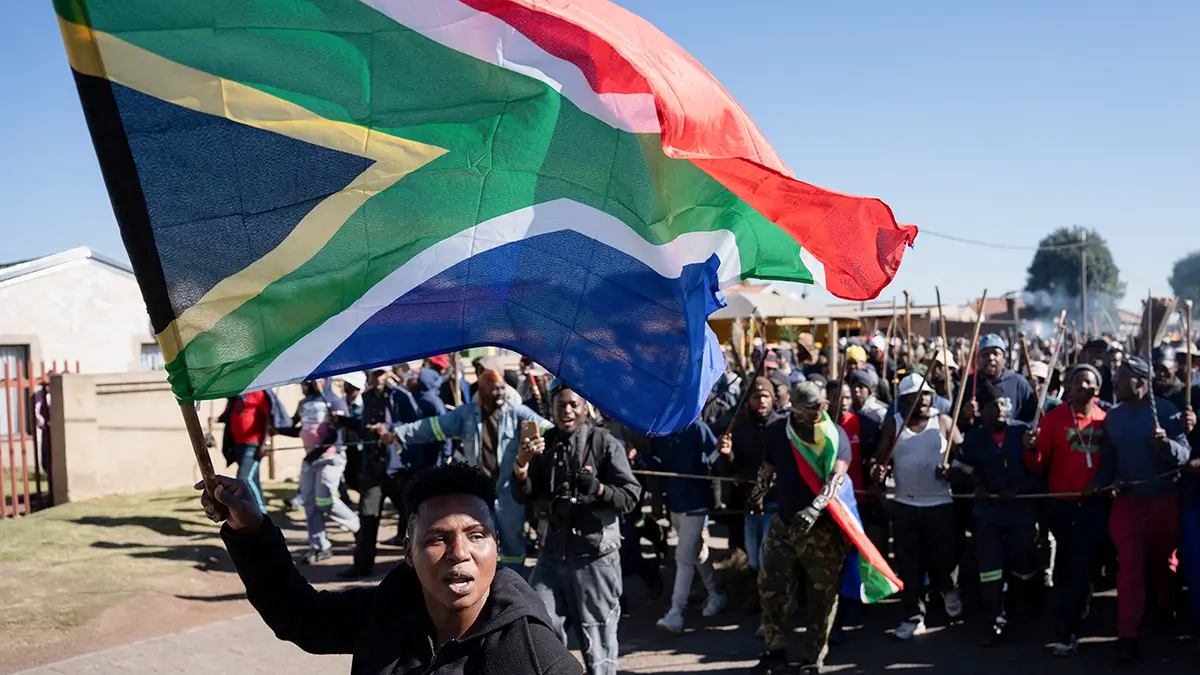
The images captured in recent weeks in Johannesburg, Durban, Pretoria, Soweto and Pietermaritzburg are difficult to reconcile with Mandela’s political legacy. Thousands of demonstrators have taken to the streets demanding the immediate expulsion of African immigrants; entire neighbourhoods have suffered organised attacks; shops owned by foreigners have been looted; entire families have fled their homes in panic for fear of being killed; and several African governments have been forced to organise evacuation operations to rescue their citizens.
The violence is merely the most dramatic expression of a process of deterioration that has been brewing for years. Behind the attacks lies a society deeply frustrated by unemployment, persistent poverty, political corruption, the deterioration of public services and the increasingly widespread perception that the transition to democracy failed to transform the economic structures inherited from apartheid.
South Africa remains the most developed economy on the African continent, but it is also one of the most unequal societies in the world. According to various studies by the World Bank and South African experts, wealth remains extraordinarily concentrated, whilst large sections of the black population continue to live in conditions very similar to those that existed during the final decades of the segregationist regime.
The contrast is particularly striking in the major metropolitan areas. Modern financial districts coexist with sprawling townships where millions of people eke out a living with limited access to formal employment, inadequate healthcare services, dilapidated infrastructure and frequent interruptions to the electricity and drinking water supplies. Public policies promoted by the ruling African National Congress succeeded in expanding access to housing, electricity and education during the early years of democracy, but never managed to decisively alter the economic structure inherited from apartheid.

Economic and social inequalities
Various economists agree that the economic liberalisation implemented since the late 1990s helped maintain macroeconomic stability, but did not significantly reduce inequality. The growth experienced between the late 1990s and the years leading up to the 2008 global financial crisis fostered the emergence of a black middle class and boosted domestic consumption, although it left virtually untouched the enormous concentration of wealth accumulated over decades by the economic elites.
The data continue to illustrate this structural divide. Research carried out by South African academics indicates that the richest ten per cent of the population hold around ninety per cent of the national wealth, whilst the vast majority have virtually no assets. Social mobility remains extremely limited and millions of young people face enormous difficulties in entering the labour market.
Unemployment is probably the main destabilising factor. Official figures put the unemployment rate at over thirty per cent, although various experts maintain that, when those who have given up looking for work are included, actual unemployment far exceeds forty per cent of the economically active population. Among young people, the situation is even more serious, making South Africa one of the economies with the highest levels of labour market exclusion in the world.
Added to this reality is a prolonged process of institutional decline. Over the last fifteen years, the country has suffered repeated corruption scandals, a progressive loss of administrative capacity and a deep crisis affecting strategic state-owned enterprises. The state-owned electricity company Eskom continues to face serious financial and technical difficulties, which have forced it to impose scheduled power cuts over long periods, affecting both industrial activity and the daily lives of millions of citizens.

Insecurity
Insecurity represents another key factor in the collective discontent. South Africa has some of the highest crime rates in the world, with high rates of homicide, violent robbery and organised crime. In many working-class neighbourhoods, the perception of state neglect has encouraged the emergence of community organisations that claim to act in defence of public safety, although in many cases they end up becoming pressure groups or even vigilante groups operating outside the law.
Analysts argue that this combination of mass unemployment, the deterioration of public services, persistent corruption and growing insecurity has profoundly eroded the legitimacy of the democratic state built in the wake of apartheid. The historical prestige of the African National Congress, forged over decades of struggle against racial segregation, is no longer sufficient to contain social discontent, which is expressed through almost constant protests and a gradual decline in electoral support.
Nor can the economic crisis be understood solely as a short-term phenomenon. The South African economy continues to depend heavily on traditional sectors such as mining, whose performance remains closely linked to international cycles of demand for raw materials. The slowdown in global growth, energy shortages, insufficient private investment and the limitations of the productive apparatus have significantly reduced the country’s capacity to absorb the growing labour supply.
The phenomenon of regional migration
Paradoxically, that very same economic structure continues to exert a powerful pull on millions of citizens across southern Africa. For over a century, South African mines, commercial agriculture, construction and the informal sector have, at various times, relied on labour from migrants from Mozambique, Lesotho, Zimbabwe, Malawi, Botswana and Eswatini. Regional migration is therefore not a recent phenomenon, but one of the defining features of South Africa’s economic development.
Following the establishment of democracy, this migratory dynamic intensified. South Africa’s relative institutional stability, coupled with the economic and political decline experienced in several neighbouring countries, made the country the primary destination for millions of Africans seeking employment opportunities that were unavailable in their home countries. Official statistics estimate that approximately three million foreign nationals currently reside in South Africa, equivalent to around four or five per cent of the national population.
For years, this immigration was regarded as a natural consequence of the regional integration promoted following the end of apartheid. However, as economic growth began to slow and social difficulties worsened, a growing section of public opinion began to hold immigrants directly responsible for unemployment, overcrowding in hospitals and schools, rising crime and the deterioration of public services.
Many researchers reject this interpretation. Experts from the University of the Witwatersrand, together with various human rights organisations, maintain that there is no empirical evidence to attribute responsibility for South Africa’s economic crisis to immigrants. On the contrary, they consider that foreigners have ended up becoming a convenient scapegoat onto whom frustrations are projected – frustrations generated by structural problems for which responsibility lies, primarily, with the prolonged failure of public policies and the economic system’s inability to generate sufficient employment.
However, this rational explanation has lost ground to increasingly emotional rhetoric that portrays immigration as the main threat to the economic survival of the poorest communities.

Immigration as a scapegoat: the rise of xenophobia and the normalisation of anti-immigrant rhetoric
Periodic outbreaks of violence against immigrants are not a new phenomenon in South Africa. Since the end of apartheid, the country has experienced successive waves of xenophobic attacks, particularly in 2008, 2015, 2019 and again in 2026. However, various experts believe that the current crisis differs from previous ones in two key respects: the growing institutionalisation of anti-immigrant rhetoric and the emergence of organisations capable of transforming social unrest into a permanent political movement.
What for years remained confined to isolated episodes of violence in the townships has gradually become a coherent political narrative that identifies African immigrants as the main culprits behind the country’s economic decline. Unemployment, the collapse of public hospitals, the housing shortage, the overcrowding of the education system and rising crime are all condensed into a single argument: the presence of foreigners is depriving South African citizens of job opportunities and access to increasingly limited public services.
This interpretation has found particularly fertile ground in the provinces most affected by poverty and unemployment, where competition for informal jobs and state resources is exceptionally intense. Everyday frustration makes it easier to accept simplistic explanations for problems whose true nature is far more complex.
Researchers from the Xenowatch project, developed by the University of the Witwatersrand, have accurately documented the evolution of this phenomenon. From 1994 to mid-2026, they recorded more than 1,300 incidents of xenophobic violence, nearly 700 deaths, more than 120,000 internally displaced persons, and several thousand businesses owned by immigrants destroyed or looted. These figures show that xenophobia is a structural problem rather than a mere succession of spontaneous outbreaks.
In numerous townships, small shops run by Somalis, Ethiopians or Congolese have been set on fire or looted during successive campaigns of intimidation. Somali community organisations have for years been denouncing targeted killings, systematic robberies and attacks directed against their establishments, a situation that has worsened considerably in recent months.
The Zimbabwean community is another of the most vulnerable groups. Their large presence is due both to geographical proximity and to the prolonged economic decline experienced by Zimbabwe since the beginning of the 21st century. Thousands of families have crossed the border in search of employment opportunities that are impossible to find in their country of origin. However, the sheer scale of this migration has made them a prime target for nationalist organisations, which portray them as direct competitors for jobs and social services.
The wave of violence in 2026
The most dramatic episode of this new wave of violence began during the southern spring of 2026. From April onwards, various anti-immigration groups launched public campaigns demanding that all undocumented foreigners leave the country by 30 June. Although this ultimatum had absolutely no legal basis, it succeeded in creating a climate of intimidation that led to the displacement of tens of thousands of people even before the deadline set by its organisers had expired.
During those weeks, there was a succession of forced evictions, threats against immigrant families, the closure of small businesses and attacks on entire neighbourhoods predominantly inhabited by foreign nationals. Numerous landlords pre-emptively evicted their African tenants for fear of reprisals, whilst thousands of people began to gather in temporary reception centres organised by the authorities or by the diplomatic missions of their respective countries.
The scenes witnessed in Durban illustrate just how serious the situation had become. Dozens of Congolese citizens spent several nights sleeping on the streets after being evicted from their homes by landlords who feared attacks on their buildings. In other cities, foreign shopkeepers voluntarily abandoned their businesses as rumours spread of further organised looting.
Faced with the risk of further escalation, several African governments organised emergency evacuation operations. Nigeria, Ghana, Malawi, Mozambique and Zimbabwe coordinated special flights and land convoys to facilitate the voluntary return of thousands of citizens who no longer considered it safe to remain on South African territory. Other states, such as Kenya and Lesotho, issued warnings advising their nationals to take extra security precautions or to leave the country temporarily. Behind this mobilisation lie organisations that have gained growing political influence in recent years.

The best known is Operation Dudula, whose name roughly means “to expel” or “to push out” in the Zulu language. Founded in 2021 in Soweto as a purported community initiative aimed at combating crime, it soon evolved into an organisation dedicated to identifying immigrants, inspecting shops, demanding documentation in working-class neighbourhoods and putting pressure on hospitals and schools to prevent foreigners from accessing public services. Various human rights organisations have repeatedly condemned its methods of intimidation, characterised by neighbourhood patrols, illegal raids and acts of violence against African citizens.
One of the most harrowing incidents attributed to this climate of persecution was the death of the son of a worker originally from Malawi. According to humanitarian organisations, the mother tried to obtain medical care for the child at several public hospitals, but the healthcare centres’ fear of inspections carried out by Operation Dudula activists ultimately prevented the child from receiving timely treatment, and he eventually died. The case took on enormous symbolic significance within the debate on the growing dehumanisation of anti-immigrant rhetoric.
Unlike other informal movements, Operation Dudula decided to enter the political arena directly. In 2023, it gained legal recognition as a political party and subsequently took part in national and local elections. Its results were meagre, with vote shares of less than one per cent even in its main strongholds, but many analysts believe that its true influence lies not in the number of votes obtained, but in having succeeded in bringing much of its agenda into the national political debate.
During 2026, a new organisation called March and March also emerged, quickly becoming the visible face of recent protests. The movement, led by the Zulu journalist Jacinta Ngobese-Zuma and the activist Nkosikhona Ndabandaba, spearheaded an intense campaign of nationwide demonstrations calling for mass deportations, much stricter border controls and rigorous enforcement of immigration laws.
Although its leaders reject being labelled as xenophobic and maintain that they merely seek to ensure compliance with the law, their rallies have consistently coincided with attacks on immigrants, looting and outbreaks of collective violence. The slogans chanted during the marches — “South Africa for South Africans”, “let’s take back our country” or the Zulu phrase Abahambe (“let them go”) — have helped to cement a narrative of exclusion that equates nationality with legitimate access to public resources.
The ActionSA party, led by Herman Mashaba, has made the tightening of immigration policy one of its key policy priorities. The Patriotic Alliance, led by Gayton McKenzie, has for years used slogans explicitly directed against African immigrants, and some of its leaders previously took part in demonstrations organised alongside Operation Dudula. Even sections of the uMkhonto we Sizwe (MK) party, founded by former President Jacob Zuma, have begun to advocate far more restrictive immigration policies.

The evolution of the African National Congress itself is equally significant. Heir to a deeply pan-Africanist tradition and having benefited for decades from the political, economic and military support of numerous African countries during the struggle against apartheid, the ruling party has gradually toughened its stance on migration. Prominent figures within the government have advocated for stricter border controls, police operations against irregular migrants and biometric systems designed to strengthen population control. For many academics, this convergence in discourse has helped to legitimise approaches that were previously confined to extremist organisations.
This normalisation is probably the most disturbing feature of the current situation. As many researchers warn, the danger lies not only in the violence perpetrated by radical groups, but in the growing social acceptance of the idea that migrants are the main cause of South Africa’s economic problems. When this perception begins to take hold in the political debate and within some public institutions, the line between legitimate discourse on migration control and the indirect legitimisation of collective violence becomes extraordinarily fragile.
Thirty-two years after Nelson Mandela proclaimed that South Africa was once again taking its place “within the bosom of humanity”, the continent’s largest economic power finds itself at a historic crossroads. It can choose to rebuild the democratic and inclusive project that inspired the birth of the rainbow nation, or allow economic frustration, exclusionary nationalism and institutional erosion to permanently transform post-apartheid hope into a policy of confrontation amongst the most vulnerable. The resolution of this dilemma will not only determine South Africa’s future. It will also shape the credibility of the pan-African project and the role that Africa’s leading economy aspires to play on a continent that is increasingly interdependent and subject to profound demographic, economic and geopolitical pressures.