
To the USMNT, it was an enormous boost. To opponents Belgium, it was an outrage. To UEFA, it was “unprecedented, incomprehensible and unjustifiable,” whereas to U.S. President Donald Trump, it was the reversal of “a great injustice”.
The suspension of Folarin Balogun’s one-game ban, first revealed by The Athletic’s Dan Sheldon and Adam Crafton, is the biggest story of the World Cup. Articles relating to it were featured on the front pages of over 35 nationally-distributed newspapers globally.
This is how the controversy unfolded, how our reporters broke the story, and why this is far from over.
Red cards can derail an individual and a team’s tournament.
Ask France’s Laurent Blanc, or Germany’s Michael Ballack, who missed the 1998 and 2002 World Cup finals respectively for disciplinary reasons. Ask Paul Gascoigne, who was famously distraught on the pitch when he realised his booking in the semi-finals of the 1990 edition would mean he’d be suspended for the final if England progressed.
So when referee Raphael Claus showed Balogun a straight red card in the round of 32 tie between the United States and Bosnia and Herzegovina on Wednesday, July 1, it felt like a potentially pivotal moment of the co-hosts’ World Cup campaign.
The decision itself was contentious.
As Adam Crafton pointed out in a column the following day, there is no malicious intent in Balogun’s tackle — painful as it clearly was for recipient Tarik Muharemovic — and there were questions over whether VAR protocols were correctly applied, or whether slow-motion replays were used too heavily and exaggerated the offence. (This argument would later form part of U.S. Soccer’s submissions to FIFA.)
FIFA has not stated a reason for the decision to suspend Balogun’s ban or said there was any fault in the VAR process. Still images and slow-motion replays have continued to be used in subsequent matches.
“That was a normal action in football,” USMNT head coach Mauricio Pochettino said. “That happened by accident, and it’s never intentional. That is why, for me, it was never a red card.”
“After the game (we were) immediately talking to FIFA and the first thing that we established is that there’s no way the U.S. can appeal this red card,” says Dan Sheldon. “So you’re thinking, ‘OK, he’s definitely missing that (round of 16) game’.”
Attention, for USMNT fans, turned to how Pochettino would replace the team’s focal point for their next match against Belgium on July 6. But as Pochettino considered his tactical options, with training sessions focused on how the Americans would cope without Balogun, plans were being drawn up away from the pitch.

Balogun was sent off for this challenge (Michael Steele/Getty Images)
Sheldon explains that The Athletic were trying to establish whether FIFA’s disciplinary committee would impose an extended suspension, as happened to Qatar’s Assim Madibo after he was sent off earlier in the tournament.
“There was just this silence,” Sheldon says. “You’re still asking the questions, and there’s still nothing — ‘Oh, we’re not too sure yet’. ‘Have the disciplinary committee even looked at this?’ And at that point, you start thinking, ‘There’s clearly something amiss here’.”
“It was probably as early as Friday night, and the story broke on Sunday, that we started to get the first soundings of U.S. Soccer trying to do something to try to wriggle out of this to get Balogun on the field,” Crafton says.
The first suggestion that Trump was becoming involved also came that Friday — although, “I don’t think anyone at that point appreciated the level to which his administration was committing to this,” Crafton says.
Once FIFA had formally notified them of the red card the morning after the match, U.S. Soccer responded with its view that Balogun should not have been sent off, nor should he be suspended.
It was a view shared at the White House. Later, after the decision to suspend Balogun’s punishment had been revealed, Trump would tell journalists in the Oval Office that while he “didn’t know what the hell a red card was”, he was insistent that Balogun did not deserve one and should not miss the match against Belgium.
“I started hearing it means he can’t play in the next game, at least the next game,” Trump said. “I said, ‘Boy, that’s a big…’ — you know, if it happened to another player, it would’ve been unfair, but when they take your best player or just about… and they say, ‘You can’t play’, that’s very unfair.”
To the outside world, this looked like a closed case after the confirmation that the red card could not be appealed.
“In the background, U.S. Soccer’s legal team (and) external counsel had started to build up a case, I think mostly around the use of VAR,” Crafton explains. “But then there was a concurrent thing going on where the White House, Trump, his commerce secretary Howard Lutnick, and Andrew Giuliani, the executive director of the World Cup Task Force, were also working with lawyers to start to build up a case and sending things on to U.S. Soccer. So you have these two institutions converging.
“I think in the end, U.S. Soccer would probably still argue that they submitted their own work, but it’s very hard from the outside to get a sense of how influenced everything was by the involvement of the president.”
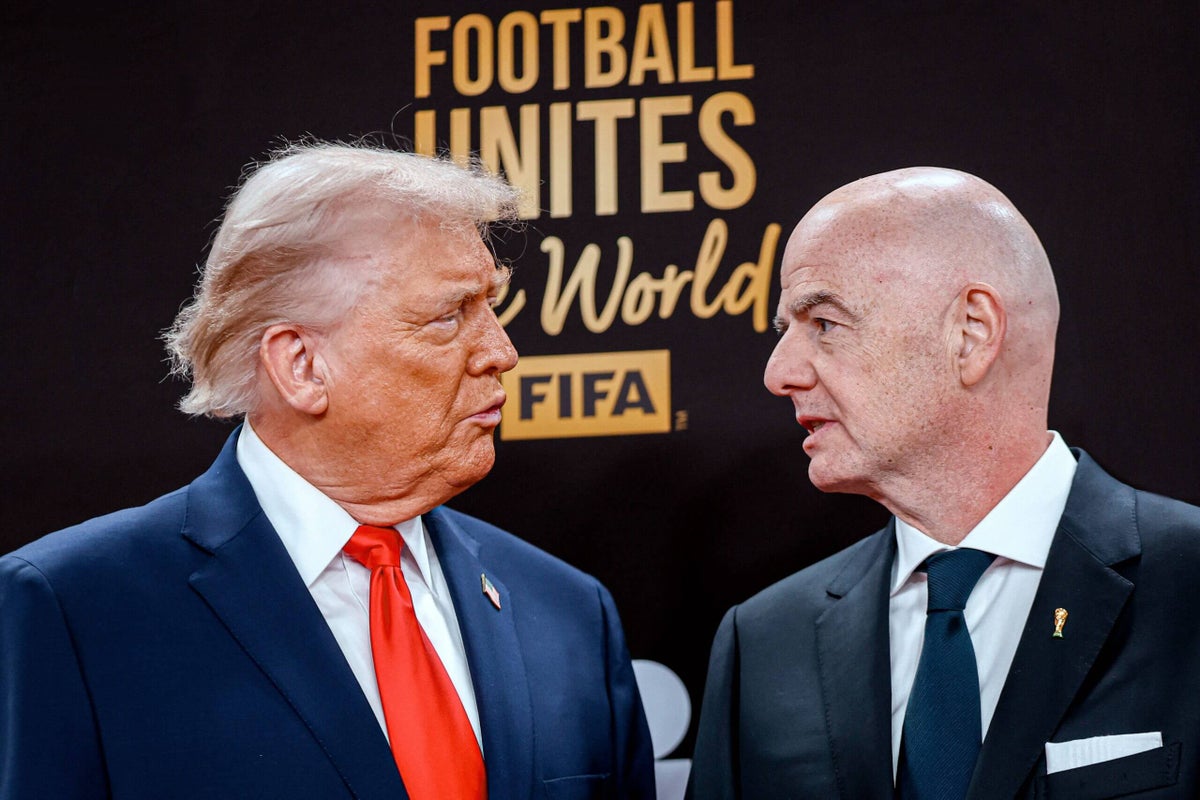
It also emerged, and was confirmed by Trump when speaking in the Oval Office, that the U.S. president had called FIFA president Gianni Infantino to discuss Balogun’s sending off and suspension, and asked for a review.

Trump mentioned calling Infantino (Saul Loeb/AFP via Getty Images)
U.S. Soccer’s submissions to FIFA did not have the full desired effect — it wanted the decision overturned entirely — but ultimately, it was successful in its short-term aim. The Athletic revealed on July 5, one day before the Belgium game, that Balogun’s punishment had been suspended so he would be available.
There were celebrations in the U.S. camp — centre-back Chris Richards said the squad had checked the shock news was not AI-generated — at the return of their star player to the potential squad. Elsewhere, there was outrage.
Former Manchester United and England captain Wayne Rooney, speaking in his role as a pundit on the BBC’s World Cup coverage, called it an “absolute disgrace”. Rooney’s fellow ex-England international Gary Neville, speaking on UK broadcaster ITV as it showed the finals, said he would be “absolutely raging” if he was involved with Belgium “or any other team in the tournament”.
“There are precedents where sanctions have been suspended or deferred,” Pochettino insisted in a press conference. “That’s why I don’t understand why anyone would be surprised; this has happened before. It’s not as if this is some extraordinary event that only happens to us.”
It’s correct that Cristiano Ronaldo could have missed the first two group matches of Portugal’s World Cup after being sent off in the qualifiers. He received a three-match ban, but two games of that were suspended. Argentina’s Nicolas Otamendi and Moises Caicedo of Ecuador also had reprieves from their own bans, with FIFA ruling in May that suspensions from qualifying would not carry over into the tournament.
But it is worth taking a moment to examine Pochettino’s statement on a deeper level and understand why, despite his insistence, the decision was so surprising.
This is the first time since the 1962 tournament that a player has been sent off at a World Cup and not been suspended for at least their team’s next game. That is a run of 16 World Cups, 64 years and 172 red cards. It is, plainly, an “extraordinary event”.
There have been 13 red cards at this World Cup — including those that have seen players suspended for a key match (Belgium’s Nathaniel Ngoy, Miguel Almiron of Paraguay and England’s Jarell Quansah) and one for another of the co-host nations (Mexico’s Cesar Montes).
It is also important to note that Balogun’s dismissal has not been overturned or retroactively labelled by FIFA as an incorrect decision. The punishment has just been changed, and the pertinent question was: why?
The Belgian football federation, which released a statement saying it was “astonished” by Balogun’s reprieve, sent a letter to FIFA requesting a copy of the decision and an explanation of the process that had been followed.
USMNT World Cup exit and Premier League preview
The strength of feeling from much of the rest of the global game was made clear by a statement from European football’s governing body UEFA, which released a statement on July 6, the day of the match, saying that the suspension of Balogun’s ban has “crossed a red line”.
“Sometimes rules are open to interpretation. In this case, not,” the statement read. “We express our disbelief at such an unprecedented, incomprehensible and unjustifiable decision.”
“FIFA referred back to article 27 of its disciplinary code, which essentially gives the disciplinary committee carte-blanche to do as they want with suspensions,” Sheldon says. “However, the exact reasons for suspending Balogun’s punishment remain unclear. They’ve never said the decision (to send him off) was incorrect.”
A FIFA statement says that the suspension of Balogun’s ban “was decided considering all of the specific circumstances surrounding the incident and evidence available”.
That evidence and those circumstances are not specified, and one of the biggest questions is whether one of the ‘circumstances’ was Trump’s wishes.

Balogun played, and the USMNT lost to Belgium anyway (David Ramos/Getty Images)
“I did (call Infantino); I asked for a review, because I didn’t think it was a foul,” Trump said, also on Monday, July 6.
“I didn’t tell (Infantino) what to do; I can’t tell him what to do. And I don’t believe he made the decision; I think it was a committee that made the decision.”
A statement from Infantino via FIFA that same day reiterated the independence of the disciplinary committee that had suspended Balogun’s punishment.
“We don’t know explicitly what was said on that phone call,” Sheldon says. However, if the president of the United States is saying, ‘I think that red card was a bit off’ — what’s the inference there?”
“The thing that everybody will remember about this,” Crafton adds, “is that the president called the president.”
Less than 24 hours before the USMNT were due to line up against Belgium, there was still an element of uncertainty over whether Balogun would feature, with the Belgian FA formally challenging his eligibility.
A little over seven hours before kick-off on Monday evening in Seattle, FIFA dismissed Belgium’s appeal on the grounds that they were “not a party to the proceedings and, as such, (had) no standing to appeal the decision”.
And so, five days after Balogun had been sent off, after an intervention in his favour from the U.S. president, an unprecedented decision by FIFA meant he lined up once again for the USMNT — but he and his team-mates could not produce a performance to match the scandal.
As Infantino watched on from the VIP section at Lumen Field, this tournament’s main hosts, for all their defiance, slumped to a 4-1 defeat and exited with a whimper. Balogun, the unwitting face of the World Cup’s biggest controversy, was made to wait until the 82nd minute for a shot on target.
“In recent days, we have been shown a lack of respect here in the U.S.,” goalkeeper Thibaut Courtois said after his team’s victory. “It was said that they could beat us easily, but I think today we proved that we are a good team. We played a great match.”
“It was the best performance Belgium produced at a tournament for years,” Crafton says. “Clearly, what had happened motivated them.”
Ultimately, Balogun’s return did not improve the USMNT’s fate. But it may yet affect others at this tournament.
“When the certainty of rules is no longer guaranteed by its guardians, the integrity of the game is at stake and the credibility of a competition is undermined,” that same UEFA statement also read. “Equally, such a decision creates a precedent in the ongoing tournament, where similar situations will now require equal treatment, to the detriment of the competition.”
Also on Monday, France appealed to FIFA to rescind Michael Olise’s yellow card from their round-of-16 win against Paraguay.
If Olise were to pick up another booking against Morocco in their quarter-final today (Thursday), he would miss the semi-final, should France progress. The French Football Federation insist, though, that their appeal was not a direct response to Balogun’s ban being suspended. Head coach Didier Deschamps revealed in his pre-game press conference on Wednesday that Olise’s caution had been upheld.
Elsewhere on Monday, it was reported that the English Football Association was considering its options over the suspension of Quansah. The defender was sent off in his team’s 3-2 win over Mexico the night before and was therefore set to miss England’s quarter-final against Norway on Saturday. FIFA confirmed today that Quansah’s two-game ban has been upheld.
Seventeen players are entering the quarter-finals on one yellow card, leaving them set to miss any semi-final if they are booked and their team go through. “It has opened this Pandora’s Box where people now feel like they can appeal anything,” Crafton says.
Belgium are preparing for their quarter-final against Spain on Friday, but even after beating a Balogun-boosted USMNT, they will not forget this episode quickly.
“The Royal Belgian Football Association (RBFA) is proud of the way the Red Devils responded on the pitch yesterday,” a statement on Tuesday, July 7, read. “At the same time, the RBFA will continue to pursue the ongoing FIFA matter off the pitch.
“Clear procedures, respect for the rights of defence and the consistent application of the regulations are essential to maintaining the confidence of member associations, coaches, players, supporters and all other stakeholders in our sport.
“Regardless of the sporting outcome, the RBFA will continue to advocate for the correct and consistent application of these principles by FIFA, ensuring that any form of arbitrariness is avoided. In doing so, we feel supported by millions of football fans around the world, as well as by many other member associations.”
The USMNT’s World Cup is now over. This story is not.