

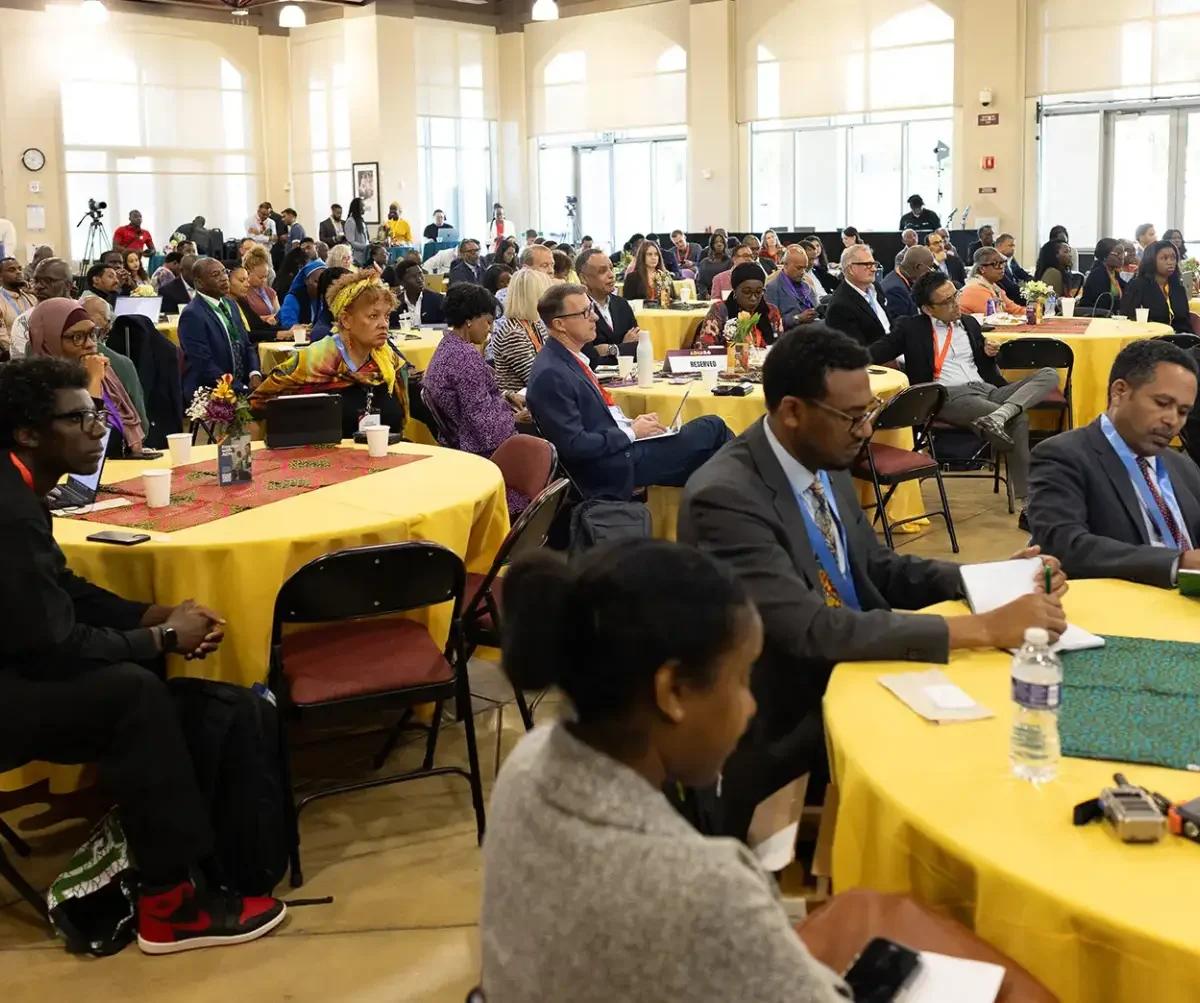
On August 11 and 12 in Washington, African business leaders, investors, and policymakers gathered for the Africa-US Global Forum around a deliberately provocative premise: “Trade, Not Aid. Deals, Not Declarations.” The gathering is the latest example of a broader shift in how Africa and its diaspora are approaching international engagement. Not simply through aid or remittances, but through investment, entrepreneurship, expertise, and networks.
Latin America should be paying attention.
Remittances to Latin America and the Caribbean reached a record $173.7 billion in 2025, according to the Inter-American Development Bank, and preliminary data suggest they continue to grow in 2026. These flows provide essential income to millions of families and remain critical to economies across the region. But their extraordinary scale also raises a larger question: Are we measuring the relationship between Latin America and its diaspora too narrowly?
More than money sent home
Measuring a diaspora primarily through remittances captures only a fraction of its potential. An entrepreneur living abroad may invest in a company in her country of origin. A professor can connect universities and research networks. A technology executive can mentor emerging entrepreneurs. A business leader can connect companies to new markets. Together, these contributions represent a reservoir of financial, intellectual, social, and relational resources: diaspora capital.
Entrepreneurship has been particularly important to the African approach. Diaspora initiatives increasingly focus not simply on giving back, but on investing in entrepreneurs, transferring expertise, opening markets, and creating businesses and jobs. That changes the relationship between diasporas and their countries of origin from one based primarily on sending resources home to one that can also involve building something together.
The philanthropic component is also revealing. Between 2018 and 2020, Latin America and the Caribbean received approximately $400 million annually in international private philanthropic funding, compared with $2.9 billion for Africa. These figures do not measure diaspora giving specifically, but they illustrate the very different ecosystems within which capital is mobilized.
From networks to institutions
Diaspora networks often emerge organically. Migrants help other migrants. Businesspeople make introductions. Professionals mentor younger members of their communities. Families support projects back home. These relationships create an invisible infrastructure of trust. But networks do not automatically become institutions.
The African Diaspora Network offers one example of what can happen when those relationships are given a platform. Since its creation in Silicon Valley, it has developed an ecosystem connecting diaspora professionals, entrepreneurs, investors, and institutions. Its programs support African entrepreneurs and connect diaspora expertise with ventures on the continent, while its annual investment symposium provides a recurring space for dispersed actors to meet.
This may be one of the most important lessons for Latin America. The region does not need a single organization claiming to represent its diaspora. It needs more connective institutions capable of identifying people, building trust, matching expertise with opportunity, and turning relationships into action.
There is a policy dimension as well. In 2023, the United States created the President’s Advisory Council on African Diaspora Engagement, bringing leaders from business, academia, civil society, faith communities, and other sectors into conversations about U.S.-Africa relations. Its significance goes beyond any particular administration or council. It recognizes a broader principle: diasporas are stakeholders in international relations.
The same logic applies to the Americas. Millions of people in the United States have professional, economic, family, and cultural relationships with Latin America. The diaspora is not peripheral to hemispheric relations. In many ways, its members are practicing them every day.
Toward a Latin American diaspora ecosystem
Perhaps the most ambitious African lesson concerns identity itself.
There is no single African diaspora experience. Nigerians, Ethiopians, Ghanaians, Kenyans, South Africans, Senegalese, and many others maintain powerful national identities and vastly different histories. Yet institutions have emerged around the broader idea of an African diaspora without requiring those national identities to disappear.
Latin America has developed far less infrastructure around an equivalent regional diaspora identity.
The United States has, of course, developed a powerful Latino identity encompassing people from across the region. But a Latino community and a Latin American diaspora ecosystem are not necessarily the same thing. The former describes, among other things, a community and identity within the United States. The latter describes a transnational network connecting people, institutions, capital, knowledge, and opportunities across borders.
That distinction could matter for the future of U.S.-Latin American relations. Traditional sources of international cooperation have become less predictable, while interest in philanthropic, catalytic, and locally mobilized capital is growing. Diasporas should be part of that emerging architecture. But diaspora engagement does not happen automatically because people maintain emotional ties to their countries of origin.
Relationships require infrastructure. Trust requires institutions. Capital requires credible opportunities. And collaboration requires places where people can find one another.
The histories and migration patterns of the two regions are far too different for Africa to offer a direct blueprint for Latin America. But its experience offers an important provocation.
Perhaps Latin America’s greatest untapped diaspora resource is not the money migrants send home, but the enormous web of relationships, expertise, capital, influence, and trust that Latin Americans have accumulated around the world.
What could we build if we started thinking of Latin America’s diaspora not as a collection of communities abroad, but as an ecosystem?
Africa’s experience suggests that building such an ecosystem may be the next frontier of diaspora engagement in the Americas.
Juan Pio Hernandez is a Venezuelan-American strategist, author, and advisor whose work focuses on migration, diasporas, international affairs, and the role of cross-border networks in economic and social development. He is the author of the forthcoming book Raíces y Pies.
Image via the African Diaspora Network.