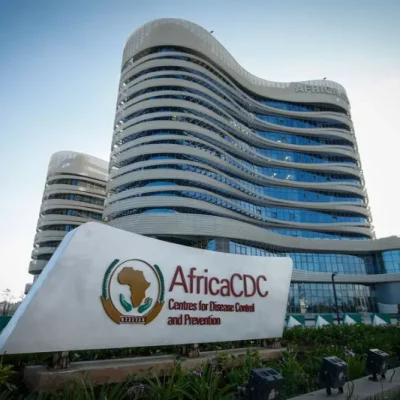

NAIROBI, The Africa Centres for Disease Control and Prevention has reaffirmed its support to Kenya after the country confirmed four additional Ebola cases, bringing its total to seven, including one death.
According to an official press release from Kenya’s Ministry of Health signed by Director General Dr. Patrick Amoth, three of the newly confirmed cases involve healthcare workers who treated the first patient, while the fourth is a close male relative of the deceased. All four were already under quarantine when they developed fever, a detail Africa CDC highlighted as evidence that contact tracing and active surveillance are functioning. The Ministry confirmed the cases tested positive at both the National Virology Reference Laboratory and the KEMRI laboratory.
The Ministry reported that 128 of 130 identified contacts, or 98.5 percent, have been traced and placed under quarantine, with efforts ongoing to locate the remaining two. This is above the global contact tracing benchmark of 85 percent required to break the chain of transmission. The Ministry said there is no evidence of community transmission at this stage and noted that the second and third patients are stable and responding well to supportive treatment. All individuals in quarantine are receiving mental and psychosocial support.
An Imported Crisis, Not a Local Outbreak
Kenya’s first Ebola case was confirmed on October 6. The patient was a Kenyan national who had been living in the Democratic Republic of the Congo for seven years, traveled by road to Uganda, spent a night there, and then flew to Nairobi on October 3. He died two days later. The male relative who tested positive has been in quarantine since October 6.
The Bundibugyo strain responsible for the outbreak has no approved vaccine or specific treatment, according to Congolese health authorities. The DRC outbreak, declared in May, has now surpassed 9,000 confirmed cases and more than 4,500 deaths, spreading across eight provinces. The WHO has described it as the fastest-moving Ebola epidemic on record, with the majority of deaths still occurring in communities rather than treatment centers.
Africa CDC’s Director General, Dr. Jean Kaseya, said the agency was working closely with Kenyan and Ugandan authorities to strengthen cross-border coordination. “Early detection saves lives,” the agency stated, commending Kenya’s government for its “leadership and swift public health response.”
Kenya’s Preparedness Under Scrutiny
Kenya had never previously reported an Ebola case. Since the outbreak began in the DRC, Kenyan authorities have screened more than 652,000 travelers at 15 points of entry, trained nearly 5,000 healthcare workers, and designated isolation and treatment facilities with a combined capacity of 241 beds.
The three infected healthcare workers, two men and one woman aged 29, 35 and 32 respectively, treated the first patient between October 3 and 4. They were placed under quarantine on October 9 after developing fever. Their infections raise questions about infection prevention and control protocols at the facility where the index patient was treated, though the Ministry of Health has not disclosed which hospital was involved.
Kenya’s Cabinet Secretary for Health, Aden Duale, has repeatedly assured the public that the country does not have an outbreak and that the risk to the general population remains low. The Ministry’s press release reiterated that the country remains open for business, with no restrictions on travel, trade or public gatherings, urging citizens to rely on official information.
Somalia’s Parallel Preparedness Effort
Across the border, Somalia has been tracking the regional outbreak since May, when the WHO declared a Public Health Emergency of International Concern over the DRC and Uganda outbreaks. In May, Mogadishu hosted a high-level national conference on Ebola readiness at the National Public Health Emergency Operations Center, bringing together security, foreign affairs, health, civil aviation, and disaster management officials to coordinate screening and stockpiling of protective equipment.
Puntland issued its own public health alert in May, urging residents to remain vigilant and report suspected cases, while emphasizing that no Ebola cases had been recorded in the state or elsewhere in Somalia. The federal government also initiated emergency containment measures, including enhanced screening at airports, seaports, and land borders.
Following Kenya’s confirmation of its first case in early October, Somalia’s Cabinet approved the establishment of a national Ebola preparedness committee composed of six ministries and chaired by the Second Deputy Prime Minister. Health authorities deployed staff at Mogadishu airport to monitor arriving travelers.
However, the Cabinet’s own assessment noted that Somalia’s points of entry have International Health Regulations core capacities of only 20 percent, and the federal government does not control all airports and borders. A committee can coordinate policy, but it cannot substitute for functioning isolation facilities, biosecure transport, and laboratory capacity.
Critical Note
Africa CDC’s statement and Kenya’s official press release are calibrated to project confidence: the new cases were detected in quarantine, contact tracing exceeds global benchmarks, and there is no community transmission. These are genuine achievements, and Kenya’s response has been faster and more transparent than many observers might have expected from a country confronting its first Ebola outbreak.
But the infection of three healthcare workers is not a minor detail. It suggests that the front line of Kenya’s defense, the hospitals and clinics where suspected cases first present, may not be as prepared as the screening statistics imply. Healthcare workers are the most predictable victims of any Ebola outbreak, and their infection is an indicator of gaps in protective equipment, training, or triage protocols. The fact that they were quarantined after exposure does not erase the fact that they were exposed while doing their jobs.
The broader regional picture is also less reassuring than the Kenya-specific data suggests. The DRC outbreak continues to accelerate, with the WHO warning that chains of transmission remain undetected and that the virus is still “ahead” of the response. Somalia’s own preparedness architecture, while active on paper, rests on entry-point capacities that its own Cabinet has assessed at 20 percent. A national committee chaired by a deputy prime minister can convene meetings and issue directives, but it cannot manufacture isolation beds, laboratory reagents, or trained epidemiologists at border crossings.
Kenya’s seven cases are a manageable cluster. But the border between Kenya and Somalia is not a firewall, and the movement of people across East Africa is constant. The question is not whether Kenya can contain this cluster, but whether the region’s surveillance systems can detect the next importation before it becomes something larger. On that question, the evidence from Somalia’s own assessments suggests the answer is far from assured.
Share your story. FTL Somalia is continuing to follow public health developments (Ebola) across the region. If you have information or insights to share, contact us at info@ftlsomalia.com. Your identity will be protected.