
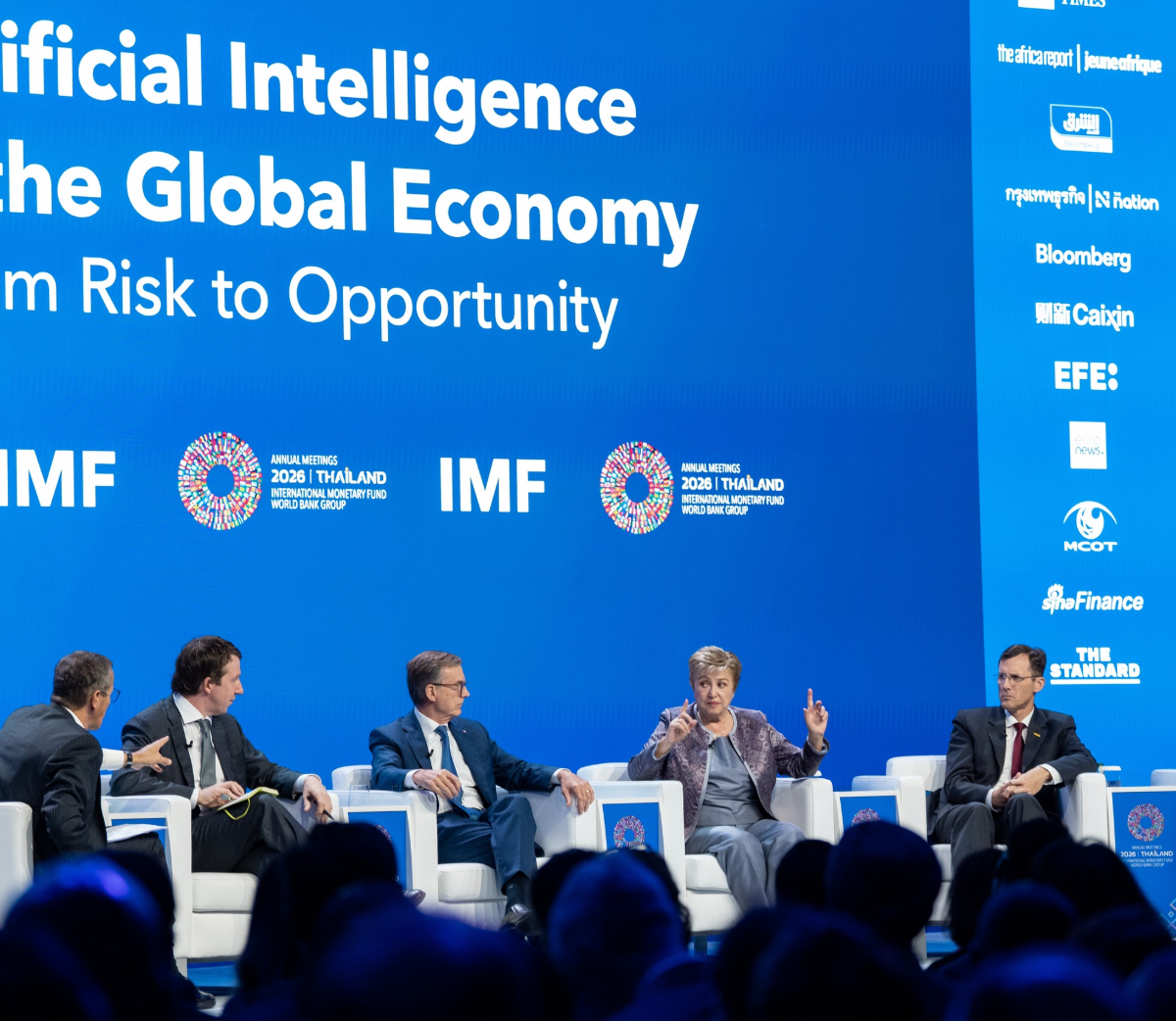
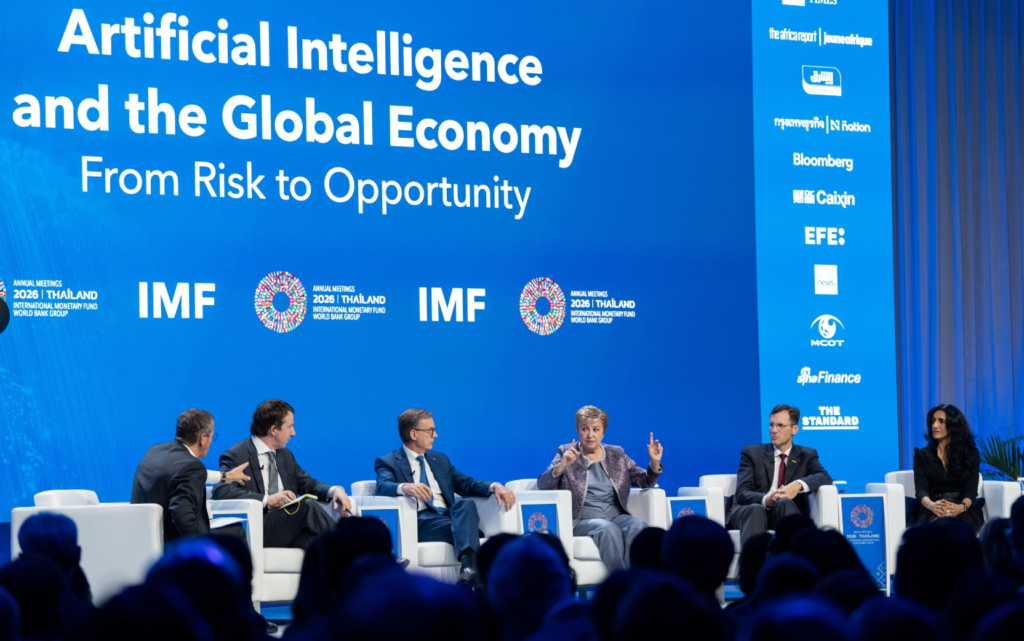
IMF Managing Director Kristalina Georgieva and Bank of Canada Governor Tiff Macklem on the main IMF AI panel, October 16th, 2026/IMF
By Kevin Lynch and Paul Deegan
Saturday, October 18, 2026
The Annual Meetings of the International Monetary Fund (IMF) and World Bank Group just wrapped up in Bangkok, Thailand. Since the annual IMF Spring Meetings in Washington in April, managing Director Kristalina Georgieva’s report of a surprisingly resilient global economy has grown more nuanced, including on AI.
In this decade alone, the world has been subjected to an extraordinary sequence of shocks — the COVID pandemic, Russia’s war on Ukraine, the imposition by the United States of arbitrary tariffs and trade barriers, Donald Trump’s war with Iran, the weaponization of global supply chains — and yet the global economy has proved remarkably resilient.
“This resilience is reaching its limits,” Georgieva said during her Global Policy Agenda Press Briefing on October 14th.
These are the issues that the IMF tackles in its latest biannual World Economic Outlook (WEO), titled Resilience Under Strain, Urgent Choices.
To set the context, the IMF argues that “two major transformative forces – geopolitics and technology – are reshaping the global economy.” Because of the amplifying effect of the confluence of those forces, unpredictability and uncertainty have become the norm rather than the exception.
Writing in the Financial Times this week, Martin Wolf was more direct about Donald Trump’s role as a driver of the chaos: “Current U.S. policy making is not just reckless and immoral, it is also one of the main causes of the world’s unpredictability.”
Still, the resiliency is evident in the outlook. Global growth is unchanged at 3.1 per cent this year and a bit higher next year at 3.4 per cent despite the ongoing disruption in global energy supply chains from the Iran war, the resulting surge in oil prices and the new wave of Trump tariffs. U.S. growth is solid at 2.3 per cent this year and next, double that of Europe and well ahead of Canada’s tepid 1.1 per cent pace this year and somewhat better 1.7 per cent growth in 2027.
The leader of the global growth pack is India, sprinting ahead at a 7 per cent clip, while China’s growth is slowing to around 4 per cent as a structurally weak property market, slumping job prospects and manufacturing overcapacity take their toll.
The sources of this resiliency are instructive.
Despite the massive disruption to global oil and gas supplies from the closing of the Strait of Hormuz, the spike in oil prices and its impact on growth has been much less than the IMF models predicted because of increased production elsewhere (importantly, the U.S. but also Canada), inventory drawdowns (particularly in China), coordinated releases from national strategic petroleum reserves, alternate export corridors utilized by Middle East energy producers, and reduced oil intensity (the volume of oil a country or the world consumes for every unit of its Gross Domestic Product).
But, the IMF warns, these energy shock absorbers have limits and a prolonged shutdown of the Strait of Hormuz or disruption to the Bab Al-Mandab Strait would test these limits given the depleted state of oil reserves and the scarcity of additional sources of production in the near term.
Another source of resiliency has been the extraordinary investment boom triggered by artificial intelligence (AI). AI investment spending in the U.S. is projected to hit 1.9 per cent of GDP this year, accounting for an astonishing half of U.S. growth.
With the U.S. taking a hands-off position, the AI risks may outweigh the benefits given American dominance in AI — unless middle powers form an AI alliance for the safe, effective, and ethical use of artificial intelligence.
Capital spending on AI data centers by the five hyper-scalers alone – Google, Amazon, Meta, Microsoft, and Oracle — is estimated at $4.2 trillion (USD) between 2026 and 2029. AI hardware and related tech products now account for 10 per cent of global goods trade from essentially nil five years ago. If current spending plans are realized, the AI investment boom in the U.S. would dwarf infrastructure projects such as the building of the railroads, the interstate highway system, and the plumbing for the internet according to the Wall Street Journal.
But, the IMF cautions, this source of resiliency is very unequally distributed across countries, with the U.S. being the biggest beneficiary. In the U.S., the pace of spending and borrowing to finance it is now placing a strain on capital markets, putting upward pressure on bond rates. It is also inflationary as it is driving up the costs of labour, electricity, and other inputs needed to build and operate the hyperscale data centers.
The greater risk, however, is that AI revolution does not generate the predicted revenues needed to service the enormous investment bets, leading to bond and equity market turbulence. Per the Financial Times today, “Cracks are appearing in America’s debt-laden $10tn AI infrastructure boom as project delays, public backlash and shaky investor confidence bring a reckoning for the data centre build-out underpinning the US economy.”
Most chillingly, during a panel discussion in Bangkok, Georgieva described the looming impact of AI on jobs as “a slow-moving tsunami, but a tsunami nonetheless.”
A third source of resiliency has been expansive fiscal policy, attempting to cushion the blows to consumers and firms from not only the spike in energy prices from the Iran war but also the tariffs imposed by President Trump and related supply chain disruptions. Driven by public angst over affordability, they were often poorly designed and costly at a time of high fiscal deficits in many countries. And inflation has proved sticky, forcing central banks to raise interest rates.
During a panel discussion in Bangkok, Bank of Canada Governor Tiff Macklem warned, “We haven’t raised our rates yet. We’ve been looking through the increase in energy prices, but the longer this goes, the harder that gets.”
But, the IMF advises, fiscal consolidation — not expansion — needs to be the order of the day in many countries. Excessive borrowing and a lack of credible medium-term fiscal policies are pushing up long-term bond rates worldwide, with the increases in the United States and France particularly eye-catching. The U.S., with a $40 trillion debt pile, is running a deficit of 7 per cent of GDP, notwithstanding an economy running near-capacity, in part due to Trump’s massive 2005 tax cuts.
Not only are higher yields increasing the costs of financing government debt, but the trend toward higher interest rates and lower growth can pose stability problems for debt-to-GDP ratios if interest rates exceed growth rates. Fiscal consolidation is then mandatory, not optional, once the bond vigilantes pounce.
Every IMF annual meeting drills down on a key global issue, and this year it was AI and both the upside and risks above. In 2024, the IMF unveiled an AI Preparedness Index of 174 countries. This year, Singapore tops the list. The debate on AI inside the meetings was, no doubt, vigorous. The IMF is calling for balance – getting the upside of AI right, as IMF estimates suggest it could add half a percentage point to world growth, while protecting against AI’s substantial perils through regulatory guardrails and international cooperation.
With the U.S. taking a hands-off position, the AI risks may outweigh the benefits given American dominance in AI — unless middle powers form an AI alliance for the safe, effective, and ethical use of artificial intelligence.
That’s something that should be high atop the agenda at the upcoming E.U.-Canada Summit to be held at the end of October in Montreal. As Prime Minister Carney told the European Parliament a month ago: “Technology platforms increasingly seek to act as sovereign powers. They want to dictate the rules of regulation – and even circumvent them. They want to control our data, spread misinformation, and steal our children’s childhoods…Together, Canada and the European Union can anchor our ground to hold our values while forming a protective canopy under which our citizens can thrive. This is about sovereignty.”
Without ever mentioning the United States by name, the latest World Economic Outlook essentially recommends avoiding all the policies that the Trump administration is pursuing.
As Georgieva advised governments in her ‘curtain raiser’ speech in Singapore before the Bangkok meetings, “We cannot keep delaying necessary policy action – you have the tools, now have the wisdom to use them.” Those words will no doubt resonate with Prime Minister Carney as his government prepares Budget 2026.
Hon. Kevin Lynch was Clerk of the Privy Council and Executive Director for the Canadian, Irish and Caribbean constituency at the International Monetary Fund.
Paul Deegan, CEO of Deegan Public Strategies, was an executive at BMO and CN.